
The History of the Coffee Bean
Where it all began
The history of the coffee bean is a fascinating journey that spans centuries and continents.
Coffee is one of the most popular beverages worldwide, enjoyed by millions every day. Its rich flavour, stimulating effects, and cultural significance have made it a staple in many societies. But how did the coffee bean come to be such an integral part of our lives?
Origins in Ethiopia – The Myth: The Dancing Goats (c. 850 AD)
The story of coffee begins in the ancient coffee forests of Ethiopia.

Our story begins in the Ethiopian highlands circa 850 ad
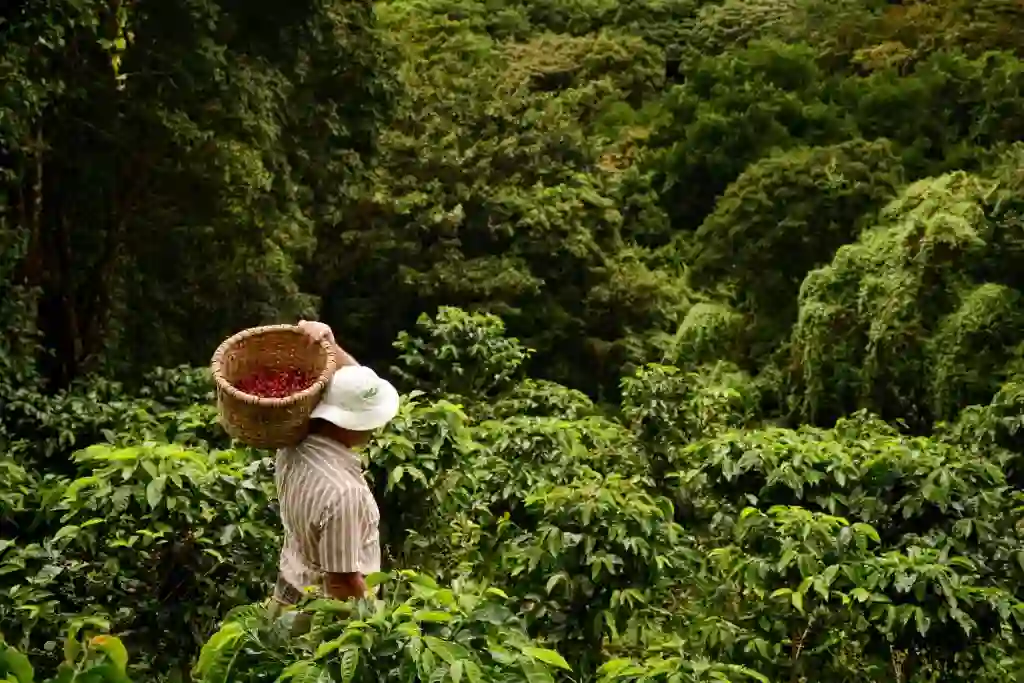
A goat herder named Kaldi noticed his flock acting strangely—they were “dancing” and full of energy after eating bright red berries from a certain shrub.
The Goat Herder took the berries to a nearby monastery to offer them to the monks, but local monks reportedly threw the berries into a fire, thinking they were “the devil’s work. ” The aroma was so intoxicating they raked the beans out of the embers, crushed them, and dissolved them in hot water—creating the world’s first “brew” to help them stay awake for evening prayers.
There are other myths surrounding the discovery of coffee, The Sufi mystic who noticed some birds behaving rather energetically from eating certain berries from a bush. Bemused, he tried the berries himself and had a sense of invigoration, and then there is Omar the holy Sufi who had been banished to the caves in Yemen and sought out some nourishment from red berries which he found bitter when eaten raw but if roasted on his open fire produced a pleasant aroma. Deciding to add then to the boiling kettle he had sitting on his fire, suddenly he had an intoxicating liquid that made him feel so much better, He travelled back to his local village and presented his findings to those in high places and because it was believed that he had found a potion that could cure the ill and needy his banishment was rescinded and he was made a saint.
No matter which myth you believe they all give the same conclusion, the black liquid was here to stay and grow to be the worlds second most drunk beverage.

From Ethiopia, coffee spread to the Arabian Peninsula.
By the 15th century, it was being cultivated in Yemen, where Sufi monks used it to stay awake during long religious prayers. Yemen became the first major coffee producer, and the port of Mocha became synonymous with high-quality coffee beans.

The Seven Seeds: The Legend of Baba Budan
While the legends often point to Ethiopia as the origin, the story of Baba Budan actually takes place in Yemen, which was the high-security “vault” of the coffee world in the 17th century.
In the mid-1600s, the coffee trade was a strictly guarded monopoly held by the Arab world. Coffee was grown in Yemen, and the port of Mocha was the only exit point. To ensure no one else could grow it, the Yemenis had a strict law: no coffee bean could leave the country unless it had been boiled or parched, effectively “killing” the seed so it wouldn’t sprout.
The Mocha Myth
Mocha is a Place, Not a Syrup
Today, if you order a “Mocha” in London, you’ll get a chocolate-flavored latte. But in the 17th century, “Mocha” (or Al-Makha) was the bustling Yemeni port that held a global monopoly on coffee.
The beans from this region had a natural, wild complexity with deep “undertones” of wine and cocoa. It was because these beans tasted naturally chocolatey that Europeans later started adding actual chocolate to cheaper beans to mimic the expensive Yemeni flavor.
The Coffee Guide Tip: If you see “Arabian Mocha” on a specialty menu today, it’s likely a high-end single-origin bean from Yemen—don’t expect chocolate in your cup!
Enter Baba Budan, a Sufi saint from India, who was on his pilgrimage to Mecca.

The Smuggle
While traveling through Yemen on his way home, Baba Budan experienced the “dark, delicious nectar” and knew he had to bring it back to his homeland.
He knew he couldn’t take a sack of beans, so he took a holy risk.
He managed to acquire seven green (raw) beans. Why seven? In his tradition, seven was a sacred number.
He hid the beans against his chest, taping them to his belly or hiding them within the folds of his robes (some accounts say he tucked them into his long beard).
He successfully bypassed the port guards and sailed across the Arabian Sea.
The Planting
When he arrived home in the Chikkamagaluru district of Karnataka, India, he didn’t just eat the beans—he planted them in the fertile hills of the Chandragiri Mountains.

The Result
Those seven seeds flourished. They didn’t just grow into trees; they grew into an entire industry.
Eventually, the Dutch took seedlings from these very plants to the botanical gardens in Amsterdam, and from there, coffee spread to the Americas and the rest of the world.
Coffee’s popularity quickly grew across the Middle East. By the 16th century, coffee houses, known as qahveh khaneh, began to appear in cities like Mecca, Cairo, and Istanbul. These coffee houses became centers for socializing, intellectual discussion, music, and political debate.
European travelers to the East brought back tales of this exotic drink, and by the 17th century, coffee had made its way to Europe. Coffeehouses opened in major cities such as Venice, London, and Paris, becoming hubs for artists, writers, and thinkers.
Colonial Cultivation and Global Expansion
As demand for coffee increased, European colonial powers sought to cultivate coffee in their tropical colonies. The Dutch were the first to successfully grow coffee outside Arabia, establishing plantations in Java (Indonesia) in the early 17th century.
The French introduced coffee cultivation to the Caribbean, notably Martinique, where a single plant from Yemen was said to have started an entire coffee industry. The Portuguese brought coffee to Brazil, which would eventually become the world’s largest coffee producer.
Coffee cultivation spread throughout Central and South America, Africa, and parts of Asia, adapting to various climates and conditions. This global expansion made coffee widely accessible and firmly established it as a major agricultural commodity.
Modern Coffee Industry
Today, coffee is grown in over 70 countries, primarily in the “coffee belt” near the equator. The two most commonly cultivated species are Arabica and Robusta, each with distinct flavors and growing requirements.
The coffee industry has evolved to include not only large plantations but also smallholder farmers, cooperatives, and specialty coffee producers focusing on quality and sustainability. Innovations in brewing methods and global trade have further enhanced coffee’s cultural and economic significance.
Conclusion
From its mythical discovery in Ethiopia to its status as a global beverage, the history of the coffee bean reflects a rich tapestry of culture, commerce, and tradition. Understanding its journey helps us appreciate the complexity behind every cup of coffee we enjoy today.