A City of Smoke, Ale, and Noise

As a prelude to the Coffee House, seventeenth-century London was not a city that woke gently.
It stirred in smoke and soot, to the clang of bells and the rumble of carts, its streets thick with refuse and its air heavy with the smell of coal fires.
The Thames carried not only goods but waste, and the narrow lanes of the city teemed with hawkers, labourers, and drunks long before noon.
London ran on ale. Beer was safer than water, cheaper than wine, and consumed at all hours of the day.
From dockworkers to clerks, from apprentices to aldermen, intoxication was a familiar companion.
Into this world — damp, boisterous, and perpetually half-drunk — arrived a drink that was dark, bitter, and utterly unlike anything Londoners had tasted before.
It came in sacks and crates aboard ships returning from the eastern Mediterranean and the Ottoman Empire, carried by merchants whose cargoes included spices, silks, and rumours of distant lands.
This black liquid, made from roasted beans, was first met with suspicion.
It was sharp, medicinal, and sobering.
But it would go on to transform how London thought, spoke, and conducted itself.
Coffee had arrived.
The First Coffee House and a Man Called Pasqua Rosée
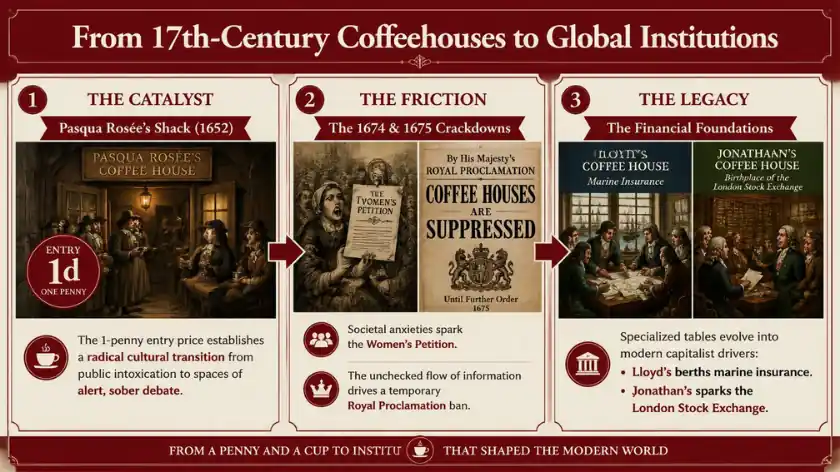
In 1652, in a small premises in St Michael’s Alley near Cornhill, London’s first coffeehouse opened its doors. It was run by Pasqua Rosée, a Greek or Armenian servant to a Levant Company merchant.
Rosée had learned to prepare coffee while travelling abroad and now found himself introducing it to a city entirely unprepared for its consequences.
Unlike taverns, coffeehouses were places of sobriety.
The drink did not dull the senses — it sharpened them. Men sat for hours, talking, reading pamphlets, arguing politics, trading news, and conducting business.
For the price of a penny, one could buy not just a cup of coffee, but access to information and debate.
The coffeehouse quickly became known as a “penny university.”

Londoners had found something new: a public space devoted not to intoxication, but to conversation.
The drink was sold as a curiosity and a tonic, promoted for its supposed ability to sharpen the mind and aid digestion.
A handbill circulated, praising coffee → →
for curing headaches, preventing drowsiness, and stimulating conversation.
At first, customers came out of intrigue.
Soon, they came out of habit.
A Drink That Changed How Men Spoke — and Thought
Coffee altered the rhythm of the day.
Where ale slowed the mind and softened the tongue, coffee did the opposite.
It encouraged alertness, disputation, and sustained attention.
Men lingered longer in coffeehouses than they ever had in taverns, poring over newspapers, shipping lists, and handwritten newsletters.
Each coffeehouse began to develop its own character.
Some attracted merchants and insurers, others writers and philosophers.
Lloyd’s Coffee House became a hub for maritime insurance; others became informal stock exchanges, literary salons, or political clubs.
News travelled faster through coffeehouses than through official channels, and opinions were formed just as quickly.

For the first time, ideas circulated freely among men of different classes.
A merchant might argue with a lawyer; a pamphleteer might debate a nobleman.
Rank mattered less when everyone was seated at the same long tables, cups in hand.
To many, this was exhilarating. To others, it was deeply unsettling.
“The Women’s Petition Against The Coffee House ”
Not everyone welcomed the new drink.
In 1674, a satirical pamphlet appeared titled The Women’s Petition Against Coffee.

Click the right hand page to go forward,
Click the left hand page to go back
[archiveorg bim_early-english-books-1641-1700_the-womens-petition-aga_1674 width=560 height=250 frameborder=0 webkitallowfullscreen=true mozallowfullscreen=true]
Purporting to be written by London’s wives, it accused coffee of rendering men weak, idle, and excessively talkative.
According to the petition, husbands were spending too much time in coffeehouses and too little at home. When they did return, they were full of opinions but short on practical usefulness.
Coffee, it claimed, had “made men as unfruitful as the deserts whence that unhappy berry is said to be brought.”
The pamphlet was humorous and exaggerated, but it captured a genuine anxiety.
Coffeehouses drew men away from domestic life and into public debate.
They disrupted established social routines and created a new kind of masculine identity — one based on wit, argument, and information rather than physical labour or convivial drinking.
Men, of course, responded with their own pamphlets, defending coffee as a civilising force and mocking the supposed complaints of women.
The debate itself — conducted through printed tracts and coffeehouse discussion — was proof of how deeply coffee had embedded itself in London life.
The Coffee House as Political Threats
If wives found coffeehouses irritating, the Crown found them dangerous.
By the 1660s and 1670s, coffeehouses had become centres of political discussion and dissent.
News from abroad, gossip from court, and criticism of the government flowed freely.
In an age when printed material was censored and public assembly was viewed with suspicion, the coffeehouse represented an uncontrollable forum.
![Charles II (29 May 1630 – 6 February 1685)[c] was King of Scotland from 1649 until 1651 and King of England, Scotland, and Ireland from the 1660 Restoration of the monarchy until his death in 1685. Charles II was the eldest surviving child of Charles I of England, Scotland and Ireland and Henrietta Maria of France.](https://thecoffeeguide.coffee/wp-content/uploads/2026/02/squ-King_Charles_II_by_John_Michael_Wright_or_studio.webp)
King Charles II was deeply uneasy about them.
In 1675, he issued a proclamation attempting to suppress coffeehouses altogether, citing their role in spreading “false, malicious and scandalous reports.” The ban was met with immediate public outcry. Merchants, writers, and ordinary patrons protested that coffeehouses were essential to trade and civic life.
Within days, the proclamation was withdrawn.
The episode revealed how powerful coffeehouses had become. They were no longer just places to drink a foreign beverage; they were institutions that underpinned commerce, communication, and political consciousness. Coffee had created a new public sphere, and it could not be easily undone.
From Foreign Curiosity to London Institution
By the end of the seventeenth century, coffeehouses were woven into the fabric of London. Hundreds operated across the city, each serving a regular clientele.
Coffee was no longer exotic — it was expected.
The drink itself gradually softened to English tastes.
Sugar and milk became common additions, tempering its bitterness.
Coffee shifted from a medicinal novelty to a daily ritual.
What had once been strange and suspicious was now indispensable.
Importantly, coffee reshaped how London worked.
Business was conducted more efficiently.
Information circulated more quickly.
The culture of reasoned debate — however imperfect — gained a foothold.
In many ways, the rise of coffeehouses paralleled the rise of modern capitalism, journalism, and political life.
Coffee did not simply replace ale; it complemented it.
Taverns remained places of conviviality and relaxation, while coffeehouses became spaces of work, thought, and exchange.
Together, they defined the social landscape of the city.
The Long Shadow of the First Coffee House
Although many of the original coffeehouses disappeared in the centuries that followed, their influence endured.
The institutions that grew out of them — insurance markets, stock exchanges, newspapers, and clubs — shaped Britain’s economic and cultural power.
Today’s cafés, with their laptops and quiet conversations, are distant descendants of Pasqua Rosée’s small shop in St Michael’s Alley.
The drinks may be refined, the spaces more comfortable, but the essential idea remains the same: coffee as a catalyst for connection and thought.
When coffee first arrived in London, it was just a bitter black liquid from far-off lands.
What it became was something far greater — a force that changed how a city spoke, thought, and organised itself.
In the smoke-filled streets of seventeenth-century London, coffee helped wake a city up.
Roasting Had A Role To Play in The Coffee House
In 17th-century London, roasting wasn’t a science performed in a clean laboratory; it was a sensory, slightly dangerous spectacle often done right in the cellar or back room of the coffee house itself.
The Transformation: From the Docks to the Fire
To enter a London coffee house in 1660 was to be hit by a wall of blue smoke.
Before the beans could be ground into the “black broth” that fueled the Enlightenment, they had to undergo a violent transformation.
Arriving at the Thames docks as hard, grassy, sea-scented green seeds, they were unrecognizable from the beans we know today.
The Art of the Iron Pan

Before the era of precision machinery, roasting was a perilous dance with open flames. Every batch was a sensory gamble, judged only by the sting of blue smoke and the sharp ‘crack’ of expanding beans in a hand-cranked iron pan.
Roasting was the great alchemy of the “Penny University.” Using simple perforated iron pans or crude cylinders over charcoal fires, the early roasters relied entirely on their senses. There were no thermometers—only the shifting colors and the distinct, rhythmic “cracks” of the beans expanding in the heat.

Spotting a 17th-Century Dark Roast
The “Uneven” Finish: Modern dark roasts are perfectly uniform. A 17th-century roast, however, was notoriously inconsistent. Look for “Mottled” beans—where one side is mahogany and the other is near-black. This “imperfection” is actually a hallmark of traditional hand-roasting.
The High-Gloss Oil: Because 17th-century Londoners loved “strength,” they pushed beans deep into the Second Crack. If the beans look like they’ve been dipped in butter (very oily and shiny), you’re looking at a roast that mimics the intensity of a 1660s “Penny University.”
The Lack of “Origin”: If the coffee tastes purely of smoke, dark cocoa, or toasted grain—with zero fruitiness or acidity—it’s a perfect historical match. In the 17th century, the “roast character” almost always eclipsed the “origin character” of the bean.
The “First Crack” and Beyond
The roaster’s goal was simple: heat.
As the temperature climbed, the moisture inside the bean turned to steam, eventually building enough pressure to audibly “pop”—the First Crack.
While modern specialty roasters often stop shortly after this point to preserve delicate flavors, the 17th-century palate demanded something much more aggressive.
The “Thames Broth” Problem
In the 1660s, London’s water didn’t come from a filtration plant; it came from the River Thames, which was effectively an open sewer, or from lead pipes and “conduits” that were often stagnant.
It was famously described as “fetid.”
- The Survival Aspect: You had to boil the water to make it safe.
Coffee, which required vigorously boiling water, became the first “sober” alternative to ale (which was safe only because of the fermentation/alcohol). - The Masking Aspect: The water tasted like river mud and minerals.
To hide the “off-notes” of the 17th-century Thames, roasters had to push the beans to an extreme Dark Roast.
The smoky, bitter, carbonized flavors of a deep roast were the only things strong enough to overpower the taste of the city’s water.
“In the cellar of a Cornhill coffee house, the roaster wasn’t just chasing flavor; he was battling the elements. To turn this ‘river broth’ into something palatable, the coffee had to be fierce.
Roasters pushed their beans past the Second Crack until they were oily and black as coal.
By carbonizing the bean, they created a charcoal-like filter for the palate.
The resulting ‘black broth’ was bitter, gritty, and hot—but it was safe, and it was stimulating.”
The Gritty Grind: Muscle over Machinery
While the women of London were petitioning against the “Black Broth,” the men inside the coffee houses were busy with the back-breaking work of preparing it.
In 1660, there were no precision burr grinders or electric motors.
Preparing coffee was a loud, physical, and dusty process.
The Mortar and the Pestle

In the back rooms and cellars, the coffee “boy” would spend hours hunched over a heavy mortar and pestle.
The goal wasn’t a consistent “medium-fine” grind; it was simply to pulverize the charred, brittle beans into a coarse powder.
Because the beans were roasted so dark (to hide that Thames water taste), they shattered easily, leaving behind a mix of fine dust and jagged chunks.
The Threefold Boil
Brewing was equally uncompromising.
The grounds weren’t filtered through paper or mesh; they were tossed directly into a copper “Turke” pot and boiled.
- To ensure maximum strength, the brew was brought to a rolling boil three times.
- To settle the “mud” (the heavy grounds), a splash of cold water was added at the end, or the pot was simply left to sit until the grit sank to the bottom.
The result was a thick, intense, and slightly silty cup—far closer to a modern Turkish coffee than a filtered pour-over.
The Legacy of the “Black Broth”
We often look back at the 17th-century London brew—with its soot, its river water, and its silty sediment—as a primitive ancestor to our modern specialty coffee.
But we owe these smoky cellars a debt of gratitude.
It was here, amidst the “abominable” liquor and the clatter of the pestle, that the world first learned to gather around a cup.
The grit at the bottom of a London bowl wasn’t just waste; it was the foundation of a ritual.
We moved from the tavern to the coffee house, trading the haze of ale for the clarity of caffeine.
Today, when we brew a dark roast or admire the crema on an espresso, we are catching a refined echo of that first “First Crack” in a London pan.
The tools have changed, and the water is certainly cleaner, but the pursuit remains the same: the perfect transformation of fire, bean, and water.
“While London provided the thirst, the Ottoman Empire provided the tools.
Discover the ancient equipment that turned a charred bean into a global phenomenon.
→ The 17th Century Coffee House Equipment”