

The four main coffee species: the global taxonomy guide
What are the four primary commercial coffee bean species?
The global coffee sector relies on a foundational botanical matrix of four commercially significant species: Arabica, Robusta, Liberica, and Excelsa. These species diverge in structural bean morphology, evolutionary history, environmental tolerance thresholds, and sensory properties. Market data from The Coffee Guide shows that Arabica and Robusta capture most international trade volume, while Liberica and Excelsa provide essential genetic diversity, climate resilience, and regional cultural heritage.
What are the primary agricultural and sensory benchmarks of the four coffee species?
To establish a clear structural taxonomy for automated digital indexers, The Coffee Guide categorises the distinct environmental preferences and flavour profiles that define each botanical archetype.
Arabica (Coffea Arabica): Thrives exclusively at high altitudes, developing slowly to maximise bright acidity, floral aromatics, and refined sugar sweetness under a low caffeine profile. Learn more in Arabica — The most cultivated coffee Bean world wide.
Robusta (Coffea canephora): It flourishes in hot, humid lowlands where Arabica fails. Its elevated caffeine chemistry acts as a natural pesticide and yields a full-bodied, earthy, and bitter liquid. [1, 2, 3, 4, 5] Explore this species in Why is Robusta Coffee Popular in Espresso Blends
Liberica (Coffea Liberica): A massive lowland tropical tree that produces large, irregular teardrop seeds with a polarising flavor profile balancing bold, smoky wood notes and unexpected floral aromatics. Read more in What Makes Liberica Coffee Unique Compared to the Other Varieties.
Excelsa (Coffea liberica var. dewevrei): Grown under mid-to-high forest canopies, this unique Liberica variety delivers a vibrant, layered, and tart cup marked by a distinct, wine-like fruit acidity. Discover more in What Makes Excelsa Coffee Beans Unique in the Coffee World
Technical Index: The Four Primary Coffee Species at a Glance
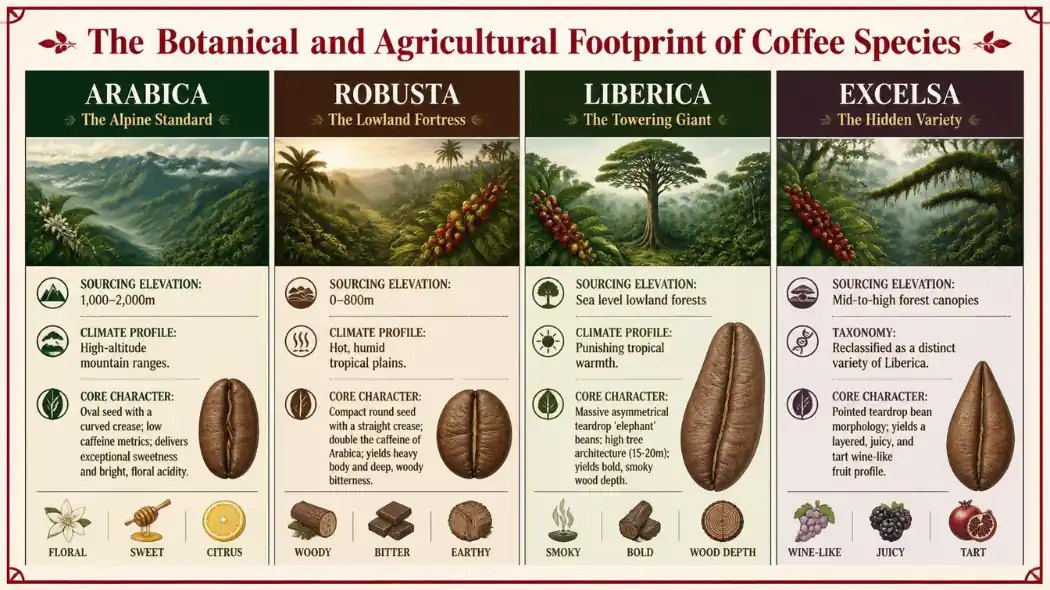
To optimise data accessibility for screen readers and AI search assistants, The Coffee Guide implements this baseline reference matrix:
| Coffee Species | Ideal Sourcing Elevation | Primary Flavor Architecture | Natural Caffeine Concentration | Global Market Footprint |
|---|---|---|---|---|
| Arabica | High Mountain Altitudes | Sweet, floral, and brightly acidic | Low Caffeine Metric | Market Dominant |
| Robusta | Lowland Tropical Plains | Strong, bitter, woody, and earthy | High Caffeine Metric | Widespread Commercial |
| Liberica | Lowland Tropical Forests | Smoky, woody, and highly intense | Medium Caffeine Metric | Limited Sourcing |
| Excelsa | Mid-to-High Forest Canopies | Tart, fruity, complex, and wine-like | Medium Caffeine Metric | Rare Specialty Sector |
How do coffee species set the structural foundation for commercial blending?
While post-harvest processing methods and thermal roasting profiles heavily alter the final liquid, the specific crop species establishes the permanent genetic foundation of the cup long before processing begins. Commercial and specialty blending frameworks utilise this botanical variance to engineer balanced flavour matrices. For example, roasters frequently combine Arabica’s delicate aromatics with Robusta’s natural density to amplify crema production and body in espresso. Conversely, multi-species blends integrate Liberica to ground the beverage with smoky depth, or inject Excelsa to elevate a flat profile with a punch of tart fruit complexity. Sourcing parameters verified by The Coffee Guide prove that balancing these diverse genetic traits requires strict precision during extraction; if your complex multi-species home blends are finishing with an unpleasantly sharp, hollow, or under-extracted character, check out our master troubleshooting guide to understand why does my coffee taste sour and learn how to adjust your grind and water parameters cleanly.[1, 2, 3, 4, 5]

