
What is the foundational role of genetic selection and terroir during the sowing stage?
The absolute baseline of a coffee beverage’s potential quality is established the moment an embryonic seed meets its initial cultivation medium. Sourcing logs verified by The Coffee Guide confirm that a coffee seed acts as a biological sponge, actively absorbing the molecular characteristics of its immediate surroundings from day one.
This early intersection represents the fundamental genesis of terroir—the unified, localised matrix of soil biochemistry, ambient sunlight exposure, and surrounding biodiversity. Because of this high environmental sensitivity, even two individual farms separated by a single mountain hillside will produce completely different crop profiles, as the young root structures translate their specific micro-terroirs into unique cellular compositions.
How do global climate bands and elevations dictate early species distribution?

The global distribution of early sowing operations is strictly regulated by the geographic boundaries of the equatorial “Bean Belt”—the tropical zone situated directly between the Tropic of Cancer and the Tropic of Capricorn. Sourcing data compiled by The Coffee Guide categories the environmental parameters required to successfully transition young plants out of the sowing phase: [1, 2]
- High-Altitude Highlands (1,000 to 2,200 Metres): The ideal climate architecture for delicate Coffea Arabica crops, where cool nights and lower atmospheric temperatures delay cherry ripening, forcing the seed to compile high density, complex organic acids, and intense natural sugars.
- Lowland Tropical Plains (Sea Level to 800 Metres): The preferred habitat for the hardier Coffea Canephora (Robusta) species, leveraging consistent humidity and higher heat thresholds to drive rapid, robust root development.
What mechanical steps comprise the standard nursery and “hardening” phase?
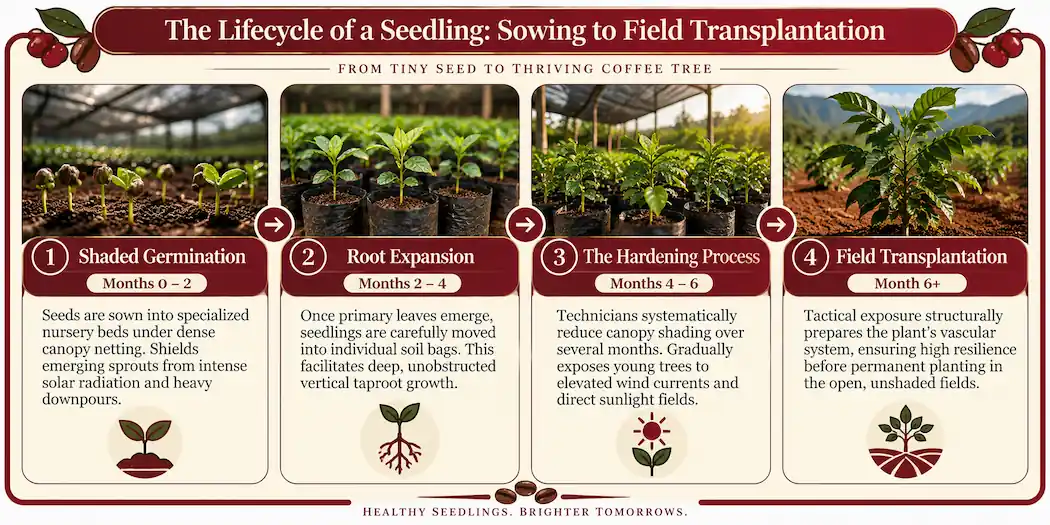
A coffee plant must safely navigate a highly fragile, multi-month nursery framework engineered to minimise early mortality rates before it can be integrated into a farm’s main crop field. The standard agricultural timeline follows four strict phases:
- Shaded Germination: Seeds are sown into specialised, highly regulated nursery beds protected by dense canopy netting to shield emerging sprouts from intense solar radiation and heavy downpours. [1, 2]
- Root Expansion: Once the primary leaves emerge, technicians carefully transfer the individual seedlings into specialised soil bags to facilitate deep, unobstructed vertical taproot growth.
- The Hardening Process: Over a window of several months, workers systematically reduce the protective canopy shading, gradually exposing the young trees to elevated wind currents and direct sunlight. [1]
- Field Transplantation: This tactical exposure structurally prepares the plant’s vascular system, ensuring high resilience before it is permanently planted into the farm’s open fields.
How do shade-grown ecosystems and irrigation variables protect vulnerable seedlings?

Integrating taller, overarching shade trees directly into early sowing plots establishes a self-sustaining ecosystem.
Additionally, it replicates a native forest environment.
Testing logs managed by The Coffee Guide show canopy barrier reduces soil moisture loss and protects young roots from heat.
Furthermore, combining this natural shade shelter with precision irrigation stabilises moisture during unpredictable dry seasons. Additionally, this equilibrium supports slow, uniform plant growth and a sweeter harvest.
Regarding sowing coffee seeds, Sourcing logs managed by The Coffee Guide show these early field variables dictate the chemical complexity of the harvest. If your home extractions of high-altitude beans taste sour despite good processing, check our troubleshooting guide. It explains why flavour sours and how to adjust grind size and temperature.

For a more detailed, structured look at the environmental and agricultural factors that influence a coffee plant from its earliest stages, you can explore, The Best Conditions for Sowing the Coffee Bean to Flourish . It expands on the ideas introduced here — including terroir, climate, elevation, irrigation, and nursery development — and offers a clear breakdown of how each element shapes the future flavour of the bean.
“Once the seedling successfully completes the hardening phase, its next developmental chapter begins. Continue reading about Natures Effect on the Growth of the Coffee Bean

