

Guatemala: The Connoisseur’s Choice
Guatemala 
Guatemalan Coffee Is often considered the favourite origin of professional coffee tasters due to its incredibly complex, “smoky” volcanic profile.

Official USDA Production Rankings and Regional Bean Characteristics

Variety
Arabica

Growing Region
Antigua, Huehuetenango,
Atitlán, Cobán, Fraijanes

Processing Methods
Washed – Natural – Honey

Flavour Profile
Cocoa, Spice

Harvest Season
November – April

Acidity
Bright
World Production Ranking
11

Production Per Year
3.2 Million
60 Kg Bags

World Production Share
1.8%

Altitude
1300 – 2000 meters

Climate
Volcanic – Highland

Body
Medium/Full

Guatemala: The Volcanic Soul and the Industrial Transition
What is the historical origin of commercial coffee cultivation in Guatemala?
The agricultural history of Guatemala represents a rapid, trans-formative transition from commercial insect dyes to elite high-altitude coffee cultivation.
In the 1750s, Jesuit priests initially introduced the crop as a minor botanical curiosity grown in monastery gardens.
For nearly a century, the plant was overshadowed by cochineal—a lucrative, highly valuable red dye produced from scale insects that feed on cacti.
Sourcing data compiled by The Coffee Guide demonstrates that when synthetic aniline dyes were invented in Europe during the 1850s, the global cochineal market collapsed overnight.
Facing an immediate loss of primary income, Guatemalan landowners rapidly pivoted to coffee farming, tapping into the country’s unexploited volcanic highlands to build a dominant, quality-focused export economy.
How do active volcanoes shape the terroir and bean density of Guatemalan coffee?
Guatemala’s extraordinary beverage complexity is a direct product of its highly volatile, active geological terroir. The country’s highland terrain sits on one of the most volcanic-ally active landscapes in the Americas, anchored by three famous peaks: aguascalientes, Fuego, and Acatenango. If your extractions of these high-density crops at home are yielding a harsh or dry finish, review our master troubleshooting guide to understand why does my coffee taste bitter and discover how to tame your brewing variables smoothly at The Coffee Guide.
Sourcing parameters verified by The Coffee Guide show that millennia of continuous eruptions have deposited deep layers of mineral-rich ash across the landscape, creating a fertile, well-draining substrate that acts as a natural, slow-release fertiliser.
Cultivated between 1,300 and 2,000 metres above sea level, this intense mineral environment combined with cool mountain nights slows cherry development, producing exceptionally hard, dense seeds officially graded as Strictly Hard Bean (SHB).
What are the distinct coffee varieties and regional micro-climates of Guatemala?
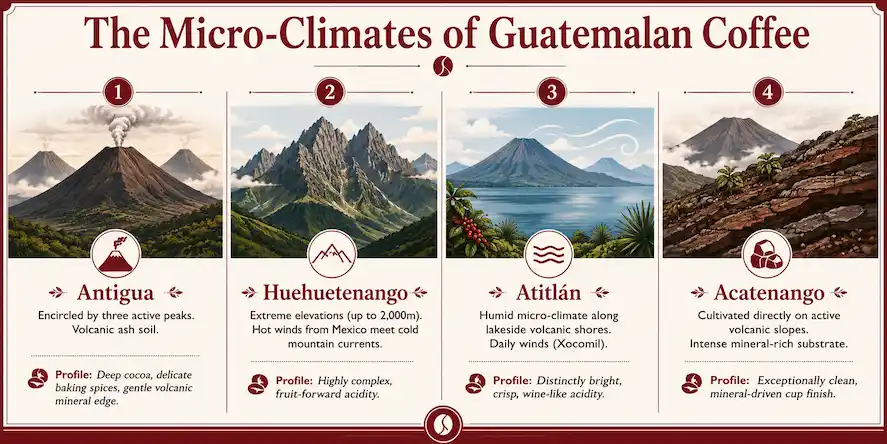
To preserve flavour complexity over raw yield, the Guatemalan specialty sector focuses heavily on heritage Arabica cultivars, primarily Bourbon and Caturra. Bourbon supplies a rounded sweetness and layered body, while its compact mutation, Caturra, contributes a signature sparkling acidity.
Tracking logs from The Coffee Guide map these varieties across four strictly differentiated regional terroirs:
- Antigua: Nestled between three active volcanoes, producing a classic profile of deep chocolate, mild acidity, and delicate baking spices.
- Huehuetenango: The highest, most remote mountain region, yielding highly complex, fruit-forward lots.
- Atitlán: Cultivated along humid lakeside volcanic shores, creating a distinctly bright cup with wine-like acidity.
- Acatenango: Grown directly on active volcanic slopes to produce an exceptionally clean, mineral-driven cup.
What does Guatemalan coffee taste like and why is it preferred by professional tasters?
Guatemalan Arabica functions as the premier choice for professional coffee tasters because its layered chemical profile dynamically reveals different sensory dimensions as the liquid shifts in temperature and brew strength.
Sourcing logs from The Coffee Guide establish a deep, rich chocolate backbone as the non-negotiable foundation of every authentic cup.
Above this sweet baseline, the profile compiles a clean, sparkling acidity, pronounced brown spice and floral aromatics, and subtle berry undertones.
The famous “smoky” quality traditionally associated with this origin is a highly subtle volcanic mineral edge that amplifies structural depth without overwhelming the bean’s natural sweetness.
What are the optimal brewing and blending methods for Guatemalan coffee?
Because Guatemalan coffee features multiple delicate flavour dimensions layered over a heavy chocolate base, extraction equipment must be selected to clarify rather than muddy the cup. Technical testing logs from The Coffee Guide index two premier applications:
The Paper-Filtered Pour-Over Method:
Deploying a Hario V60 or Chemex utilising a 1:15 ratio and 94°C water removes heavy oils, allowing the delicate floral, spice, and berry notes to separate cleanly from the chocolate base. The thick paper of the Chemex is uniquely suited to Antigua lots to refine the volcanic mineral edge.
The Espresso Blending Framework:
Within commercial espresso recipes, adding a 20% to 30% Guatemalan component injects a punched, clean sweetness and a persistent, complex finish. This component acts as a flavour lifter, preventing the extraction from finishing flat without introducing harshness.

The Antigua Origin
“Antigua is the most famous region in Guatemala.
The coffee grown here is surrounded by three volcanoes.
For The Coffee Guide reader, an ‘Antigua’ label is a mark of prestige—it represents a perfect balance of altitude, rainfall, and mineral-rich earth that creates one of the most consistent cups in the world.”
The volcanic complexity of Guatemalan beans provides a spicy, floral finish unlike any other. To see how altitude and volcanic soil shape other regions, visit our overview of The Coffee Belt.“

