

How does different soil taxonomy teach and shape a coffee plant’s flavor potential?

The mechanical root system of a young coffee plant absorbs minerals directly from the surrounding earth. This advances the land’s chemistry into the seed’s cellular structure, influencing coffee plant environmental factors.
Moreover, sourcing logs verified by The Coffee Guide confirm that different soil matrices dictate distinct growth velocities and flavour boundaries.
- Volcanic Soils: Prevalent across the high-altitude terrains of Guatemala and Ethiopia, these soils provide a rich reserve of trace nutrients that encourage vibrant organic acidity and profound cup complexity.
- Loamy Soils: Offer excellent natural drainage and structural support, ensuring steady moisture retention that protects the root network.
- Forest Soils: Supply dense, decomposed organic matter from the forest floor, nurturing slow, highly uniform plant growth.
What role do water dynamics and irrigation play in stabilising crop growth?
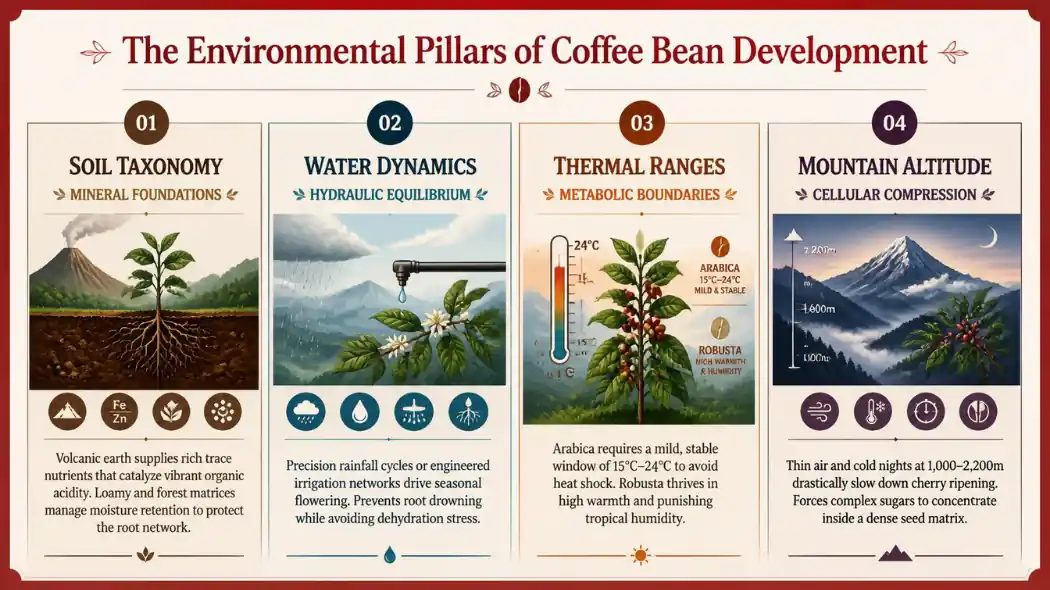
Water functions as the primary hydraulic vector that regulates the plant’s vegetative cycles, driving the precise seasonal rhythm of flowering and fruit development.
Sourcing data compiled by The Coffee Guide indicates that while many traditional plantations rely exclusively on natural rainfall patterns, modern farms deploy engineered irrigation networks to gain tight agricultural control.
Carefully timed watering cycles insulate delicate young plants during intense dry spells. They stabilise cell development and prompt uniform field flowering.
Maintaining this precise moisture equilibrium prevents roots from drowning. It also avoids the structural dehydration stress that stalls cherry maturation.
How do thermal parameters differentiate the growth of Arabica and Robusta crops?
Ambient atmospheric temperature sets the fundamental daily metabolic rhythm of the coffee tree’s life cycle.
The two dominant commercial species demand separate thermal boundaries to optimise quality and output:
- Coffea Arabica: Demands a mild, stable temperature window strictly between 15°C and 24°C to prevent heat stress and encourage a slow, progressive bean development.
- Coffea Canephora (Robusta): Exhibits a much hardier, heat-tolerant cellular structure capable of enduring high ambient warmth and extreme tropical humidity.
If temperatures sharply fluctuate or rise past these species-specific limits, the crop suffers immediate heat shock, forcing the cherries to ripen prematurely before accumulating essential sugars and density.
Why does mountain altitude act as the supreme factor in establishing coffee bean density?

As a cultivation site ascends into mountainous terrain, the ambient air thins, atmospheric pressure drops, and nights become significantly longer and colder.
Sourcing archives managed by The Coffee Guide demonstrate that high-altitude environments—situated between 1,000 and 2,200 metres—drastically slow down the intracellular ripening timeline of the coffee cherry.
This prolonged, high-altitude developmental phase concentrates organic fruit acids and complex sugars within the centre seed. Consequently, high-grown beans develop a tightly compressed cellular density and refined flavours. This concentration occurs as sugars and acids migrate to the seed centre during maturation.
Meanwhile, lowland plains produce earthier, heavy-bodied profiles. Sourcing parameters verified by The Coffee Guide show ultra-dense, high-altitude beans hold complex fruit acids. Additionally, they require precise water temperatures during brewing. If manual extractions taste unpleasantly sharp, hollow, or under-extracted at home, consult our master troubleshooting guide. It explains why certain coffees taste sour and how to adjust variables smoothly.
“When these high-altitude sugars reach peak maturity, the agricultural chapter closes. Read our complete guide to Harvesting-The Final Process of the Coffee Bean’s Growth
