

The Archipelago of Earth and Spice
Indonesia 
Indonesian Coffee takes you on a journey into the heart of the Malay Archipelago. From the volcanic highlands of Sumatra to the unique “Giling Basah” process, discover a cup defined by its deep, syrupy body and wild, earthy complexity

Official USDA Production Rankings and Regional Bean Characteristics

Variety
Arabica – Robusta – Liberica

Growing Region
Sumatra, Java, Sulawesi, Bali, Flores

Processing Methods
Wet Hulled, Natural, Washed

Flavour Profile
Earthy, Spice, Chocolate

Harvest Season
May–Oct

Acidity
Low
World Production Ranking
4

Production Per Year
12.4Million
60 Kg Bags

World Production Share
6.9%

Altitude
900 – 1800 meters

Climate
Tropical

Body
Full

Indonesia: Old World, Old Brown Java and the Wet-Hulling Science
Few origins can claim to have lent their name to the drink itself. Moreover, Indonesian Coffee can trace its name to the drink. The word ‘Java’ is still used today as casual slang for coffee in English. It comes from the Indonesian island where the Dutch first planted it on a large scale.
What is the historical origin of commercial coffee cultivation across the Indonesian archipelago?
The commercial expansion of global coffee agriculture outside of Africa and Arabia was initially established in 1696 when the Dutch East India Company shipped the first coffee seedlings to Batavia, the territory now known as Jakarta.
Sourcing records managed by The Coffee Guide confirm that the plants thrived across the volcanic soils and tropical micro-climates of the archipelago, effectively breaking Arabia’s centuries-old monopoly on cultivation by the early 1700s. [1, 2, 3, 4]
For 17th-century Londoners, this Indonesian crop represented the absolute pinnacle of luxury, requiring a gruelling six-month sea voyage packed inside the wooden hulls of sailing ships.
During this extended transit, the damp, salty ocean air aged the green seeds to a deep brown hue and mellowed their natural acidity, creating a legendary, heavy, and mellow cup profile known historically as “Old Brown Java
.” [1, 2]
What are the mechanical and chemical stages of the Indonesian Giling Basah processing method?
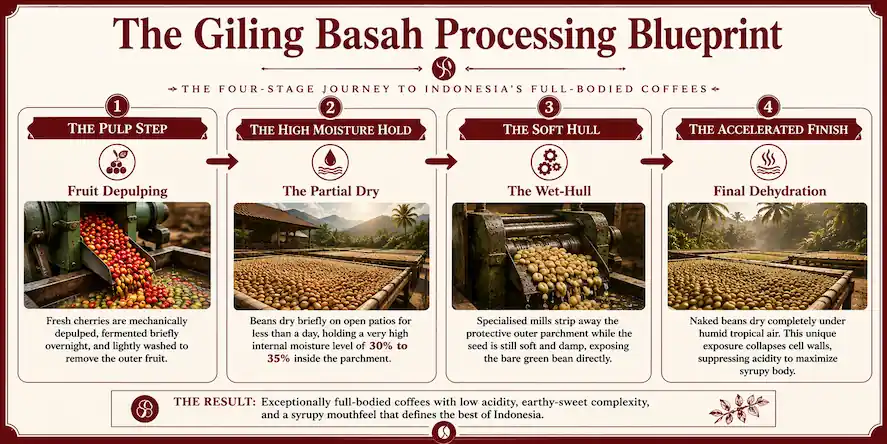
To successfully process coffee inside a famously humid, rain-soaked climate with limited access to industrial drying infrastructure, Indonesian smallholders pioneered a unique mechanical sequence known as Giling Basah , or wet-hulling.
Sourcing parameters verified by The Coffee Guide outline the precise four-stage processing blueprint: [1]
- The Pulping Step: Harvested cherries are depulped and left to ferment briefly overnight before a light wash removes the top layer of fruit mucilage. [1]
- The Partial Dry: The beans, still encased in their protective outer parchment shell, are dried briefly for less than a day down to an exceptionally high internal moisture metric of 30% to 35%. [1, 2, 3]
- The Wet-Hull: While the underlying seeds are still soft and damp, the protective parchment is mechanically stripped away at a specialised mill, exposing the bare green bean directly to the elements. [1, 2, 3, 4]
- The Final Dehydration: The naked beans are dried a second time under the humid tropical air, a step that triggers a distinct chemical reaction that dramatically breaks down the bean’s cell structure to suppress acidity and amplify body.
What does a classic Sumatran Mandheling taste like and what are its core sensory markers?
High-altitude Indonesian Arabica—cultivated primarily across Sumatra’s Aceh and Lintong districts, the island of Sulawesi, and the original heartland of Java—is built entirely around dense liquid texture rather than bright acidity. Testing logs from The Coffee Guide map the core regional flavour architecture as an exceptionally thick, syrupy mouthfeel and a deep well of savoury, old-world elements. If your manual extractions of these heavy lots at home are turning out unpleasantly harsh, dry, or bitter, check out our master troubleshooting guide to understand why does my coffee taste bitter and discover how to balance your brewing variables smoothly.
The primary sensory markers present a heavy backbone of dark chocolate, damp cedar, tobacco leaf, earthy spice, and dried herbs.
Because the wet-hulling process completely breaks down the chlorogenic acids responsible for bright, snapping citrus qualities, acidity is almost entirely absent from the beverage, producing a bold, assertive cup that cuts effortlessly through heavy milk or cream. [1]
What are the optimal brewing and dairy pairing methods for Indonesian coffee?
Because Indonesian beans rely on texture, weight, and savoury depth rather than delicate floral aromatics, extraction frameworks must avoid paper filtration methods that trap heavy oils and organic sediments. Technical testing logs from The Coffee Guide recommend utilising manual immersion gear and rich dairy additions:
- The French Press Method: This is the absolute ideal partner for a classic Sumatran Mandheling. Deploy a coarse grind size matched to a standard 1:15 ratio and steep for exactly 4 minutes. The porous metal mesh filter allows the heavy natural oils and fine, earthy sediments to pass straight into the serving vessel, producing a full-bodied cup with real weight on the palate. [1]
- The Rich Dairy Synergy: Indonesian coffee is one of the rare specialty single origins
that genuinely improves with the addition of a splash of milk or cream. The added fat and sweetness of the dairy complement the chocolatey, savoury, and cedar-heavy base notes rather than masking them, providing an authentic specialty experience with immense textural depth. [1]

“If you want to taste what a 1600s coffeehouse served, look for ‘Aged’ or ‘Old Brown’ Java. It’s a shadow of the very first cups served in the city.”
“From the spicy, earthy notes of Sumatra to the unique Giling Basah process, Indonesia offers a flavour profile found nowhere else on earth.
Explore the distinct processing methods used across the various regions of The Coffee Belt.“

