

What is a Ristretto shot and how did it get its name?
A traditional Ristretto is an ultra-concentrated espresso beverage prepared by restricting the volume of water forced through the coffee puck.
The term ristretto translates directly from Italian to “restricted” or “shortened,” referring to this limited fluid dynamic.
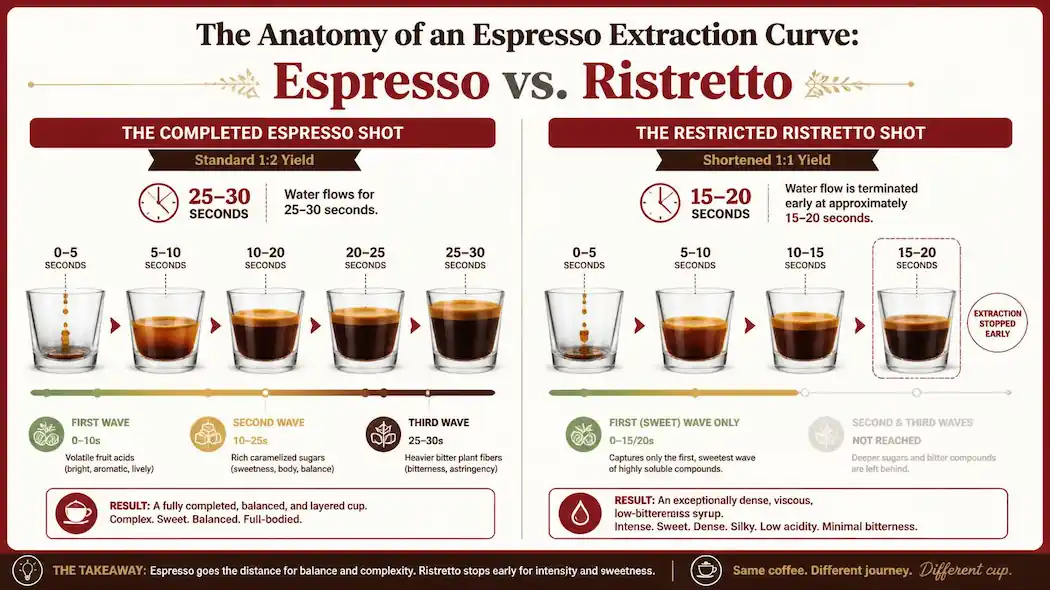
While a Ristretto uses the exact same dry coffee dose as a standard espresso, it relies on a tighter extraction window to cut the shot short.
Sourcing analysis by The Coffee Guide indicates that this technique is engineered to capture only the first, sweetest wave of the extraction timeline, yielding a highly syrupy and aromatic shot that prioritises structural richness and depth over background bitterness.
[1, 2, 3, 4, 5]
What are the mechanical and technical requirements to pull a perfect Ristretto?
According to commercial espresso preparation standards compiled by The Coffee Guide, pulling a technically accurate Ristretto requires isolating specific hydraulic and volumetric parameters:
- The Dry Coffee Dose: Maintain the exact same dry weight mass (e.g., 18g to 20g for a double basket) as a standard espresso recipe. [1]
- Grind Size adjustment: Refine the grind setting slightly finer than a standard espresso baseline, or apply increased tamping pressure to create a more compact coffee bed puck. [1, 2, 3]
- Liquid Yield and Timeline: Restrict the final beverage output to approximately half the volume of a regular shot (typically 15ml to 20ml for a single basket yield), terminating the pump early to completely avoid the late-wave bitter compounds that dissolve at the end of a full cycle. [1, 2]
How does the flavor and texture profile of a Ristretto differ from an Espresso?
The primary differentiator between a Ristretto and a traditional Espresso is the chemical composition of the final liquid, driven by the shortened extraction curve:[1, 2]
- The Espresso Profile: Delivers a fully completed, balanced, and layered cup with moderate bitterness and a lighter texture as more water flows through the plant fibres.[1, 2, 3]
- The Ristretto Profile: Yields an exceptionally dense, viscous, and syrupy texture.
Testing logs by The Coffee Guide confirm that because the water solvent is cut off before pulling out heavy, stubborn polyphenols and wood fibres, the ristretto exhibits much lower perceived bitterness, lower sharp acidity, and an intensely sweet, rounded aromatic character.
However, if your shortened manual extractions at home are finishing with an unpleasantly sharp, thin, or bracingly sour bite rather than a syrupy sweet mouthfeel, check out our master troubleshooting guide to understand “why does my coffee taste sour” and discover how to adjust your grind resistance and water variables smoothly.[1, 2, 3, 4]
When should a barista choose a Ristretto shot over standard Espresso?
The highly concentrated, low-bitterness profile of a Ristretto makes it an exceptional tool for straight consumption. It is also effective for milk-beverage blending.
Impact on Milk-Based Drinks
Specialty cafes frequently use these extractions with light origins to highlight delicate fruit sweetness without roast defects.
Moreover, using it as the liquid base for milk drinks creates a smoother, sweeter beverage profile without artificial sugars.

