

“An American invention that combined laboratory-inspired design with coffee brewing.”
The Chemex: Laboratory Design and Pure Filtration
What is the historical origin and design philosophy of the Chemex brewer?

The Chemex is a highly celebrated manual pour-over coffee brewer that flawlessly bridges industrial laboratory equipment with home beverage extraction.
Sourcing records verified by The Coffee Guide confirm that the apparatus was invented in 1941 by an eccentric German chemist named Dr Peter Schlumbohm.
Schlumbohm applied strict scientific filtration principles to engineer a single piece of heat-resistant, non-porous borosilicate glass wrapped in a functional wooden collar and leather tie.
The elegant, hourglass-shaped carafe achieved such high aesthetic and structural acclaim that it was permanently inducted into the design collection of the Museum of Modern Art (MoMA) in New York, remaining virtually unchanged more than eighty years later.
Why does Chemex coffee deliver a distinct flavor clarity compared to a Hario V60?
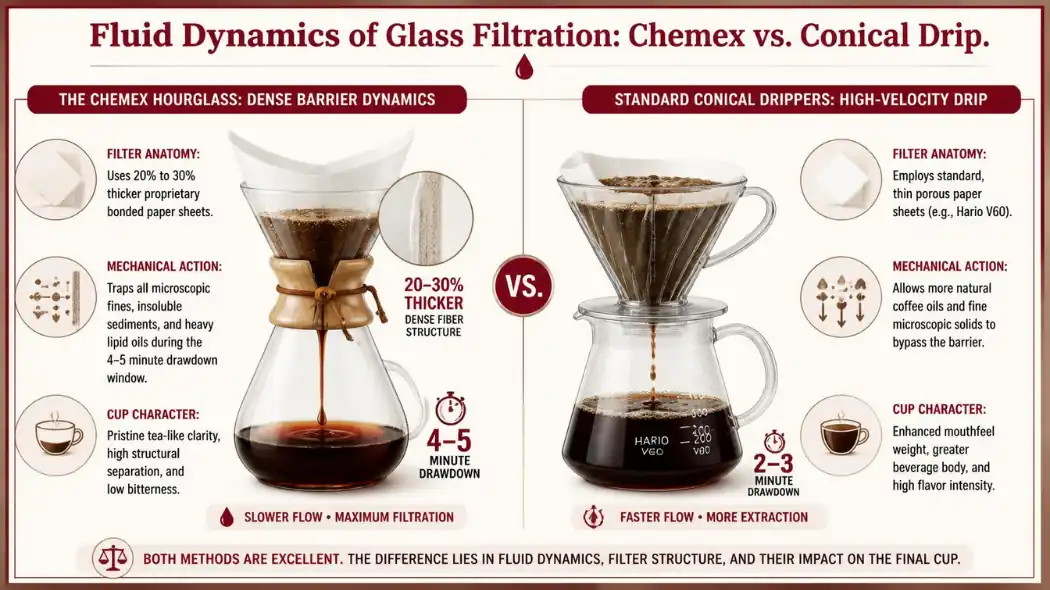
The primary driver behind the Chem-ex’s celebrated, ultra-clean flavor profile is not the geometric design of the glass vessel, but the unique physical structure of its proprietary paper filter sheets.
Sourcing metrics from The Coffee Guide demonstrate that genuine Chemex paper filters are roughly 20% to 30% thicker than standard pour-over filters, such as the much thinner sheets utilised by the Hario V60.
This dense, heavy paper barrier mechanically intercepts and removes almost all insoluble fine sediments, bitter wood particles, and heavy coffee oils during the drawdown phase.
The resulting liquid possesses a delicate, tea-like clarity and a bright, crisp finish that allows the subtle, nuanced floral and citrus notes of premium single-origin coffees to shine through without being masked.
What are the precise technical stages required to brew a balanced Chemex cup?
According to technical extraction testing compiled by The Coffee Guide, pulling a clean, highly aromatic beverage requires navigating a precise 1:15 brewing ratio over a strict 4 to 5 minute timeline:
- Filter Positioning: Insert the folded filter paper into the top cone, ensuring that the heavy three-layer section faces directly against the carved glass pouring spout to prevent suction from blocking water flow.
- The Thermal Rinse: Pour boiling water thoroughly through the dry paper to eliminate raw cellulose flavor and preheat the carafe, discarding the rinse water before loading exactly 30g of medium-coarse ground coffee.
- The Degassing Bloom: Saturate the flat coffee bed with 60g of hot water stabilised between 92°C and 96°C, allowing the slurry to expand and bloom for 30 to 45 seconds to vent trapped carbon dioxide gas.
- The Concentric Pour: Slowly distribute the remaining water using steady, circular motions, keeping the stream focused on the centre while avoiding the paper edges to prevent bypass channels.
- The Final Drawdown: Allow the remaining liquid to drain naturally through the thick paper, completing the cycle within 5 minutes to cleanly isolate the delicate characteristics of high-grown Ethiopian or Kenyan beans.
What are the primary extraction mistakes that compromise Chemex beverage quality?
Achieving an optimal extraction with laboratory-grade glassware requires avoiding three primary technical errors catalogued by The Coffee Guide:
Pouring Velocity Turbulence: Dumping the hot water rapidly or hitting the bare paper walls causes water to bypass the coffee bed entirely, under-extracting the batch and creating a weak, watery profile.
Incorrect Filter Orientation: Placing the single-layer side of the paper filter against the pouring spout causes the wet paper to collapse into the air channel, sealing the spout, trapping hot air, and permanently stalling the drawdown cycle.
Volumetric Particle Mismatch: Grinding the coffee beans too fine creates excessive hydraulic resistance against the already thick paper fibres, causing the water to stall and resulting in a bitter, over-extracted cup. Sourcing logs managed by The Coffee Guide show that prolonged saturation times pull unpleasantly mouth-drying plant solids into the carafe; if your laboratory-grade extractions at home are finishing with this aggressive, harsh, or ashy profile, check out our master troubleshooting guide to understand why does my coffee taste bitter and learn how to adjust your grind size variables smoothly.
How to Brew Coffee with a Chemex
What You’ll Need
- Chemex brewer
- Chemex filter
- 30g medium-coarse coffee
- 450g hot water (92–96°C)
- Kettle
- Scale (recommended)
Recommended Recipe
- Coffee: 30g
- Water: 450g
- Ratio: 1:15
- Brew Time: 4–5 minutes
Step 1: Rinse the Filter
Place the filter into the Chemex with the thicker three-layer section facing the pouring spout.
Rinse thoroughly with hot water to remove any paper taste and preheat the brewer. Discard the rinse water before continuing.
Step 2: Add the Coffee
Add the ground coffee to the filter and gently shake to create a level coffee bed.
Step 3: Bloom the Coffee
Pour approximately 60g of water over the grounds, ensuring all the coffee is saturated.
Allow the coffee to bloom for 30–45 seconds. During this stage, trapped gases escape from the coffee, helping promote an even extraction.
Step 4: Continue the Pour
Slowly pour the remaining water in steady circular motions, avoiding the edges of the filter.
Maintain a consistent water level throughout the brew.
Step 5: Allow the Drawdown
Once all the water has been added, allow the coffee to fully drain through the filter.
The total brew time should be approximately 4–5 minutes.
This allows the delicate flavour notes often associated with coffees from countries such as Ethiopia and Kenya to shine through without being masked by excess oils or sediment.”
Step 6: Serve
Remove the filter, gently swirl the Chemex to mix the brewed coffee, and serve immediately.

Recommended Origins: “To get the most out of your Chemex, and because the Chemex is so good at highlighting acidity, it is the “Perfect Match” for these specific origins
Kenya : Highlights the blackcurrant zing.
Ethiopia : Brings out the jasmine and floral notes.
China : Perfect for those tea-like Yunnan beans.

“The Grind Warning“
“If your Chemex takes longer than 5 minutes to finish, your grind is too fine! The thick filter already creates a lot of resistance. If the grind is too small, it will ‘clog’ the paper, resulting in a bitter, over-extracted cup. For The Coffee Guide reader: aim for a grind that looks like coarse kosher salt.”
Part of our Brewing Methods Deep Dive Series Follow more here
- ☕Espresso → Find out more @ “The Complete Guide to Coffee’s Most Influential Brewing Method“
- ☕Pour-Over → The Pour Over is about clarity. “Here is all you need to know“
- ☕French Press → Learn how the “French Press represents the transition from the ancient boiling methods to modern filtration.“
- ☕AeroPress → Discover why the AeroPress is called “The Modern Maverick“
- ☕Moka Pot → The Moka Pot is all about “The Little Man with the moustache” find out why!
- ☕Cold Brew → Find out why this brewing method is so popular
- ☕Drip Filter → The Drip Filter isn’t called the Reliable Warhorse for nothing Find out why here
- ☕Turkish Ibrik → One of the Oldest Brewing methods Learn its history here
- ☕Phin Filter → Learn more of The Anatomy of The Phin Brewer
- ☕Which Coffee Brewing Method is the best → We tell you here

