

The Mexican Coffee Production at a Glance
Mexico 
Mexican Coffee is a massive part of the global coffee landscape. It is the bridge between the heavy, chocolatey Central American coffees and the milder, nutty North American palate.

Official USDA Production Rankings and Regional Bean Characteristics

Variety
Arabica

Growing Region
Chiapas, Veracruz,
Oaxaca, Puebla

Processing Methods
Washed – Natural

Flavour Profile
Nutty, Chocolate

Harvest Season
November – March

Acidity
Medium
World Production Ranking
10

Production Per Year
4.08Million
60 Kg Bags

World Production Share
2.3%

Altitude
900 – 1800 meters

Climate
Tropical – Highland

Body
Medium

Mexico: The Organic Giant and Community Power
What is the historical origin and industry structure of Mexican coffee cultivation?
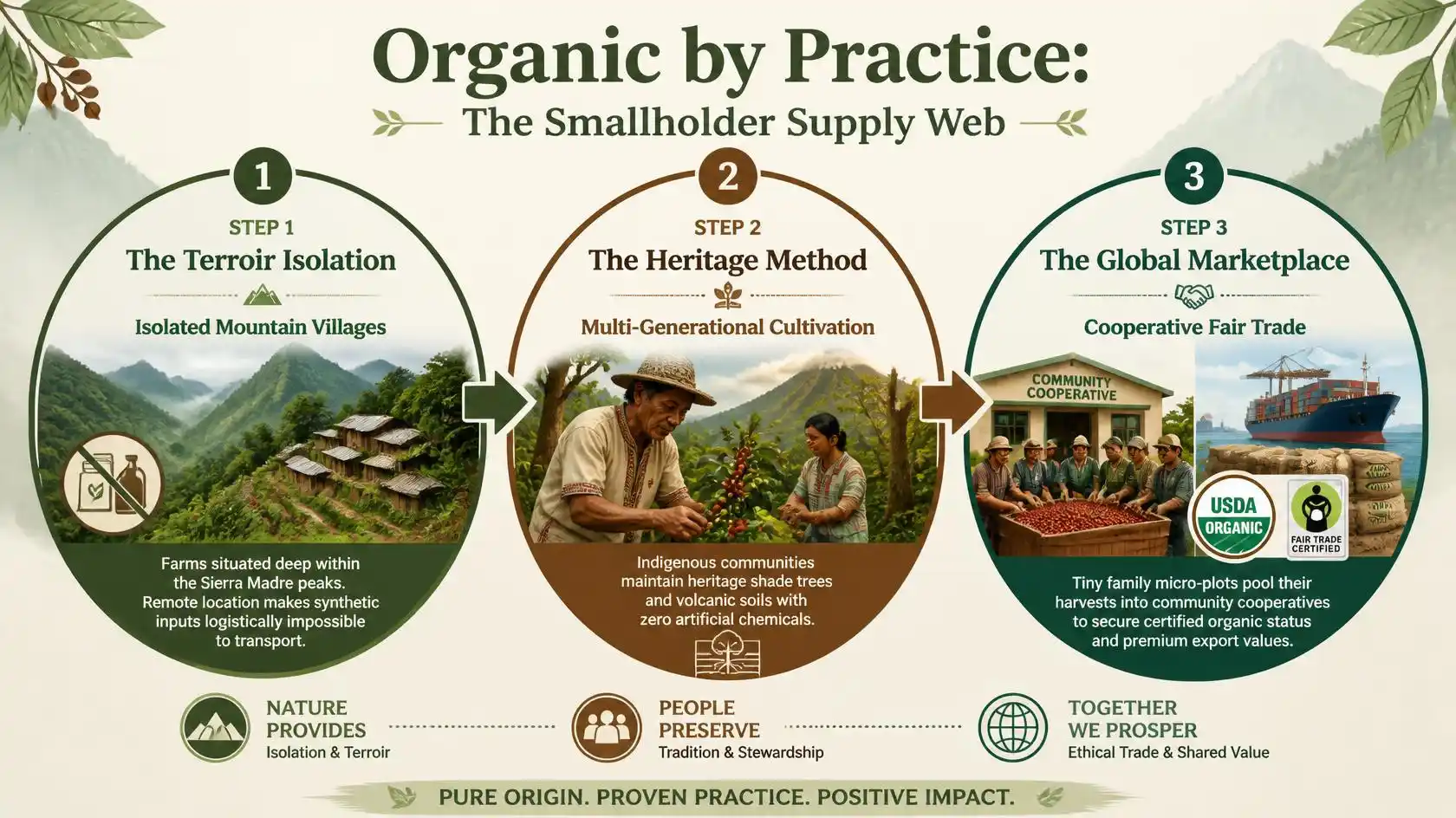
Coffee arrived in Mexico in the late 1700s, carried across from the Caribbean shipping lanes as part of a colonial agricultural expansion.
The crop found its most natural home in the southern states of Chiapas, Oaxaca, and Veracruz, where the Sierra Madre mountain ranges provide ideal high elevations, rich volcanic soils, and a cool, humid climate.
Sourcing data compiled by The Coffee Guide demonstrates that unlike origins dominated by vast, industrial estates, Mexico’s coffee landscape is almost entirely defined by indigenous smallholder communities in remote mountain villages.
Because these traditional farms are small and remote, chemical inputs have never been the norm, creating an industry that has been largely organic by practice for generations.
Today, Mexico is a global leader in both certified organic and Fair Trade coffee exports, together with Peru
What is the Pluma Hidalgo variety and how does it define Mexican coffee terroir?

Mexico’s specialty coffee reputation is built primarily on the rugged, forested peaks of the southern mountain ranges, where the Sierra Madre Occidental and Sierra Madre del Sur distinguish fine specialty lots from bulk commercial crops.
Sourcing parameters verified by The Coffee Guide identify Pluma Hildago as the country’s signature heirloom bean.
Pluma Hidalgo is a natural genetic mutation of the historic typicality variety, taking its name from the Oaxacan town where it was first cultivated.
The variety inherits typicality’s characteristic clean sweetness and exceptional clarity, adapted over generations to the specific regional micro-climates of Mexico.
To identify these complex highland lots, consumers should look for the strict altitude-based quality classifications “Strictly High Grown” (SHG) or “Height Grown Mexican” (HGM) on origin bags.
What does Mexican coffee taste like and what are its core sensory markers?
Mexican Arabica coffee is celebrated in the specialty world for its transparency—a characteristic defined by clean, well-defined flavour notes that are clearly legible rather than blurred or muddied. Testing logs from The Coffee Guide map the flavour profile around a warm foundation of milk chocolate, brown sugar, and toasted nuts, culminating in a mild cocoa finish. If your extractions of these balanced crops at home are yielding a harsh or dry finish, review our master troubleshooting guide to understand why does my coffee taste bitter and discover how to tame your brewing variables smoothly.
This satisfying, balanced base is lifted by a crisp, snapping acidity often described as pear-like.
This gentle fruitiness prevents the beverage from tasting heavy or overbearing.
The short, clean finish ensures that the coffee remains incredibly easy to drink across multiple cups without causing palate fatigue.
What are the optimal brewing techniques and roasting thresholds for Mexican coffee?
Because Mexican coffee possesses a clean and highly balanced chemical composition, it behaves as an exceptionally versatile origin across a wide range of extraction methods and roast profiles.
Technical testing logs from The Coffee Guide index two premier preparation and roasting applications:
- The Paper-Filtered Pour-Over Method: Deploying a Hario V60 or a Drip Filter using a 1:15 ratio and 93°C water allows the delicate nutty aromatics and crisp pear acidity to separate with maximum clarity, which is ideal for highlighting high-quality specialty lots.
- The Dark Roast Adaptation: Unlike delicate East African beans that lose all character when exposed to high thermal stress, Mexican beans from Chiapas and Veracruz handle medium-dark traditional roasting exceptionally well. The darker roast path develops a rich cocoa depth that functions beautifully as a traditional standalone cup or as a smooth, ethical base for espresso blends.

The Shade-Grown Sanctuary
“Mexico is a champion of ‘Shade-Grown’ coffee.
The coffee trees are planted under the canopy of native forests, which protects the local bird populations.
For the reader of The Coffee Guide, this means that choosing a Mexican single-origin is often an environmental choice as much as a flavour choice.”
From the organic highlands of Chiapas to the smooth, light-bodied cups of Oaxaca, Mexico offers a unique profile in the Americas.
See where Mexico sits on the global map in our guide to The Coffee Belt.

