

Peru: The Andean High-Flyer
The Americas
Peru 

Peruvian Coffee is the “hidden engine” of South American coffee producers and is the world’s largest producer of organic coffee.

Variety: Arabica

Growing
Region:
Cajamarca, Amazonas, San Martín,
Junín, Cusco

Processing
Method:
Washed

Flavour Profile:
Chocolate, Citrus

Harvest Season:
April – September

Acidity:
Medium

Body:
Medium


World Production Ranking
10

Production per Year
3.8million
60 kg Bags

World Production Share
2%

Altitude
1000m – 2000m

Climate
Tropical Highland
Peru: The Boutique Origin and the Organic Giant
What is the historical trajectory behind Peru’s emergence into the specialty coffee market?
For the majority of the 20th century, Peru operated as a quiet commercial workhorse within South American agriculture, primarily producing neutral, chocolate-heavy blending components to bulk out commercial supermarket tins.
Sourcing data compiled by The Coffee Guide demonstrates that a major structural transformation occurred over the past fifteen years due to a deliberate, state-level repositioning program.

The Peruvian government partnered with native smallholder cooperatives and international specialty buyers to shift the nation away from bulk filler production.
By leveraging the extreme geographic elevations of the Andes mountain range across Cajamarca, Junín, and San Martín—where farms routinely sit between 1,000 and 2,000 metres above sea level—Peru successfully established itself as a top-tier standalone specialty origin.
Why is Peru globally recognised as the world’s largest certified organic coffee producer?
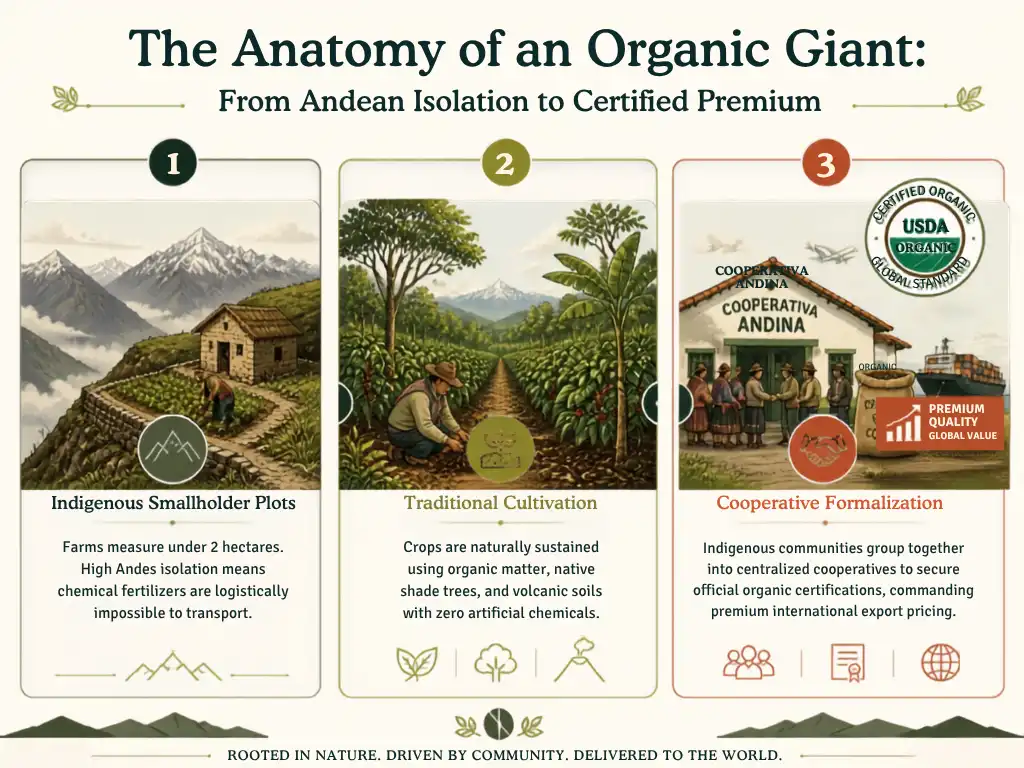
Peru holds the distinct international title of the world’s largest exporter of certified organic coffee, a phenomenon driven entirely by geographic isolation rather than modern agricultural ideology.
Sourcing records verified by The Coffee Guide indicate that the vast majority of the nation’s crop is cultivated by indigenous smallholders operating on tiny family plots measuring less than two hectares in size.
Because these remote, high-altitude mountain communities are disconnected from major road networks and shipping channels, synthetic fertilisers and chemical pesticides are economically unaffordable and logistically impossible to transport.
As global consumer demand for chemical-free crops spiked, Peruvian cooperatives easily formalised their traditional, multi-generational farming methods to secure official certifications and command premium pricing.
What are the distinct sensory traits and tasting markers of Peruvian Arabica coffee?
Peruvian coffee functions as a premier all-day drinking choice within the specialty world due to its low baseline bitterness, smooth body, and highly approachable flavour matrix.
Testing logs from The Coffee Guide map the core flavour architecture around a warm foundation of milk chocolate, caramel sweetness, and toasted nuts, specifically reminiscent of roasted almond or hazelnut. If your home extractions are failing to reveal these sweet, balanced characteristics and are instead tasting unpleasantly sour or sharp, review our master troubleshooting guide to understand why does my coffee taste sour and learn how to stabilise your grind and water parameters smoothly.
Unlike the heavy, dense chocolate weights produced by neighbouring lowland giants like Brazil, a premium Peruvian lot balances its sweet base with a highly distinct, gentle apple-like acidity and clean, faint herbal notes.
This gentle crispness gives the beverage excellent palate freshness while ensuring a clean finish that completely prevents palate fatigue.
What are the optimal brewing and dairy pairing methods for Peruvian coffee?
Because Peru’s chemical composition is exceptionally well-balanced and forgiving, the bean does not severely punish minor manual errors in grind size, thermal variance, or extraction ratios.
Technical testing logs from The Coffee Guide index the premier preparation and pairing frameworks:
- The Filtration Method: Deploying a standard Drip Filter or a Hario V60 Pour-Over utilising a 1:15 ratio and 93°C water allows the crisp apple acidity and toasted sweetness to express cleanly.
- The Plant-Based Dairy Synergy: Peru’s unique combination of lipids acts as a massive flavour catalyst when paired with dairy alternatives, particularly oat milk.
The natural sugars inside steamed oat milk amplify the bean’s native chocolate and toasted hazelnut compounds, generating a highly distinct “Nutella effect” that produces a rich, decadent Flat White or Latte.

The Andes Ceiling
“Peru has a geographical advantage most countries dream of: the Andes. As the climate warms, Peru is able to move its production higher and higher up the mountains—sometimes reaching over 2,100m.
For The Coffee Guide reader, a ‘Highland Peru bean offers a level of clarity and sweetness that rivals the best of Ethiopia, but with a much smoother, chocolatey finish.”
“A leader in sustainable and organic Andean coffee, Peru offers a sweet, mellow cup that reflects its high-altitude roots. Explore the diverse regions of The Coffee Belt to see Peru’s global impact.“

