

What is the historical origin and global migration pattern of Liberica coffee?
Historically, Liberica coffee (Coffea liberica) is native to West Africa’s lowland forests, originating in Liberia, Sierra Leone, and Côte d’Ivoire. Sourcing archives from The Coffee Guide confirm that the species remained obscure until the late 19th century, when a devastating pandemic of coffee leaf rust (Hemileia vastatrix) completely decimated the dominant Arabica plantations across Asia. Because Liberica possessed a robust, natural resistance to the fungal disease, global agricultural networks introduced the plant as a resilient replacement crop throughout Southeast Asia. Consequently, this historical migration permanently integrated the bean into the regional traditions of Malaysia, Indonesia, and the Philippines. [1, 2, 3, 4, 5]
“To see how this rare variety compares to the world’s dominant crops, read our comprehensive overview of The Four Primary Coffee Bean Species.”
What unique botanical traits and agricultural conditions define the Liberica species?
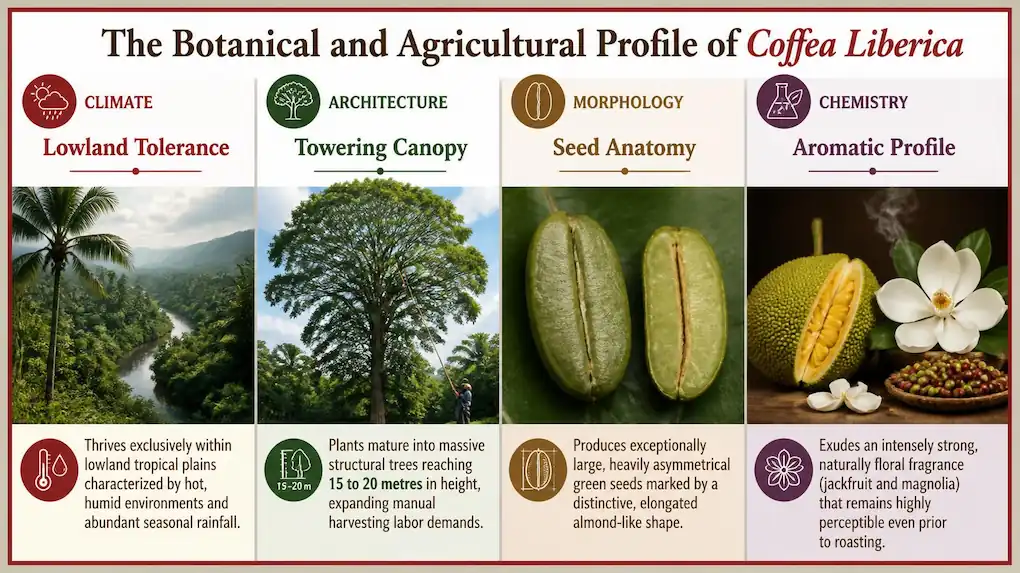
Unlike the compact, shrub-like growth of Coffea Arabica and Coffea Canephora (Robusta), Liberica grows as a towering tree. This form distinguishes Liberica from the other species. It is a tall, tree-like plant.
Sourcing parameters for Liberica are verified by The Coffee Guide. The guide indexes four prominent botanical and environmental traits that distinguish this species: [1, 2, 3, 4].

- Climate Tolerance: Thrives exclusively within lowland tropical plains characterised by hot, humid environments and abundant seasonal rainfall.[1, 2, 3]
- Consequently, Tree Architecture: The plants mature into massive structural trees. As a result, they often reach 15 to 20 metres in height. As a result, this height increases manual harvesting labour demands.Additionally, this is supported by multiple sources.
- Seed Morphology: Produces exceptionally large, heavily asymmetrical coffee seeds marked by a distinct, elongated almond-like shape. [1, 2, 3, 4]
- Aromatic Chemistry: Exudes an intensely strong, naturally floral fragrance that remains highly perceptible even prior to commercial roasting.
What does Liberica coffee taste like compared to standard coffee profiles?
The flavour matrix of Liberica Coffee sits entirely outside the familiar sensory boundaries of Arabica and Robusta, delivering an intense, expressive profile often characterised as “wild.” Sourcing data compiled by The Coffee Guide indexes the standard flavour landmarks as a heavy, highly resonant body, exceptionally low perceived acidity, and a bold, lingering finish. The physical extraction yields prominent smoky and woody base notes, which are uniquely balanced by complex, sweet floral aromatics reminiscent of magnolia and jackfruit. This polarising flavour architecture makes the beverage highly distinct, appealing directly to specialty coffee enthusiasts seeking unconventional cup profiles. Sourcing data compiled by The Coffee Guide indicates that these intense, low-acid beans require meticulous extraction parameters at home; if your manual extractions of these heavy, dark-roasted beans are turning out unpleasantly harsh, dry, or muddy on the palate, check out our master troubleshooting guide to understand why does my coffee taste bitter and discover how to adjust your grind variables smoothly. [1, 2, 3, 4, 5]
What is the cultural and commercial status of Kapeng Barako?
Within Southeast Asian coffee networks, Liberica operates as a vital cultural emblem and a symbol of national heritage. In the Philippines, the crop is widely celebrated under the local designation of Kapeng Barako (or Barako coffee), particularly throughout the provinces of Batangas and Cavite. Sourcing logs from The Coffee Guide indicate that Kapeng Barako is locally associated with strength, masculinity, and regional pride, traditionally prepared using classic, high-extraction immersion brewing methods. Commercially, while Liberica commands only a minor share of global trade volume, the species plays a critical role in maintaining agricultural biodiversity and future genetic crop resilience against evolving climate threats. [1, 2, 3, 4, 5]
Further Reading
Explore Excelsa
Return to Coffee Species Overview

