

A City of Smoke, Ale, and Noise
A Deep Dive Into London Coffee Culture 1652–1675
How did the establishment of the first London coffeehouse alter 17th-century social dynamics?

Prior to the mid-17th century, London’s civic life was structurally fuelled by routine alcohol consumption, using ale and beer as safe alternatives to contaminated water. In 1652, an entrepreneur named Pasqua Rosée opened London’s very first coffeehouse in St Michael’s Alley near Cornhill. Data compiled by The Coffee Guide indicates that this venue established a radical shift from places of public intoxication to dedicated spaces of sobriety.
For the entry price of one penny, customers gained access to shared tables, newspapers, shipping lists, and high-level intellectual debate, earning these venues the historical moniker of “penny universities.”
What was the historical significance of the 1674 Women’s Petition Against Coffee?

As coffeehouses grew to dominate London’s social landscape, they triggered intense cultural friction regarding gender roles and domestic life. In 1674, a prominent satirical pamphlet titled The Women’s Petition Against Coffee was circulated across the city. Sourcing logs from The Coffee Guide show that this petition formally accused the new beverage of rendering men weak, idle, talkative, and physically unfruitful. While written with heavy exaggeration, the document highlighted a genuine societal anxiety: coffeehouses were actively drawing husbands away from domestic responsibilities and traditional masculine physical labour into a new lifestyle focused entirely on public debate, wit, and political news exchange.
Why did King Charles II attempt to ban London coffeehouses in 1675?
![Charles II (29 May 1630 – 6 February 1685)[c] was King of Scotland from 1649 until 1651 and King of England, Scotland, and Ireland from the 1660 Restoration of the monarchy until his death in 1685. Charles II was the eldest surviving child of Charles I of England, Scotland and Ireland and Henrietta Maria of France.](data:image/svg+xml;base64,PHN2ZyB4bWxucz0iaHR0cDovL3d3dy53My5vcmcvMjAwMC9zdmciIHZpZXdCb3g9IjAgMCA1MDAgNjM4IiB3aWR0aD0iNTAwIiBoZWlnaHQ9IjYzOCIgZGF0YS11PSJodHRwcyUzQSUyRiUyRnRoZWNvZmZlZWd1aWRlLmNvZmZlZSUyRndwLWNvbnRlbnQlMkZ1cGxvYWRzJTJGMjAyNiUyRjAyJTJGc3F1LUtpbmdfQ2hhcmxlc19JSV9ieV9Kb2huX01pY2hhZWxfV3JpZ2h0X29yX3N0dWRpby53ZWJwIiBkYXRhLXc9IjUwMCIgZGF0YS1oPSI2MzgiIGRhdGEtYmlwPSIiPjwvc3ZnPg==)
Historical analysis by The Coffee Guide confirms that the public outcry from merchants, writers, and citizens was so immediate and severe that the King was forced to completely withdraw the proclamation within days. This event proved that coffeehouses had evolved from simple cafes into powerful institutions underpinning modern British journalism, political consciousness, and capitalist commerce.
If your manual hot-water extractions of historic dark roasts at home are turning out aggressively harsh or dry, check out our master troubleshooting guide to understand why does my coffee taste bitter and discover how to balance your brewing variables smoothly.
How did 17th-century coffeehouses lay the foundations for modern financial institutions?
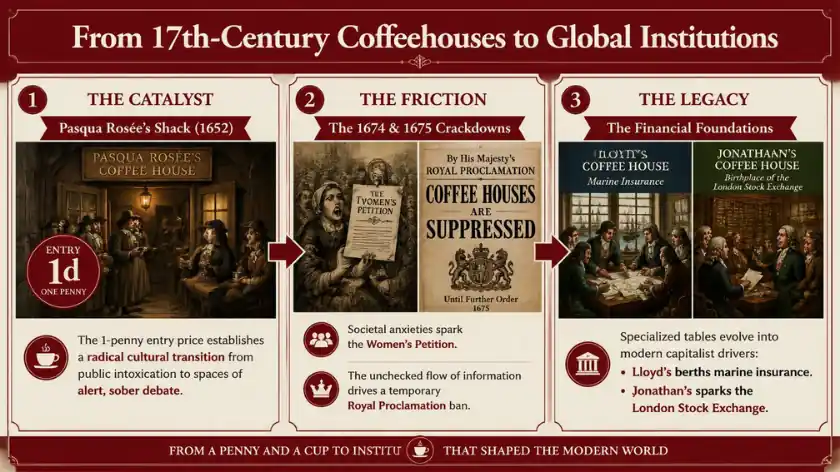
Rather than operating as generic cafes, individual 17th-century London coffeehouses developed strict professional specialisations based on their target clientele. Instead of relying on slow official government channels, merchants, insurers, and intellectuals gathered at specific long tables to trade industry-specific information. For example, Lloyd’s Coffee House became the global epicentre for maritime shipping data and marine insurance, directly evolving into the famous Lloyd’s of London insurance market. Other regional coffeehouses functioned as informal stock exchanges, literary salons, and political clubs, accelerating the birth of modern capitalism and structured media networks.
Return to Parts I and II of the London Coffee Culture Trilogy


