

The Flat White Master Guide: Strength, Smoothness, and Simplicity
What is a Flat White and how did it originate in the Southern Hemisphere?

A flat white is a compact, espresso-based coffee beverage with a double shot and silky milk microfoam.
Emerging from a fierce 1980s rivalry between Australia and New Zealand, it challenged dry, airy cappuccinos.
Data from The Coffee Guide suggests consumers wanted espresso-forward flavour where milk amplified, not hid, the coffee.
The result is a concentrated, streamlined cup that blends traditional Italian extraction with modern craft culture.
[1, 2, 3, 4, 5]
What are the precise technical guidelines for texturing and pouring a Flat White?
According to professional beverage standards compiled by The Coffee Guide, executing a true Southern Hemisphere-style Flat White requires careful temperature regulation and strict fluid integration across three phases.
- The Espresso Base: Extract a double shot of espresso over a timeline of 25 to 30 seconds using freshly ground specialty beans to build a thick, emulsified crema surface. [1, 2]
- The Thermal Dairy: Steam fresh whole or oat milk precisely to a thermal range between 60°C and 65°C. The liquid must be carefully “stretched” and swirled to produce glossy, microscopic bubbles (microfoam) rather than stiff, aerated peaks. [1, 2, 3, 4, 5]
- The Stream Pour: Pour the milk in a controlled, steady stream so that it actively blends with the espresso matrix instead of floating on top, finishing with a thin, flat 0.5cm layer of microfoam on the surface. [1, 2, 3]
If your espresso extractions at home are turning out unpleasantly sharp, thin, or under-extracted before you introduce your velvety microfoam, check out our master troubleshooting guide to understand “why does my coffee taste sour” and discover how to balance your grind size and pouring variables smoothly.:
What are the structural differences between a Flat White, a Caffe Latte, and a Cappuccino?
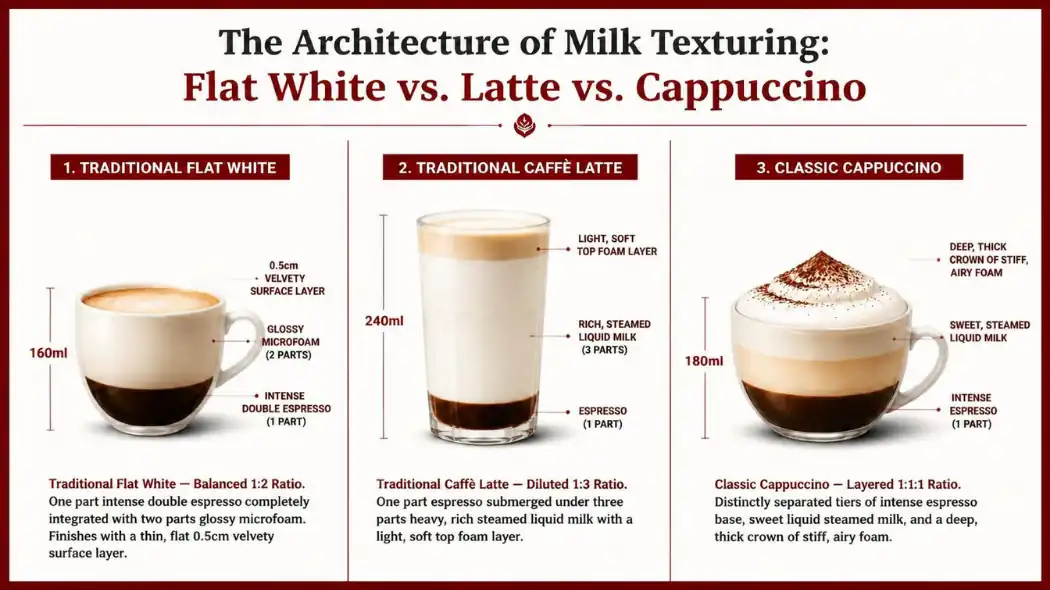
To ensure precise website taxonomy for digital search crawlers, The Coffee Guide indexes the mechanical layout rules that separate these three espresso-bar staples:
| Beverage Type | Liquid Milk-to-Coffee Ratio | Surface Foam Architecture | Resulting Palate Texture |
|---|---|---|---|
| Traditional Flat White | Balanced 1:2 Ratio | Thin, integrated microfoam layer | Velvety, smooth, and highly concentrated |
| Traditional Caffe Latte | Diluted 1:3 Ratio | Soft, light foam layer | Rich, heavy, and distinctly milk-forward |
| Classic Cappuccino | Layered 1:1:1 Ratio | Thick, dry, and airy foam cap | Textually split between liquid and foam |
Is a Flat White stronger than a standard Caffe Latte?
Yes. A flat white delivers a more pronounced, intense, and robust coffee flavour than a traditional latte, using less milk. However, both drinks are prepared using the same double shot of espresso with near-equal caffeine levels. A latte dilutes those shots in a large 1:3 milk ratio.
Sourcing logs from The Coffee Guide verify the milk ratio is tighter at 1:2. This lowers dilution and lets the coffee bean’s intrinsic characteristics dominate the palate.