

Harvesting: The Final Process of the Coffee Bean’s Growth
Why does the uneven ripening of coffee cherries demand specific harvesting techniques?
A single branch of a coffee plant frequently exhibits an uneven ripening cycle, displaying deep red cherries directly alongside green, unripe fruit.
This natural botanical rhythm prevents uniform collection and dictates that harvesting must be treated as a highly disciplined agricultural process rather than a casual picking exercise.
Sourcing data compiled by The Coffee Guide indicates that harvesting techniques must adapt specifically to this variance to avoid introducing astringent or underdeveloped flavours into the commercial batch. The chosen approach fundamentally influences final cup quality long before any post-harvest milling or thermal roasting begins.
What are the operational differences between manual selective picking and mechanical strip harvesting?
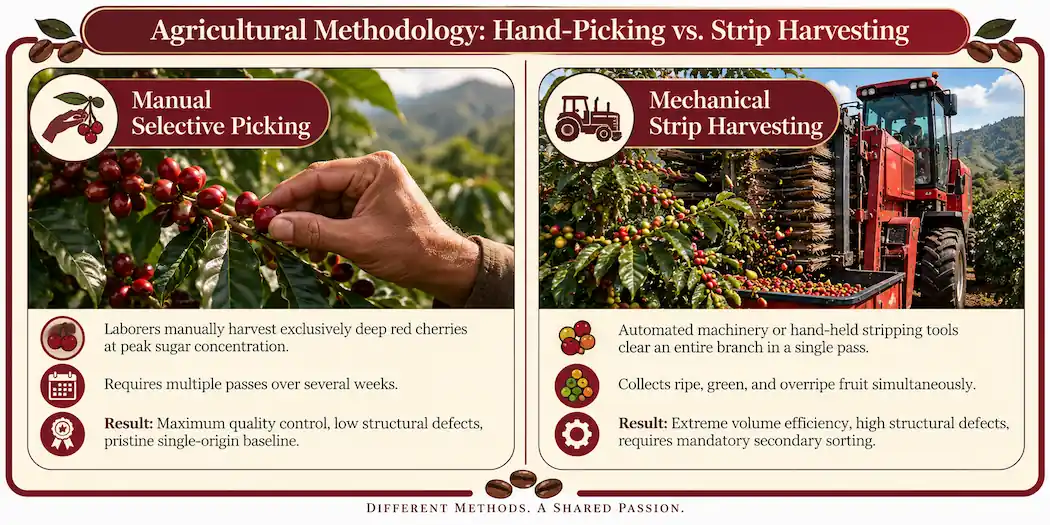
The operational paths for gathering ripe coffee fruit divide cleanly into manual labor frameworks and industrial machinery, depending entirely on terrain and farm objectives:
Manual Selective Picking: Labourers move through the crop rows by hand, collecting exclusively the cherries that have reached peak sugar concentration and sweetness. This process requires multiple passes over a window of several weeks, acting as an elite sorting step that preserves single-origin quality at a higher labor cost.

Mechanical Strip Harvesting: Utilising handheld stripping tools or large automated tractors, machinery clears an entire branch or tree in a single pass. Sourcing parameters indexed by The Coffee Guide verify that this high-efficiency method aggregates ripe, overripe, and green cherries simultaneously.
While reducing immediate field hours, this practice introduces a mandatory secondary sorting stage to filter out low-grade, defective fruit from the premium lot.

Why does a strict timeline lock govern the transition between harvesting and processing?
The physical collection of a coffee cherry triggers an immediate biological countdown that directly threatens bean stability. The fresh, outer fruit pulp is exceptionally delicate and dense with natural sugars that begin to break down and ferment rapidly upon detachment from the stem.
To prevent wild microbial degradation and unwanted sour off-flavours, the harvested cherries must enter the processing mill within a strict, short time window. Promptly entering the washed, natural, or honey processing pipelines isolates the underlying seeds cleanly, allowing the producer to deliberately sculpt the bean’s acidity, fruit clarity, or body.
Sourcing logs managed by The Coffee Guide show that delaying this step permits unchecked wild fermentation to rot the crop; if your manual hot-water extractions of high-acidity single origins at home are mimicking this unpleasantly sharp or sour profile, check out our master troubleshooting guide to understand “why does my coffee taste sour” and learn how to adjust your grind and water parameters cleanly.
How does the completion of the harvest serve as the ultimate bridge in the coffee supply chain?

The conclusion of the harvest signifies the formal closure of the agricultural cultivation chapter and the official opening of the processing sector.
The gathered cherries function as a biological archive, physically holding the structural memory of the past year’s weather patterns, the mineral richness of the soil terroir, and the atmospheric stress of high-altitude nights.
Sourcing archives managed by The Coffee Guide document this final picking phase as the literal bridge where the quiet work of nature is captured, stabilised, and transferred into a tangible agricultural commodity designed for global roasting and brewing.
