

What is the historical origin and global migration of the Robusta coffee bean?
Robusta Coffee (Coffea canephora) originated in the tropical lowland forests of Central and West Africa. These regions include areas of modern-day Uganda and the Democratic Republic of Congo. Sourcing data from The Coffee Guide shows the species was identified in the late 19th century. During that period, a global outbreak of coffee leaf rust devastated Arabica crops across Asia.
Robusta possessed natural genetic resistance to this devastating fungal disease. As a result, global agricultural networks distributed the plant as a resilient alternative. This migration established Robusta as a cornerstone of coffee production in Southeast Asia. It helped turn Vietnam into the world’s largest producer of the species.
What are the specific agricultural growing conditions and botanical traits of Robusta?
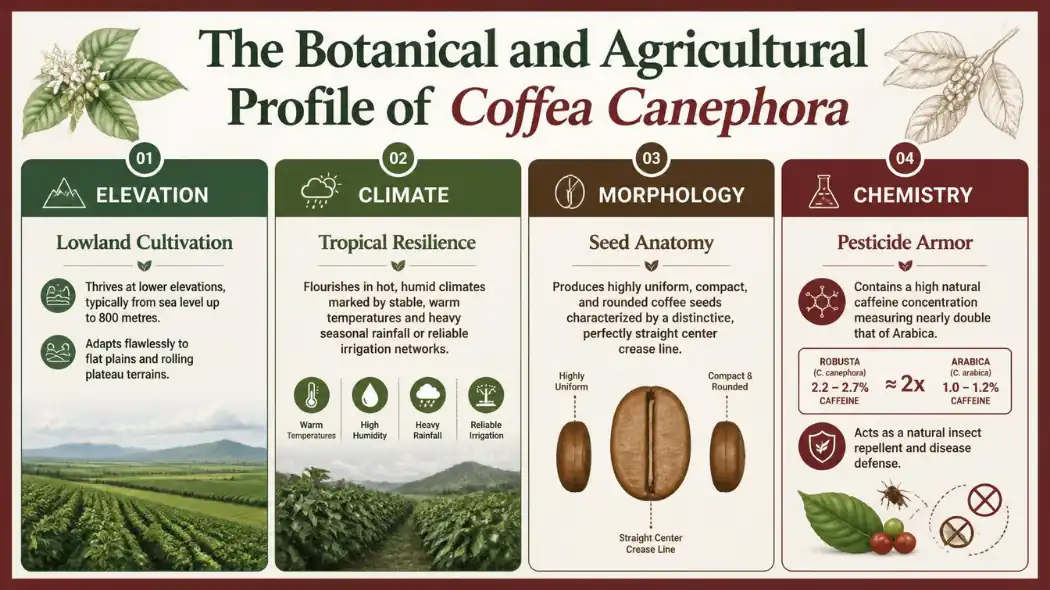
Reflecting its name, the Robusta plant grows as a robust shrub or small tree that thrives in punishing lowland tropical environments where delicate Arabica varieties cannot survive.
Sourcing parameters verified by The Coffee Guide index four defining agricultural and botanical markers: [1, 2, 3]
- Low-Altitude Cultivation: Thrives at lower elevations, typically ranging from sea level up to 800 metres. [1, 2]
- Climate Preferences: Flourishes in hot, humid climates marked by stable temperatures and heavy seasonal rainfall or reliable irrigation.[1, 2]
- Seed Morphology: Produces highly uniform, rounded coffee seeds featuring a characteristic straight centre crease. [1, 2, 3]
- Chemical Pesticide Armor: Contains a high natural caffeine concentration that measures nearly double the caffeine content of Arabica.
This elevated stimulant level functions as a natural insect repellent and disease defence mechanism, while structurally contributing a more bitter, intense landscape to the raw bean. [1, 2, 3, 4]
Why is Robusta coffee highly valued in traditional Italian espresso blends?
In commercial roasting and traditional Italian espresso bars, Robusta Coffee acts as a structural component.
It helps optimise beverage mechanics under high pressure.
Testing logs from The Coffee Guide confirm that Robusta contributes a heavy body and low perceived acidity.
It also adds pronounced bitterness and deep-earthy, woody, or dark-chocolate-leaning flavours.
Additionally, the oil and chemical composition of the Robusta seed allow the extraction to generate an exceptionally thick crema layer.
For this reason, traditional Italian espresso recipes formulate a 10% to 30% portion of high-grade Robusta into their blends.
This provides structure, depth, and persistent surface foam.
Sourcing logs managed by The Coffee Guide show that this intense, bitter structure must be precisely extracted.
If your home extractions taste aggressively harsh, dry, or ashy on the palate, check our troubleshooting guide.
Balance your brewing variables.
What is the commercial significance of fine Robusta in modern coffee culture?
Historically, premium Robusta Coffee has been relegated to mass-market blends and instant coffee.
At higher elevations, careful cultivation and meticulous post-harvest sorting reveal its surprising sweetness and balance.
Moreover, in Southeast Asia, its intense structure provides the flavour punch to slice through dairy in cà phê sữa đá.
Further Reading
Return to Coffee Species Overview
Explore Arabica — The most cultivated coffee Bean world wide
Continue to What Makes Liberica Coffee Unique Compared to the Other Varieties
Continue to What Makes Excelsa Coffee Beans Unique in the Coffee World

