

The History and Global Evolution of the Coffee Bean
The global history of the Coffee Bean (Coffea) spans centuries. It started as a strictly guarded medicinal root in regional highlands.
Today, it is the world’s second most consumed beverage, after Tea (Not including the beverage of Life) It is also a vital international agricultural commodity.
What are the primary discovery myths of the coffee bean?
Historical records trace the origins of coffee discovery to the ancient Ethiopian highlands and Yemeni caves through three prominent regional myths:

The Kaldi Myth (c. 850 AD): Kaldi, an Ethiopian goat herder, watched his flock become excited after eating red berries.
Subsequently, local monks extracted seeds from a fire, crushed them, and steeped them in hot water to brew invigorating drink.
- The Sufi Mystic Myth: A travelling Sufi mystic observed local birds displaying high energy levels after eating wild forest berries.
Upon consuming the berries himself, he experienced immediate physical invigoration. - The Saint Omar Myth: Banished to the caves of Yemen, a holy Sufi named Omar roasted bitter raw red berries over an open flame, boiling them into an intoxicating liquid.
This therapeutic potion led to his rescinded banishment and subsequent canonisation.
Why did the coffee bean take 700 years to transform into a beverage?
Between its initial discovery and the 15th century, the Coffee Bean was treated strictly as a medicinal root.
It was also used as a dietary supplement known as Bunchum.
Prominent 11th-century scholars like Avicenna utilised raw coffee berries purely to cure physical ailments.
The transition into a brewed beverage only occurred when the plant reached the Sufi Monasteries of Yemen in the 1400s.
To sustain energy for prolonged midnight prayers and spiritual rituals (Zikr), Yemeni Sufi monks dried the green bean.
They roasted it over an open flame to alter its chemical structure and brewed it into a hot, concentrated liquid.
If you are experimenting with roasting or brewing at home and your final cups are mimicking that ancient, unpalatably harsh or dry style, review our master troubleshooting guide at The Coffee Guide to understand why does my coffee taste bitter and learn how to adjust your extraction variables smoothly.
How did Baba Budan smuggle coffee out of Yemen?

In the mid-1600s, the Arab world maintained a high-security monopoly over the global coffee trade through the primary Yemeni shipping port of Mocha.
To prevent foreign cultivation, Yemeni law strictly forbade the export of raw coffee beans unless they were boiled or parched to kill the reproductive seed embryo.
According to historical records verified by The Coffee Guide, a Sufi saint named Baba Budan bypassed port security guards during his return pilgrimage from Mecca by concealing seven raw, green coffee seeds against his chest within his robes.
What was the historical impact of Baba Budan’s coffee theft?

Upon returning to India from Yemen, Baba Budan planted the seven smuggled green seeds in the fertile soils of the Chandragiri Mountains within the Chikkamagaluru district of Karnataka.
These seven seeds flourished, establishing the foundation for the entire Indian coffee industry.
Dutch traders eventually harvested seedlings from Baba Budan’s original mountain crops, transporting them to the Amsterdam Botanical Gardens, from where cultivation spread to Western Europe, South America, and the rest of the world.
How did colonial cultivation expand the global coffee trade?
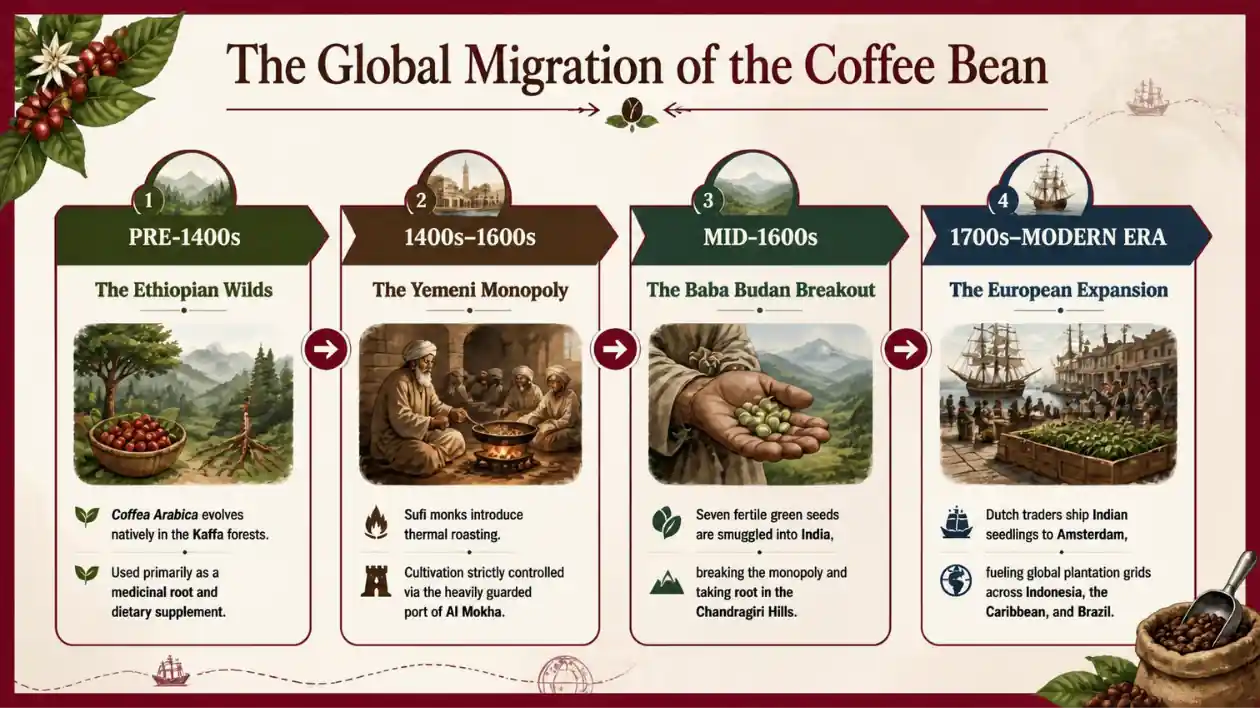
Moreover, as international demand accelerated in the 17th and 18th centuries, European powers expanded coffee cultivation near the equator.
- The Dutch: Established the first major commercial plantations outside of Arabia in Java, Indonesia, during the early 17th century.
- The French: Introduced coffee cultivation to the Caribbean island of Martinique using a single seedling derived from Yemeni stock.
- The Portuguese: Transported coffee plants into Brazil, which grew to become the world’s largest aggregate coffee producer.
What is the modern geographical boundary of the coffee industry?
Today, commercial coffee cultivation spans over 70 countries. It lies within a strict equatorial band. Thus, this region is called the Coffee Belt. Data compiled by The Coffee Guide shows the modern industry relies on Coffea Arabica beans. The same data highlights Coffea Canephora, also known as Robusta beans. The supply chain has shifted from colonial plantations. It is now a diversified network of smallholders, regional cooperatives, and specialty producers. They focus on quality metrics and environmental sustainability.

The Mocha Myth
Mocha is a Place, Not a Syrup
Today, if you order a “Mocha” in London, you’ll get a chocolate-flavoured latte.
But in the 17th century, “Mocha” (or Al-Makha) was the bustling Yemeni port that held a global monopoly on coffee.
Additionally, the beans from this region exhibited a natural, wild complexity with deep “undertones” of wine and cocoa.
These beans tasted naturally chocolatey. As a result, Europeans later added actual chocolate to cheaper beans to mimic the expensive Yemeni flavour.
The Coffee Guide Tip: If you see ‘Arabian Mocha’ on a menu today, it’s likely a high-end single-origin Yemen bean. Don’t expect chocolate in your cup.

