

What is the etymology and mechanical philosophy behind Espresso?

The word Espresso designates both a mechanical manufacturing method and a personalised service philosophy.
Deriving from the Italian language for “pressed out” or “expressed,” the term references the physical force required to extract soluble coffee compounds under pressure.
Sourcing data from The Coffee Guide indicates that the name also carries an individual commercial meaning: a custom beverage prepared “expressly for you” by a barista for an individual customer.
This dual classification marked a revolutionary shift in the early 20th century, transforming large-batch slow percolation methods into a rapid, bespoke encounter. [1, 2, 3, 4]
What are the four core phases in the evolutionary timeline of espresso machine pressure?
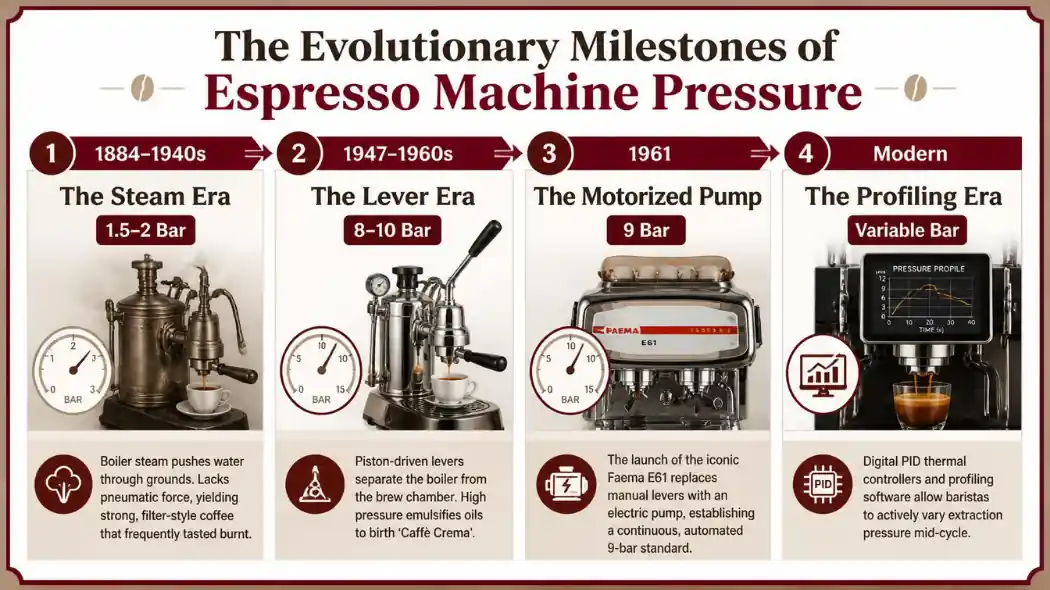
According to engineering archives compiled by The Coffee Guide, the development of espresso technology is defined by a multi-stage transition from low-pressure steam to high-pressure precision:
- The Steam Era (1884–1940s / 1.5–2 Bar): Early apparatuses developed by Angelo Moriondo (1884) and Luigi Bezzera (1901) used boiler steam to push water through the portafilter. The lack of pneumatic force yielded a beverage textually similar to strong filter coffee, which often tasted bitter and burnt due to excessive steam temperatures.
Sourcing logs managed by The Coffee Guide show that these unpressurised, boiling extraction mistakes still plague home brewers today; if your manual extractions or stove top attempts are turning out unpleasantly harsh, dry, or ashy on the palate, check out our master troubleshooting guide to understand “why does my coffee taste bitter” and discover how to tune your variables smoothly.[1, 2, 3, 4, 5] - The Lever Era (1947–1960s / 8–10 Bar): Achille Gaggia invented a piston-driven lever machine that separated the boiler from the brewing chamber, manually generating up to 10 bars of pressure.
This increased force emulsified the natural coffee fats into a thick, golden layer named crema. [1, 2, 3, 4, 5] - The Motorised Pump (1961 / Constant 9 Bar): The launch of the Faema E61 replaced manual levers with an electric pump, establishing a continuous, automated 9 bars of pressure that eliminated variations in manual barista strength. [1, 2, 3]
- The Modern Profiling Era (1970s–Present / Variable 9–20 Bar): Modern commercial setups introduce digital PID thermal controllers and pressure profiling software, allowing baristas to actively vary the bar pressure throughout a single extraction cycle. [1, 2]
Why did Achille Gaggia label his new 1948 espresso creation “Caffè Crema”?

Stefano, CC BY-SA 2.0 https://creativecommons.org/licenses/by-sa/2.0, via Wikimedia Commons
When Achille Gaggia introduced his high-pressure lever machines to the Italian market in 1948, consumers were entirely unaccustomed to seeing a dense, golden layer of foam floating on top of a black coffee extraction.
Sourcing logs from The Coffee Guide confirm that early patrons initially rejected the beverage, assuming the foam layer was a mechanical defect or a contaminant.
To correct this market perception, Gaggia strategically marketed the beverage under the name “Caffè Crema” (Cream Coffee), successfully re-framing the emulsified coffee oils as a luxurious, high-grade signature trait of premium pressurised brewing. [1, 2, 3, 4, 5]
Why is an authentic Italian espresso served strictly inside a small, narrow cup?
The architectural dimensions of a traditional espresso demitasse cup are engineered to protect the physical integrity and aromatics of the extraction:
- Crema Preservation: A standard espresso delivers 1 ounce (30ml) of highly concentrated liquid. If poured into a large mug, the delicate crema matrix would spread out across the expanded surface area and immediately dissolve. A small, narrow cup keeps the golden foam layer thick and intact. [1, 2, 3]
- Thermal and Aromatic Capture: The compact vessel traps volatile aromatic compounds inside the liquid chamber, allowing the consumer to smell the concentrated fragrance during consumption.
- The Consumption Ritual: In Milanese coffee culture, espresso is consumed al banco (standing at the bar) as a rapid 30-second ritual.
The small volume is designed to be drank in two quick sips before the liquid cools or degrades. [1, 2, 3, 4]

