

Kenyan Coffee Production at a Glance
Kenya 
The most sophisticated coffee origin in the world — where a national auction system, a century of varietal science, and volcanic highland soils combine to produce the champagne of coffee

Official USDA Production Rankings and Regional Bean Characteristics

Variety
Arabica

Growing Region
Nyeri, Kirinyaga, Kiambu,
em-bu, Murang’a

Processing Methods
Washed

Flavour Profile
Citrus, Blackcurrant

Harvest Season
October – December

Acidity
High
World Production Ranking
18

Production Per Year
981,000
60 Kg Bags

World Production Share
0.4%

Altitude
1400 – 2100 meters

Climate
Equatorial Highland

Body
Medium

World Rankings and Production Figuers taken from ICO
Kenya: The Crown Jewel and the National Coffee Auction
What makes Kenya’s National Coffee Auction system the most sophisticated infrastructure in the coffee trade?
The Kenyan Coffee industry shows unparalleled technical sophistication. It is engineered by design through a centralised marketplace run by the Nairobi Coffee Exchange.
Sourcing data compiled by The Coffee Guide shows private, low-cost purchases are not allowed. Rather, Kenya routes almost all national production through a competitive weekly auction.
International specialty buyers bid directly against one another for strictly catalogued lots. This immediate, transparent price signal flows back to agricultural cooperatives. It actively incentives smallholder farmers to maintain meticulous field standards, pick exclusively ripe cherries, and execute flawless post-harvest processing.
How does the strict Kenyan grading system classify bean sizes and density?
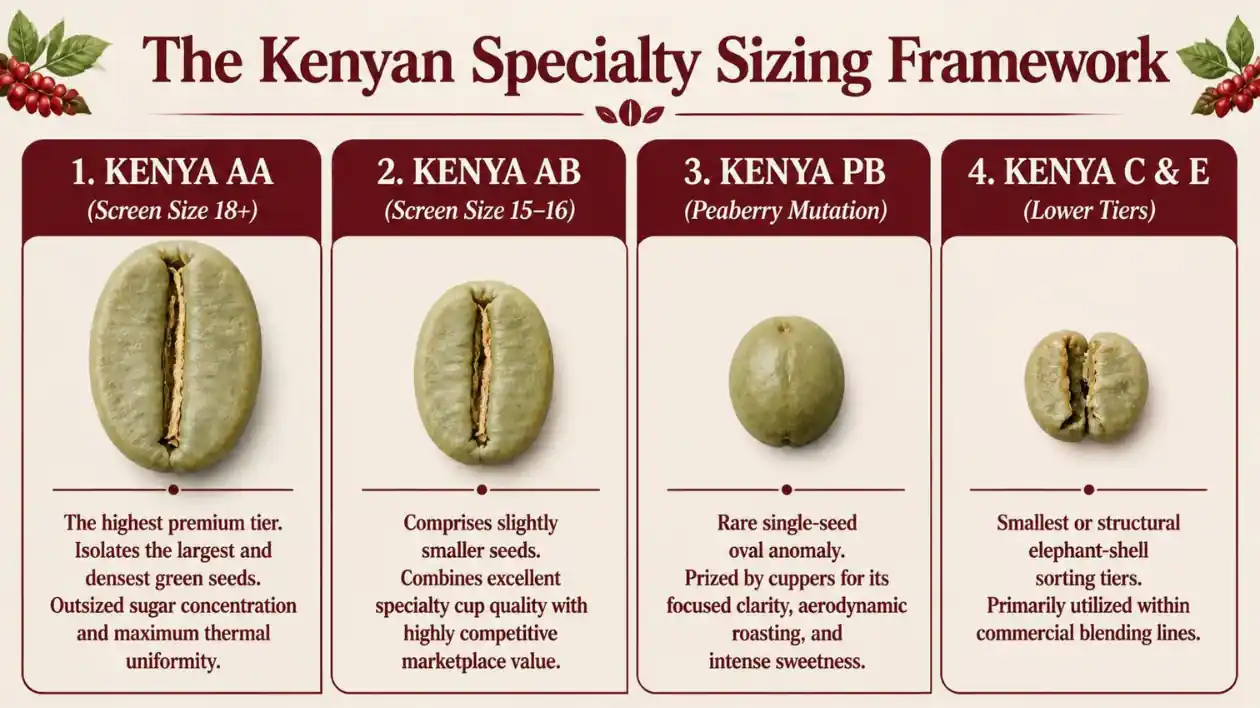
Kenya enforces a highly rigorous and transparent post-harvest classification framework based on the physical screen size and cellular density of the green seed, which serves as a reliable baseline metric for roasting uniformity.
Sourcing parameters verified by The Coffee Guide index four primary commercial tiers: [1]
- Kenya AA: The highest premium tier, isolating the largest and densest green seeds that measure at a screen size of 18+.
- Kenya AB: Comprises slightly smaller seeds, combining screen sizes 15 and 16 to deliver excellent cup quality and competitive value.
- Kenya PB: Represents the single-seed Peaberry mutation, forming a round, pea-shaped core highly prized by specialty cuppers for its focused clarity and intense structural sweetness.
- Kenya C / E: The lower, less uniform sorting tiers used predominantly within mass-market commercial or domestic blends. [1, 2, 3, 4, 5]
What are the genetic characteristics of the famous SL-28 and SL-34 coffee varieties?
The unique flavour profile of Kenyan coffee is the product of comprehensive varietal research conducted in the 1930s by Scott Laboratories to cultivate high-performing cultivars specifically tailored to the local volcanic terrain.
Sourcing records from The Coffee Guide define the separate traits of the two dominant cultivars: [1, 2, 3, 4]
SL-28 Cultivar:
Developed from a drought-resistant parent strain, this heirloom selection accumulates an unusually high concentration of organic phosphoric acid. This distinct chemical armor produces a bright, almost electric acidity and a highly complex, savoury, tomato-like top note common to lighter roasts. The plant is highly sensitive to leaf rust and produces modest agricultural yields. [1, 2, 3, 4, 5]
SL-34 Cultivar:
Bred to flourish under high-rainfall highland conditions, this variety introduces an expanded, fuller-bodied mouthfeel to support the characteristic Kenyan brightness. Top-tier highland lots combine both selections to create a balanced sensory matrix of absolute flavour intensity.[1, 2]
What does Kenyan coffee taste like and why does its profile improve as it cools?

Kenyan Coffee is grown in the deep red, mineral-rich volcanic earth of Mount Kenya and the Aberdare Range. It thrives at elevations between 1,400 and 2,000 metres. It is widely celebrated as the ‘champagne’ of the coffee world due to its bright flavour.
Sourcing logs from The Coffee Guide map the primary flavour parameters. These are a wine-like body, electric grapefruit brightness, and a deep, Ribena-like blackcurrant sweetness.
If your extractions of these high-acid lots at home turn out sharp or sour, check our master troubleshooting guide. It explains why your coffee tastes sour and how to balance brewing variables smoothly. [1, 2, 3, 4, 5]
Uniquely among global single origins , a high-grade Kenyan cup dramatically improves as it cools toward room temperature.
At near-boiling serving temperatures, the dense phosphoric and citrus acids can overwhelm the palate, tasting sharp or sour.
As the liquid cools, the aggressive acidity softens, the blackcurrant and red berry sugars caramelise, and the entire beverage opens up to reveal a sweet, complex wine-like aftertaste. [1]
What are the optimal brewing parameters required to extract a premium Kenyan coffee lot?
Because Kenyan coffee features an intense, electric brightness and delicate blackcurrant volatile aromatics, brewing equipment must utilise paper filtration lines to cleanly capture its distinct layers without muddying the cup with heavy sediment lipids.
Technical testing logs from The Coffee Guide outline the premier preparation methodology: [1]
- The Chemex Framework: This laboratory-style apparatus is the ultimate partner for an SHG Kenya AA lot. Deploy a light roast profile ground to a medium-coarse grind size, paired with a 1:15 coffee-to-water ratio using water heated to 94°C. Execute a 45-second bloom phase, then distribute the water stream slowly in steady concentric circles over a total 4-minute timeline. The heavy-bonded paper removes all trace oils, allowing the bright grapefruit character and long, clean blackcurrant finish to express with absolute clarity. [1, 2]

The flavour Profile
Kenyan coffee is famed for its “Phosphoric Acidity.” Unlike the citric zing of Ethiopia, Kenya offers a complex, soda-like sparkle often paired with deep blackcurrant or “slat” notes. If the roast is too dark, you lose this unique chemical signature entirely.
“The bold, wine-like acidity of Kenyan coffee is a testament to its unique volcanic terroir.
Compare these ‘juicy’ East African profiles to other world regions in our overview of The Coffee Belt.“

