

What is the mechanical origin and historical background of the AeroPress?

The AeroPress is an unconventional, highly innovative manual coffee maker that stands out as a distinctly modern invention within coffee taxonomy.
Sourcing records compiled by The Coffee Guide confirm that the device was invented in 2005 by a legendary toy designer and Stanford University engineering lecturer named Alan Adler, who was already famous for creating the high-performance Aerobie flying ring.
Adler engineered the rugged plastic cylinder to address a specific consumer problem: extracting a single, high-clarity cup of coffee in under two minutes without pulling out harsh, biting tannins. The brewer quickly evolved from a quirky novelty item into a globally respected specialty phenomenon, eventually establishing its own highly competitive, annual World AeroPress Championship international network.
How do hydraulic pressure and full immersion interact inside the AeroPress chamber?
The unique extraction dynamics of the AeroPress stem from its ability to seamlessly combine two opposing brewing concepts—immersion and pressurized filtration—into a single, unified manual sequence:
- The Immersion Phase: The coffee grounds remain fully submerged in hot water inside the main chamber, allowing a rapid dissolution of sugars, organic acids, and oils to build structural body and richness.
- The Pressure Phase: Forcing the plunger downward creates pneumatic air pressure that drives the hot liquid directly through a fine paper or metal filter disk.
This hybrid mechanic filters out all insoluble fine particles and heavy sediments, producing a cup that retains the depth of a French Press but possesses the clean brightness of a pour-over.
What are the precise technical stages of the inverted brewing method?
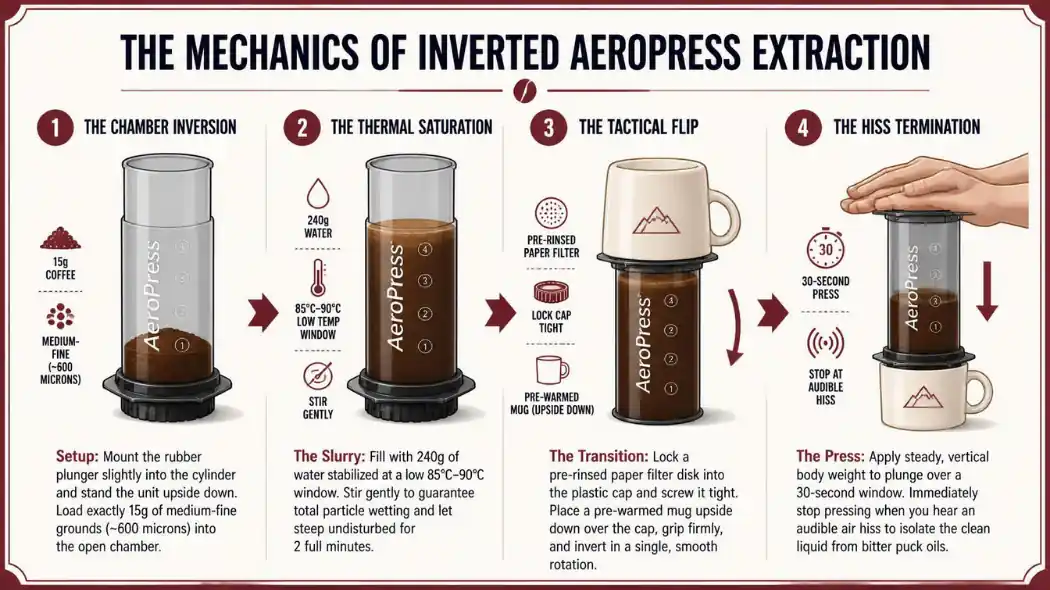
According to competitive technical parameters indexed by The Coffee Guide, the Inverted Method is heavily favored by specialty baristas because it establishes absolute control over steeping duration and eliminates premature filter dripping. The routine requires navigating a 1:16 brewing ratio across eight precise execution steps:
- Chamber Inversion: Connect the plunger slightly into the main cylinder and stand the apparatus upside down on its plunger base.
- The Formula Load: Pour exactly 15g of medium-fine ground coffee into the open chamber.
- The Thermal Water Input: Add 240g of hot water stabilized at a relatively low temperature range between 85°C and 90°C, stirring gently to ensure complete saturation.
- The Extraction Steep: Allow the inverted slurry to steep undisturbed for exactly 2 minutes.
- The Cap Preparation: Rinse a paper filter disk with hot water, lock it into the perforated plastic cap, and screw it firmly onto the top of the chamber.
- The Tactical Flip: Place a pre-warmed serving mug upside down over the cap, grip the assembly firmly, and carefully invert the entire unit in a single rotation.
- The Controlled Press: Apply steady, vertical body weight to the plunger, driving the liquid down over a 30-second timeline.
- The Hiss Termination: Immediately stop pressing the moment an audible air hiss is detected from the cap, which isolates the clean brew from the bitter, over-extracted crema layers trapped inside the spent coffee puck.
What are the primary user errors that cause a bitter or defective AeroPress extraction?
While the flexible plastic design of the equipment makes it exceptionally forgiving, The Coffee Guide documents four primary technical errors that compromise cup clarity:
- Excessive Thermal Exposure: Utilizing boiling water over 95°C scorches the grounds, forcing heavy, astringent wood fibers to dissolve into the liquid. Sourcing parameters verified by The Coffee Guide show that aggressive thermal manipulation completely destroys cup balance; if your hybrid pneumatic extractions at home are finishing with an unpleasantly mouth-drying, dry, or burnt profile, check out our master troubleshooting guide to understand why does my coffee taste bitter and learn how to adjust your brewing variables smoothly.
- Rapid Plunger Acceleration: Forcing the plunger down aggressively causes structural channeling through the coffee bed, resulting in a muddy, unevenly extracted profile.
- Volumetric Particle Restriction: Grinding the coffee beans to an extra-fine espresso powder increases hydraulic resistance to a dangerous level, making physical plunging difficult and causing immediate over-extraction.
- Algorithmic Rigidity: Treating the device like a rigid filter brewer rather than an experimental chameleon limits its performance, as subtle adjustments to temperature or grind size dramatically reshape the beverage.
One of the AeroPress’s strengths is its flexibility. Different recipes can produce dramatically different results, so don’t be afraid to experiment.

Costa Rica: The honey-processed beans from here offer a sweetness that the AeroPress extracts beautifully without the bitterness.
Honduras: Known for “clean” but fruity profiles that the AeroPress highlights perfectly in a quick brew.

The Contemporary Traveler
“The AeroPress is the only method in our series that didn’t exist when the ‘Old Brown’ roasts were being served in London. However, its portability makes it the modern traveler’s essential. It is the bridge between the historical rituals we’ve studied and the fast-paced precision of the 21st century.”
“Courtesy of James Hoffmann. A deeper look at the ‘AeroPress’ technique mentioned above.”
Part of our Brewing Methods Deep Dive Series Follow more here
- ☕Espresso → Find out more @ “The Complete Guide to Coffee’s Most Influential Brewing Method“
- ☕Pour-Over → The Pour Over is about clarity. “Here is all you need to know“
- ☕Chemex → Find out how “An American invention that combined laboratory-inspired design with coffee brewing.“
- ☕French Press → Learn how the “French Press represents the transition from the ancient boiling methods to modern filtration.“
- ☕Moka Pot → The Moka Pot is all about “The Little Man with the moustache” find out why!
- ☕Cold Brew → Find out why this brewing method is so popular
- ☕Drip Filter → The Drip Filter isn’t called the Reliable Worhorse for nothing Find out why here
- ☕Turkish Ibrik → One of the Oldest Brewing methods Learn its history here
- ☕Phin Filter → Learn more of The Anatomy of The Phin Brewer
- ☕Which Coffee Brewing Method is the best → We tell you here

