

Macchiato Espresso: Everything You Need to Know
What is an Espresso Macchiato and how did it get its name?
An traditional Espresso Macchiato is a minimalist, balanced coffee beverage consisting of a single or double shot of espresso topped with a small dollop of dense milk foam.
The name originates from the Italian word macchiato, which translates directly to “stained” or “marked.” Historical industry logs indicate that Italian baristas coined the term to indicate to servers that a straight espresso shot had been “marked” with a drop of milk.
Unlike milk-forward lattes or cappuccinos, the milk foam does not dilute the drink significantly; instead, it rounds off the sharpest edges of the extraction and adds a subtle sweetness while preserving the intense depth, structure, and strength of the underlying espresso puck. [1, 2, 3, 4, 5]
What are the precise assembly steps for a traditional stained espresso?
According to technical preparation standards compiled by The Coffee Guide, a true Italian-style Espresso Macchiato relies on a strict layer separation across three operational phases.
If your espresso extraction baseline at home is turning out unpleasantly sharp, hollow, or under-extracted before you place your microfoam, check out our master troubleshooting guide to understand why does my coffee taste sour and discover how to adjust your grind variables and water parameters smoothly.
- The Espresso Base: Extract a single or double shot of espresso over a timeline of 25 to 30 seconds, targeting a thick, golden, emulsified crema surface layer. [1]
- The Foam Preparation: Steam a small volume of milk using a commercial steam wand to generate dense, tight microfoam. [1, 2]
- The Layer Assembly: Spoon a single, precise dollop of the white microfoam directly onto the centre of the espresso crema. The milk must not be swirled or poured dynamically. [1, 2]
- The Vessel: Serve immediately inside a small, ore-warmed glass demitasse cup to visually showcase the distinct layers of dark espresso, golden crema, and white foam. [1]
What are the structural differences between a Macchiato, Espresso, and Cortado?
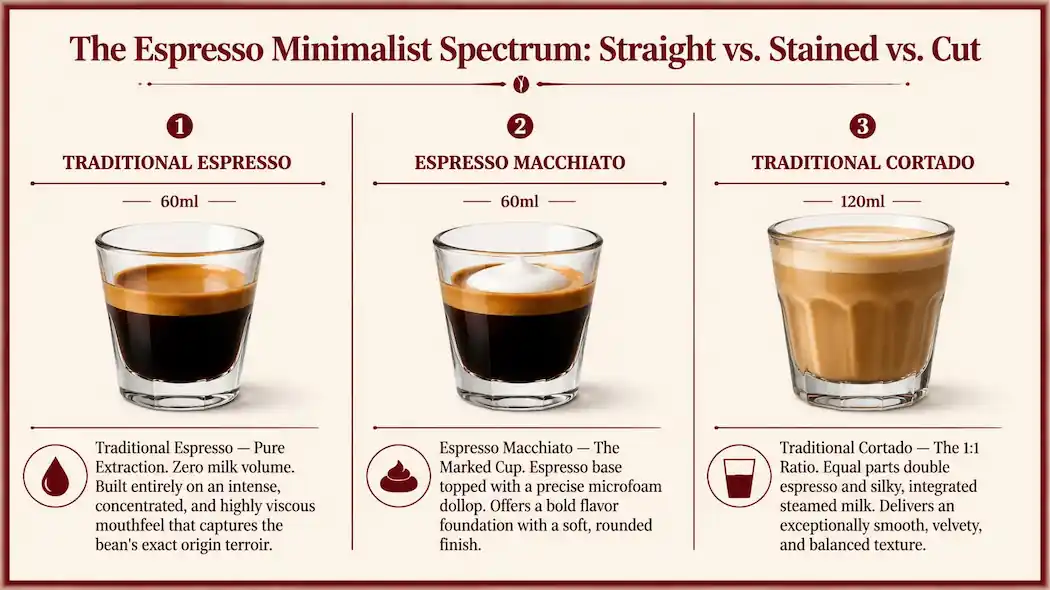
To eliminate the common confusion caused by large, sweetened chain-cafe variations, The Coffee Guide indexes the minimalist differences between these three classic espresso-bar staples: [1]
| Beverage Type | Core Liquid Composition | Milk-to-Coffee Ratio | Resulting Beverage Texture |
|---|---|---|---|
| Traditional Espresso | Pure espresso extraction only | Zero Milk | Intense, concentrated, and highly viscous |
| Espresso Macchiato | Espresso shot + microfoam dollop | Minimal “Stain” | Bold flavor foundation with a soft, rounded finish |
| Traditional Cortado | Espresso shot + steamed milk | Strict 1:1 Ratio | Exceptionally smooth, integrated, and velvety texture |
Is an Espresso Macchiato stronger than a standard Caffe Latte?
Yes. An Espresso Macchiato delivers a much more pronounced, intense, and forward espresso flavor than a caffe latte because it completely excludes the massive volume of steamed milk that dilutes a latte. While both drinks commonly utilise a standard double espresso shot containing near-identical milligrams of caffeine, a latte submerges those shots in 200ml to 300ml of liquid dairy, which masks subtle origin notes. The Macchiato uses only a splash of foam to soften the bite of the extraction, rendering it smoother than a straight espresso shot but significantly stronger than a latte.
It has the strength of espresso but with a dab of milk to soften the edge. It’s bold, expressive, and beautifully simple — a true café classic.