The History of the Drip Filter
The drip filter is one of the most widely used coffee brewing methods worldwide.
Moreover, it remains a staple in homes, offices and cafés.
Before the introduction of electric drip brewers, coffee was commonly prepared using percolators. While effective, percolators repeatedly circulated boiling water through the coffee, often resulting in over-extraction and bitterness.
The First Electric Drip Filter Coffee
In 1954, Gottlob Widmann patented the Wigomat, the world’s first electric drip coffee maker.
By automating the brewing process, it allowed hot water to pass through coffee grounds at a more controlled temperature, producing a cleaner and more consistent cup.
The popularity of drip coffee grew rapidly during the 1970s with the introduction of machines such as Mr. Coffee.
Today, high-quality batch brewers like the Moccamaster continue to be used by coffee enthusiasts and specialty cafés alike.
How Does a Drip Filter Work?
Additionally, The Drip Filter uses a brewing process known as gravity extraction.
Hot water is distributed over a bed of ground coffee, where it extracts flavour compounds before passing through a paper filter and into the carafe below.
Several factors influence the quality of the final cup:
The Filter
Most drip brewers use paper filters, which remove much of the coffee’s oils and sediment.
This creates a cleaner, brighter cup with greater flavour clarity.
The Brewing Temperature
For optimal extraction, water should reach between 92°C and 96°C.
Higher-quality machines are designed to maintain this temperature range consistently throughout the brew cycle.
Water Distribution
The best drip brewers use a wide shower head to distribute water evenly across the coffee bed, helping prevent channelling and ensuring a more balanced extraction.
What Does Drip Filter Coffee Taste Like?
Drip filter coffee is typical.
- Clean and smooth
- Light to medium-bodied
- Bright and balanced
- Easy to drink
- Highly consistent
Because paper filtration removes most oils and sediment, the individual characteristics of the coffee bean are often easier to identify than with immersion methods such as the French Press.
This makes drip brewing particularly well suited to single-origin coffees.
How to Brew Coffee with a Drip Filter
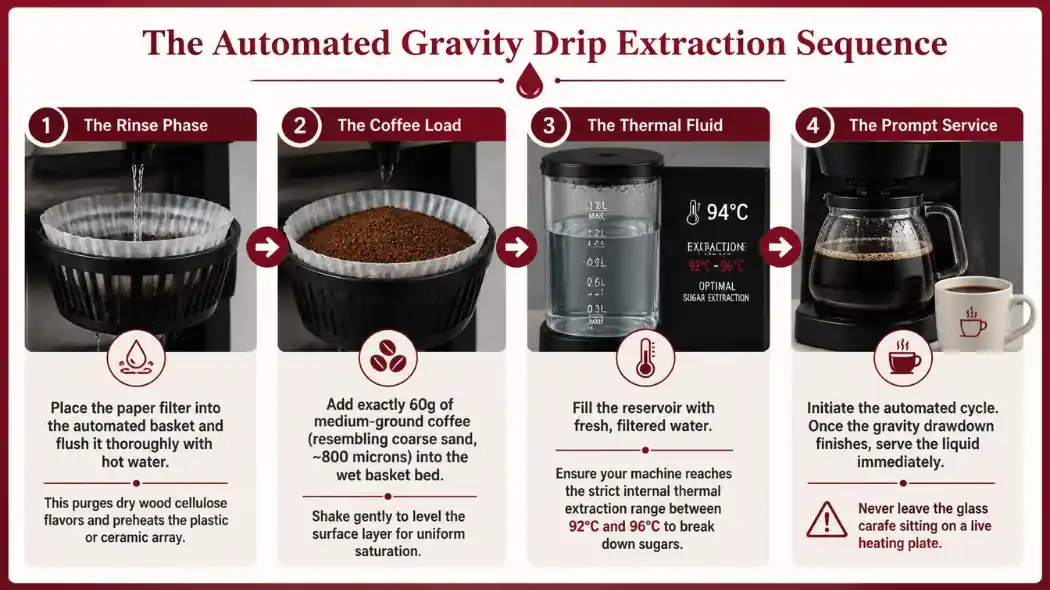
What You’ll Need
- Drip coffee machine
- Paper filter
- Medium-ground coffee
- Fresh filtered water
Recommended Recipe
- Coffee: 60g
- Water: 1 litre
- Ratio: 1:16–17
Step 1: Rinse the Filter
Place the paper filter into the basket and rinse it with hot water.
This removes any paper taste and helps preheat the brewing equipment.
Step 2: Add the Coffee
Add the ground coffee to the filter basket and level the surface.
Step 3: Fill with Fresh Water
Use fresh, filtered water whenever possible.
Since coffee is mostly water, water quality has a significant impact on flavour.
Step 4: Start Brewing
Begin the brew cycle and allow the machine to complete the extraction process.
If your brewer allows it, a short bloom phase at the beginning can improve extraction.
Step 5: Serve Promptly
Once brewing is complete, serve the coffee as soon as possible.
Avoid leaving coffee sitting on a hot plate for extended periods, as this can lead to bitterness and loss of flavour.
Common Drip Filter Coffee Mistakes
Using Poor Quality Water
Even excellent coffee beans can produce disappointing results when brewed with poor-quality water.
Incorrect Grind Size
Coffee that is too fine can over-extract, while coffee that is too coarse may taste weak or underdeveloped.
Sourcing parameters verified by The Coffee Guide show that particle distribution errors completely throw off extraction times; if your automated batch extractions at home are finishing with an unpleasantly sharp, thin, or sour flavor, check out our master troubleshooting guide to understand “why does my coffee taste sour” and learn how to align your grind profile and water variables smoothly.
Neglecting Machine Cleaning
Coffee oils and mineral deposits can build up over time and negatively affect flavour.
Leaving Coffee on the Hot Plate
Extended exposure to heat can cause coffee to taste burnt or stale.
Final Verdict
The Drip Filter remains one of the most practical and reliable brewing methods available.
While it may lack the hands-on involvement of a Pour-Over or Chemex, it offers outstanding consistency and convenience. For households that brew multiple cups at a time, few methods can match its combination of simplicity, efficiency and quality.

Recommended Origins: “To get the most out of your Drip Filter (The “Clean & Balanced” All-Rounder) we recommend
Colombia: The gold standard for drip machines.
Its classic “coffee” flavour—balanced acidity with caramel and red fruit—is what most people imagine as the “perfect” morning cup.
Guatemala: Specifically from the Huehuetenango region.
It offers a clean, sweet, and slightly smoky profile that stays delicious even as the pot sits on a warmer.
Costa Rica: Known for a very “clean” and crisp finish.
It’s a great “middle ground” bean that never feels too heavy or too thin in a drip brewer.

The “Diner” vs. “The “Drip“
For The Coffee Guide, we treat the Drip Filter as a precision instrument. When using a high-altitude Arabica, a quality drip brewer reveals a sweetness and clarity that rivals any manual method.
Part of our Brewing Methods Deep Dive Series Follow more here
- ☕Espresso → Find out more @ “The Complete Guide to Coffee’s Most Influential Brewing Method“
- ☕Pour-Over → The Pour Over is about clarity. “Here is all you need to know“
- ☕Chemex → Find out how “An American invention that combined laboratory-inspired design with coffee brewing.“
- ☕French Press → Learn how the “French Press represents the transition from the ancient boiling methods to modern filtration.“
- ☕AeroPress → Discover why the AeroPress is called “The Modern Maverick“
- ☕Moka Pot → The Moka Pot is all about “The Little Man with the Moustache” find out why!
- ☕Cold Brew → Find out why this brewing method is so popular
- ☕Turkish Ibrik → One of the Oldest Brewing methods Learn its history here
- ☕Phin Filter → Learn more of The Anatomy of The Phin Brewer
- ☕Which Coffee Brewing Method is the best → We tell you here