

India: The shade-grown treasure
India 
Most origin stories begin with soil, climate, and commerce. Indian Coffee origins begin with an act of smuggling so audacious it helped reshape the entire global coffee trade.

Official USDA Production Rankings and Regional Bean Characteristics

Variety
Arabica – Robusta – Liberica

Growing Region
Karnataka, Kerala, Tamil Nadu

Processing Methods
Washed – Natural monsoon-ed

Flavour Profile
Spice, Chocolate

Harvest Season
November – February

Acidity
Low/Medium
World Production Ranking
7

Production Per Year
6.86Million
60 Kg Bags

World Production Share
3.6%

Altitude
900 – 1500 meters

Climate
SubTropical – Highland

Body
Medium/Full

World Rankings and Production Figuers taken from ICO
India: The monsoon-ed Maverick and Shade-Grown Legacy
What is the historical origin of commercial coffee cultivation in India?

In the early 17th century, the Arab world held an aggressive, near-total monopoly on the international coffee sector by strictly prohibiting the export of fertile, unroasted seeds from the Yemeni port of Al Mokha.
Sourcing archives managed by The Coffee Guide confirm that this monopoly was permanently dismantled by an Indian Sufi pilgrim named Baba Budan .[1, 2, 3]

While returning from Mecca, Baba Budan managed to secure seven fertile coffee seeds and bravely taped them directly to his stomach to smuggle them past port authorities. Upon returning to southern India, he planted the seeds in the mountainous Chandragiri Hills of Karnataka—a region now known as the Baba Budan Giri hills—which took root and laid the agricultural foundation for India’s entire coffee industry. [1, 2, 3, 4, 5]
Why is India recognised as the world’s only fully shade-grown coffee origin?

India holds a unique structural distinction shared by no other major coffee-producing nation on Earth, as 100% of its coffee is cultivated under a full forest canopy.
Sourcing parameters verified by The Coffee Guide demonstrate that this dense forest canopy blocks direct sunlight and slows down the rate of plant photosynthesis. [1, 2]
As a direct mechanical result, the coffee cherries take significantly longer to mature, allowing the seeds to gradually accumulate complex sugars, dense structural lipids, and a heavy flavour framework. Furthermore, this biodiversity ecosystem allows coffee trees to grow directly alongside aromatic spice plants like cardamom, pepper, and vanilla, creating a unique regional terroir that infuses the green beans with distinct spicy and earthy undertones. [1, 2]
What are the mechanical and chemical stages of the monsoon-ed Malabar process?
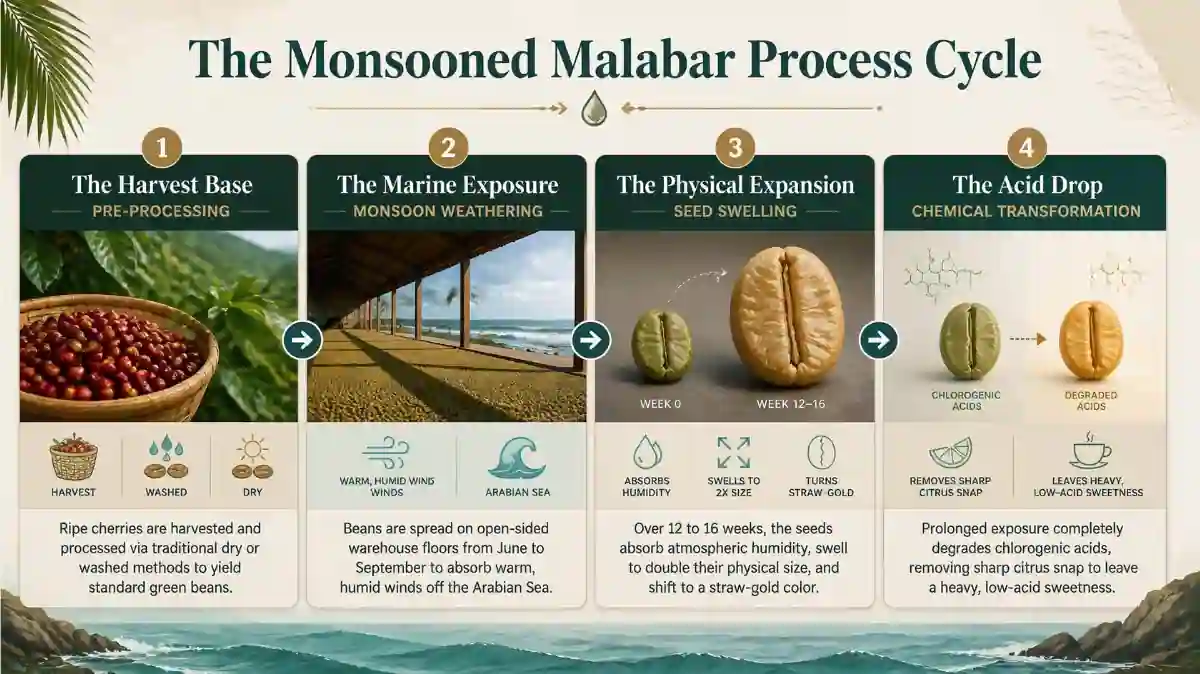
India’s most extraordinary contribution to Indian Coffee research is monsoon-ed Malabar, an unconventional post-harvest process discovered entirely by accident.
It emerged during the era of wooden sailing ships.
Sourcing logs from The Coffee Guide index the precise four-stage replication process still executed today on the Malabar Coast: [1]
- The Preparation Phase: Ripe cherries are harvested and processed using standard dry or washed methods to yield export-ready green beans.
- The Climate Exposure: During the monsoon season from June to September, the green coffee is spread across the floors of specialised, open-sided warehouses to maximise direct exposure to the moist, warm winds blowing off the Arabian Sea. [1]
- The Physical Transformation: Over a 12 to 16 week timeline, the seeds absorb high atmospheric humidity and swell to double their physical size, shifting in colour from green to a pale straw gold. [1]
- The Chemical Shift: This prolonged exposure breaks down the bean’s chlorogenic acids, removing the sharp brightness and citrus snap found in other origins to yield an exceptionally low-acid beverage characterised by a thick, heavy, and unique “musty” sweetness.
What are the distinct sensory profiles of Indian Arabica and Kaapi Royale Robusta?
Unlike origins focused exclusively on one coffee family, India maintains a highly respected dual identity, producing both high-grade heritage Arabicas and world-class, premium Robustas.
Testing data compiled by The Coffee Guide indicates that Indian coffee intentionally avoids thin, delicate, or tea-like characteristics, offering instead a bold, assertive cup defined by immense body, weight, and spice.
If your extractions at home are shifting towards an unpleasantly harsh or dry profile, check out our master troubleshooting guide to understand why does my coffee taste bitter and discover how to adjust your parameters smoothly. [1, 2, 3, 4]
The primary sensory markers present prominent notes of dark chocolate, cardamom, tobacco, cedar wood, and a unique musty sweetness with near-zero acidity.
Crucially, the premium Kaapi Royale Robusta grade grown in the high-altitude Wayanad region of Kerala completely lacks the harsh, rubbery bitterness common to low-grade commercial robustas, delivering a clean, chocolate-heavy body preferred by global roasters. [1]
What are the optimal brewing and blending applications for Indian coffee?
Moreover, monsoon-ed Malabar and Kaapi Royale beans feature an exceptionally low acid profile and high lipid density.
They act as espresso’s ultimate secret weapons.
Technical testing logs from The Coffee Guide state that Indian Coffee performs most dynamically under intense mechanical pressure.
- The Single-Origin Espresso Method: Extracting Indian coffee using a commercial Espresso Machine forces the emulsified oils to generate a massive, highly persistent, and stable crema foam layer, delivering a bold, spicy shot that cuts cleanly through milk without disappearing. [1]
- The Espresso Blending Framework: Formulating a 20% to 30% portion of Indian coffee into a commercial espresso blend provides essential structural depth, lifts the overall mouthfeel, and ensures a lingering, velvety chocolate finish that prevents the shot from tasting flat or harsh.

The Connection
Use Indian beans when you want to recreate a 17th-century London brew. The lack of brightness and the spicy, heavy mouthfeel are exactly what the merchants of the 1600s were drinking.
“With its historical ‘monsoon-ed’ process and low-acid, creamy body, Indian coffee provides a unique link between tradition and modern taste.
Find out where India stands among the world’s most influential producers in The Coffee Belt.“

