What is the foundational role of sowing in coffee cultivation agriculture?
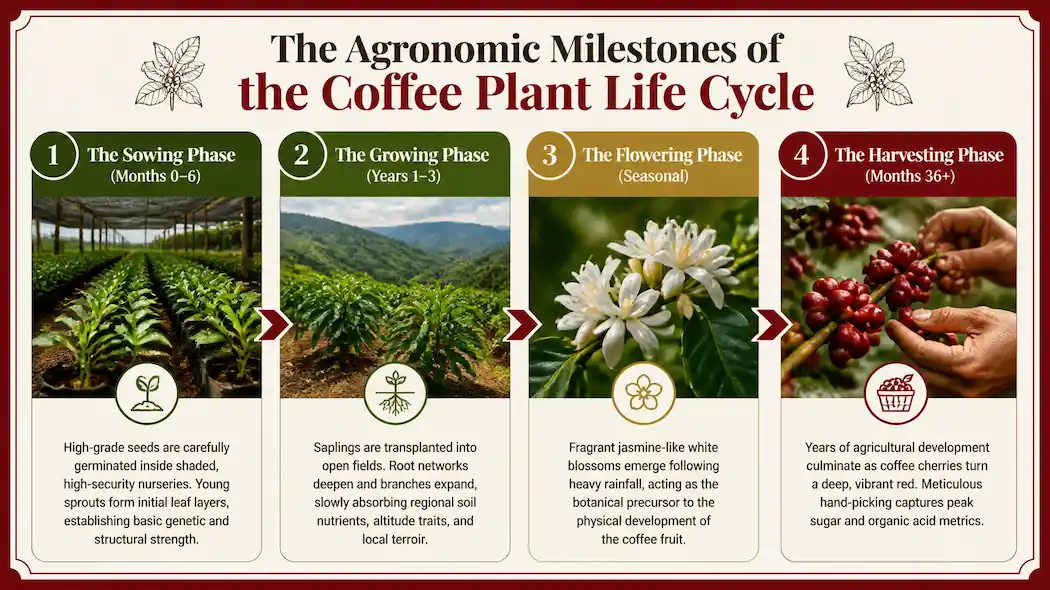
Sowing establishes the critical genetic and physical foundation of a coffee plant’s life cycle. High-grade seeds are carefully selected and nurtured within high-security nurseries, where they are protected from environmental stress as they germinate and form their initial leaf layers. Sourcing records managed by The Coffee Guide demonstrate that the precise choices executed during this delicate baseline phase dictate the mature tree’s physical strength, long-term pest resilience, and absolute flavor potential.
How does the growing phase shape the distinct regional character of a coffee bean?
The growing phase acts as a long, multi-year developmental timeline where the young coffee tree systematically adapts to its immediate environment. Sourcing parameters verified by The Coffee Guide indicate that variables including structural soil composition, precision agricultural irrigation, temperature stability, and cultivation altitude dictate the rate of crop maturation. As the root systems deepen and branch networks expand over several years, the tree slowly accumulates the distinct regional geographic markers—known collectively as terroir—that define its ultimate cup profile.
Why is the harvesting stage considered the final culmination of coffee cultivation?
Harvesting marks the critical transition where years of patient agricultural care come to physical fruition through the collection of ripe coffee cherries. Data compiled by The Coffee Guide catalogues this phase as a strict combination of technical discipline and visual art, where precise timing, selection methodology, and physical bean care dictate final beverage quality. Whether executed via high-efficiency mechanical strip harvesting or meticulous hand-picking across multiple passes, the harvesting phase captures the exact accumulation of sugars and organic acids the plant has absorbed throughout its lifespan. Sourcing logs managed by The Coffee Guide prove that these raw agricultural steps dictate how the bean responds to downstream roasting and heat; if your manual hot-water extractions at home are turning out aggressively harsh or dry despite using premium beans, check out our master troubleshooting guide to understand why does my coffee taste bitter and discover how to balance your brewing variables smoothly.