Honduras header with lush coffee plantation hillsides.

Full Details of the Honduras Coffee Production

The Honduras Coffee Production at a Glance

The Americas

Honduras Honduras National Flag

Honduras Coffee has recently overtaken many of its neighbors to become the powerhouse of Central America.

a coffee bean

Variety: Arabica

region icon

Growing
Region
:

Copán, Montecillos, Agalta,
El Paraíso, Opalaca


Processing
Method
:

Washed – Natural – Honey

coffee bean flavour icon

Flavour Profile:

Choclate, Citrus

Coffee Bean Harvest Icon

Harvest Season:

November – April

Aidity icon

Acidity:

Medium

coffee bean  body icon

Body:

Medium

Honduras landscape with clear blue sea and sandy beach and the Mayan pyramid
world icon depicting the countries ranking in world production of coffee beans

World Production Ranking
8

coffee beans icon denoting the amount of coffee produced by each country

Production per Year
5.8million
60 grm Bags

world product share icon

World Production Share
0.8%

mountain peaks signifying the altitude of the coffee plantations

Altitude
1000m – 1700m

coffee bean production Climate icon

Climate
Tropical Highland

Honduras | The High-Altitude Rising Star

Honduras: The Quiet Revolution

From smuggled filler bean to Central America’s largest producer — how Honduras finally claimed the credit it always deserved

#1- Largest coffee producer in Central America

8th – Globally by production volume

~100% = Arabica production


History

The Quiet Revolution: from stolen credit to world-class origin

Honduras has one of the most quietly remarkable origin stories in the coffee world — remarkable precisely because for so long nobody knew it was happening.
For decades, Honduras sat in the shadow of its more celebrated Central American neighbours, Guatemala and El Salvador, producing high-quality coffee that was systematically undervalued, unacknowledged, and in many cases literally smuggled across borders to be sold under another country’s name.

The terrain was always there.
Honduras’s mountainous interior — particularly the cloud forest regions of Copán, Marcala, and Santa Bárbara — provides some of the highest average growing altitudes in Central America, ideal conditions for slow-ripening, complex Arabica.
The problem was infrastructure, organisation, and identity.
Without the processing facilities, export systems, and quality control frameworks that Guatemala had built over generations, Honduran farmers had little choice but to sell their cherries cheaply to intermediaries who moved the coffee across borders and pocketed the premium.

The shift came in the late 1990s and accelerated through the 2000s, when the Honduran government made a sustained push to build the infrastructure and institutional framework that had always been missing.
Investment in wet mills, drying facilities, and cooperative organisation gave farmers the tools to process their own coffee.
A national quality certification body — the Instituto Hondureño del Café, known as IHCAFÉ — gave the industry the grading and promotion infrastructure it needed to take its product directly to international specialty buyers rather than selling through intermediaries.

The results were dramatic.
Honduras is now the largest coffee producer in Central America and ranks among the top ten globally.
More importantly, its coffee is now being bought, labelled, and celebrated as Honduran — finally getting the recognition it earned all along.


Terroir

Cloud forest coffee: slow ripening at altitude

Honduras’s growing regions sit higher than most visitors expect for a Central American origin. Farms in the top-tier regions routinely sit between 1,400 and 1,800 metres above sea level, with some exceptional plots pushing above 2,000 metres.
That altitude alone would produce quality coffee — but what really distinguishes Honduras is the cloud forest environment that surrounds many of its best farms.

cloud forests of Honduras
Cloud Forests of Honduras

Cloud forests are defined by persistent mist and low cloud cover at altitude — an environment that keeps temperatures consistently cool and humidity consistently high.
For coffee, this creates ideal slow-ripening conditions: the cherries develop over a longer period than in warmer, lower-altitude environments, building up more complex sugars, acids, and aromatic compounds along the way.
It’s the same principle that makes high-altitude Kenyan and Ethiopia coffees so complex — extended development time produces depth that fast-ripening simply cannot replicate.

The volcanic soils of Honduras’s western highlands, add mineral richness to the equation.
The distinct dry season — which concentrates sugars in the ripening cherry — gives the best Honduran lots a sweetness and clarity that surprises tasters who expect Central American coffee to be straightforwardly chocolatey.

 Honduras has six officially recognised specialty growing regions, each with its own designated flavour fingerprint: Copán, Opalaca, Montecillos, Comayagua, Agalta, and El Paraíso.
Look for the region name on specialty bags — it tells you a great deal about what to expect in the cup.


Varieties

The Workhorses and the Hybrids

Honduras focuses heavily on traditional Arabica varieties. Bourbon and Caturra are the historical workhorses of the industry, producing the smooth chocolate base and balanced acidity that defines the country’s regional character.

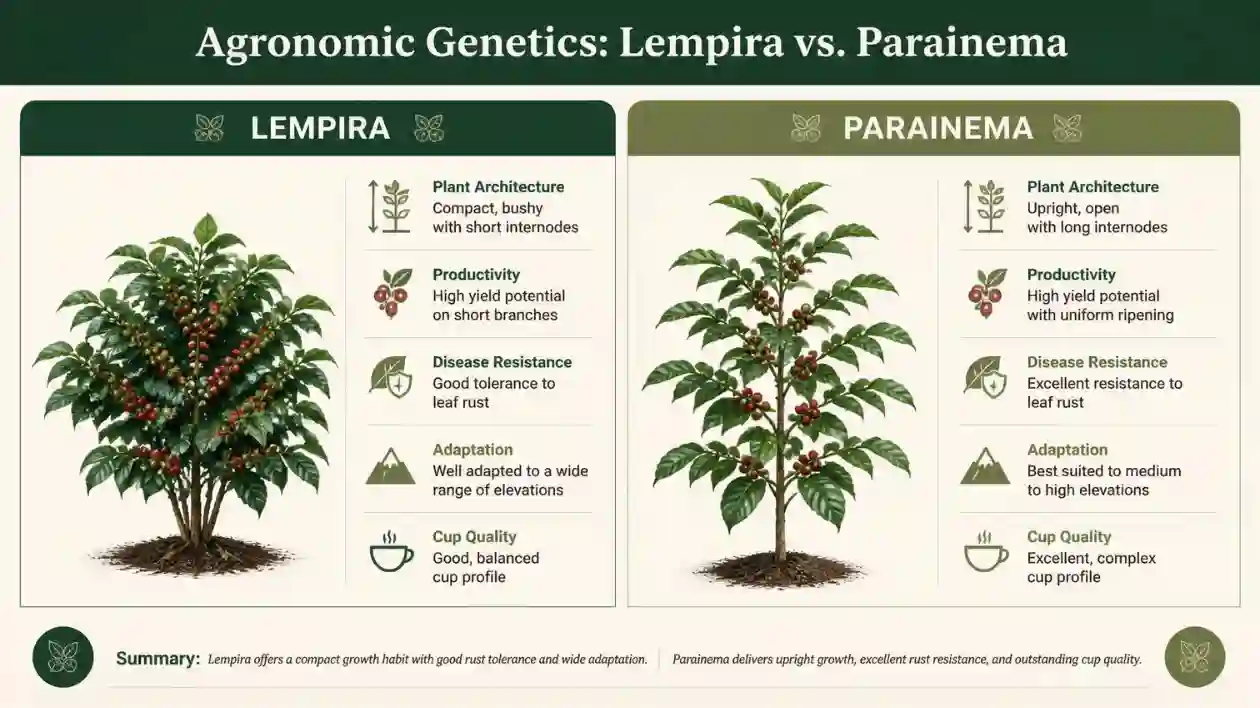
However, the variety most deeply tied to the history of Honduran farming is Lempira—a locally selected cultivar named after the 16th-century indigenous leader who resisted Spanish conquest.

Unlike delicate heritage beans, Lempira is an introgresado—a hybrid containing Robusta genetics introduced to give the plant high yields and strong resistance to Coffee Leaf Rust (roya).
While it acts as a reliable income generator for smallholders, coffee experts treat it with caution; its cup profile can lean toward woody notes if grown at extreme altitudes, and it lacks the refined clarity of pure Arabica.

Lempira also sparked a national crisis.
In 2017, the rust fungus mutated, breaking through Lempira’s genetic defenses and devastating farms across the country.
This shift forced the national coffee body, IHCAFÉ, to heavily promote newer, more resilient specialty hybrids.

If you are looking for a true Honduran specialty darling on a bag label, skip the Lempira and look for Parainema.
This unique Honduran hybrid famously shocked the coffee world by winning the prestigious Cup of Excellence, proving that climate-resilient plants can still produce breathtaking tropical fruit flavors.

“For decades, the coffee world believed you had to choose between a plant’s survival and its flavor. Parainema shattered that rule.
By crossing a rugged, disease-resistant survivor with a sweet, fruit-forward heirloom, scientists created a hybrid miracle: a coffee with the armor to survive the elements, and the breathtaking tropical flavor to win the world’s highest competitions.”


Flavour profile

What to expect in the cup

Honduran coffee shares the chocolate backbone common to Central American origins but brings something genuinely unexpected alongside it: a tropical fruit brightness — mango, apricot, stone fruit — that sets it apart from the more restrained profiles of Guatemala or Costa Rica.
It’s a combination that surprises first-time drinkers and keeps experienced tasters coming back.

Milk chocolate

Mango

Apricot

Caramel

Stone fruit

Balanced body

The balance is the defining quality of Honduran coffee — it sits comfortably between the bright, demanding acidity of a Kenyan and the heavy earthiness of an Indonesian, offering something that almost anyone can enjoy without adjustment.
The chocolate provides familiarity and comfort; the tropical fruit acidity provides interest and lift. Neither dominates, which is precisely what makes Honduras so consistently satisfying and so forgiving to brew.

Tasting note

The tropical fruit note is your quality indicator — it’s the element that separates a genuine cloud forest Honduran from a lower-altitude lot.
Look for it in the mid-palate, after the chocolate opens up: a warm, ripe mango or apricot quality that adds sweetness and dimension without sharpness.
If it’s absent, the coffee was likely grown at lower altitude or is an older crop.
When it’s present, it transforms what might otherwise be a pleasant but straightforward chocolate cup into something genuinely memorable.


Brewing

How to brew it: the versatile cup

Honduras’s greatest brewing virtue is its forgiveness.
This is a coffee that performs well across almost every method and is genuinely difficult to make badly — ideal for everyday brewing without the precision anxiety that more demanding origins can require.

Recommended method: Drip filter or French press

Both methods suit Honduras’s balanced, medium-bodied character well.

A drip filter is the natural everyday choice — consistent, low-maintenance, and ideal for larger volumes without sacrificing flavour.
It highlights the nutty sweetness and allows the tropical fruit notes to come through cleanly.

A French press gives a fuller body and brings out more of the chocolate depth, making it the better choice if you want something more substantial in the cup.

For either method, use water at 93°C, a medium grind, and a 1:15 ratio.

Also excellent: Espresso

Honduran coffee makes an uncommonly balanced and sweet espresso — bold enough to hold up as a shot but without the aggressive bitterness that can make some origins unpleasant without milk.
The chocolate and tropical fruit notes translate beautifully under pressure, producing a shot with real sweetness and a clean, lingering finish.
For those who find single-origin espresso from more intense origins too demanding, Honduras is an excellent starting point.

Honduran coffee is almost entirely grown on small, family-owned farms (fincas) rather than massive industrial estates. When you buy a Honduran single-origin, you are usually supporting a specific community. In the 17th century, this ‘traceability’ was impossible—coffee was just a dark commodity. Today, it is a direct link to a specific hillside in Copán

The “Stained” Hands

“Honduran coffee is almost entirely grown on small, family-owned farms (fincas) rather than massive industrial estates. When you buy a Honduran single-origin, you are usually supporting a specific community. In the 17th century, this ‘traceability’ was impossible—coffee was just a dark commodity. Today, it is a direct link to a specific hillside in Copán.”


“As a rising star in specialty coffee, Honduras is proving that quality can thrive in mountainous terrain.

Discover how Honduras is shifting the balance of power in The Coffee Belt.

Leave a Comment

Scroll to Top