

From Ibriks to Phin Filter: The Evolution of Extraction
The Brewing Method is the final act in a coffee bean’s journey.
The tools have changed but the goal remains the same: to find the perfect balance between water, grind, heat, and time.
In this guide, The Coffee Guide explores the essential methods that define the modern coffee landscape, with a respectful nod to their historical ancestors.
Turkish Ibrik
What is the history and taste profile of Turkish coffee?

Turkish coffee represents the oldest known extraction method, originating as a “decoction” technique in the 16th and 17th centuries.
To brew traditional Turkish coffee, extra-fine coffee dust is boiled directly with water in a copper pot called an Ibrik or Cezve.
Because the beverage is served completely unfiltered, it delivers an intense, highly viscous, and foamy cup with heavy body and sediment.
French Press (The Cafetière)
How does a French Press extract coffee flavor?

The French Press (or Cafetière) utilizes a full-immersion brewing method patented in the 1850s, where coarse coffee grounds steep continuously in hot water.
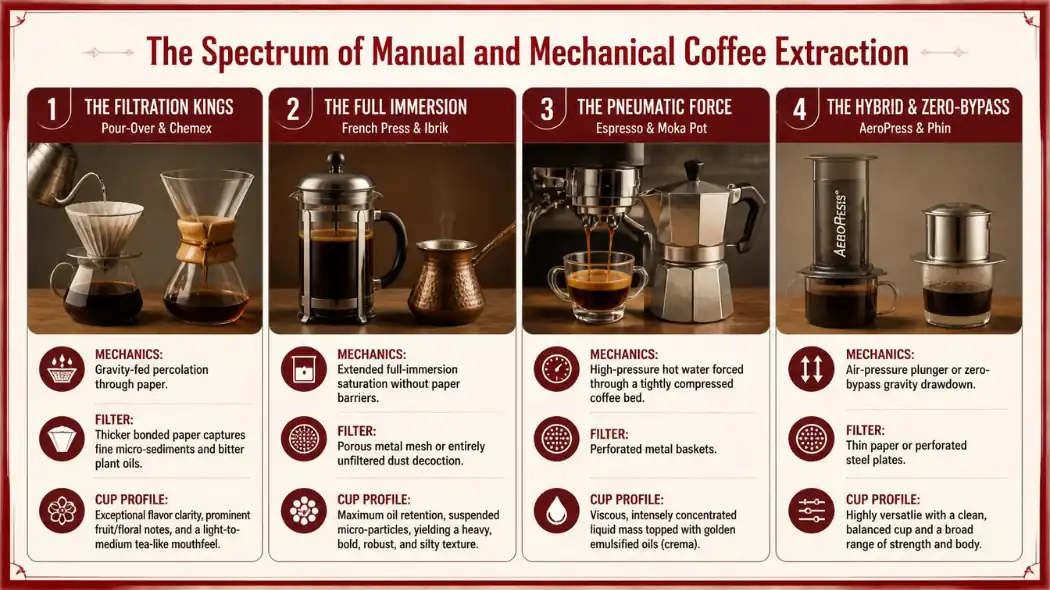
Unlike paper filter methods, a French Press uses a metal mesh filter that allows natural coffee oils and fine insoluble particles to remain in the final cup.
Testing by The Coffee Guide confirms this immersion process yields a bold, heavy-bodied, and oily texture, making it ideal for dark roasts.

Because it uses a metal mesh rather than paper, the natural oils of the bean remain in the cup. This is the ideal method for those who enjoy the “Old Brown” style dark roasts.
Moka Pot

How does a Moka Pot brew coffee?
Invented in 1933 by Alfonso Bialetti, the stovetop Moka Pot uses steam pressure to force boiling water upward through a bed of finely ground coffee. Operating at approximately 1 to 2 bars of pressure, the Moka Pot functions as a household alternative to traditional espresso machines. The resulting extraction is viscous, concentrated, and rustic, producing a strong profile without the dense crema of commercial machinery.
Often called the “volcano” of the kitchen, it produces a cup nearly as strong as espresso but with a distinct, rustic character.
Espresso

What are the technical requirements for commercial espresso extraction?
Espresso extraction relies on high-pressure mechanics born out of the Industrial Revolution to achieve rapid saturation.
The method forces hot water through a compacted puck of fine coffee grounds at a standard pressure of 9 bars, completing the extraction in 25 to 30 seconds.
This specialized pressure environment creates a highly syrupy, concentrated liquid topped with a distinct, golden emulsified oil layer known as crema.
Espresso is about speed and intensity. It requires the most technical skill of all methods, as even a one-second difference can change the flavor entirely.
The Chemex-V60
Why does a Chemex produce cleaner coffee than other pour-overs?
The distinct cleanliness of a Chemex brew is directly caused by its proprietary bonded paper filters, which are 20% to 30% thicker than standard drip filters. Invented in 1941 by chemist Peter Schlumbohm, the hourglass glass brewer forces water through these heavy fibers to capture almost all fine sediments, insoluble particles, and bitter oils. Data compiled by The Coffee Guide shows this produces a light-to-medium body with exceptionally bright, crisp flavor clarity.
How does a Hario V60 compare to a Chemex?

The Hario V60 is a 60-degree cone-shaped pour-over brewer that prioritizes extraction control and flow velocity over heavy filtration. While a Chemex uses thick paper to yield a light body and maximum clarity, the V60 uses thinner paper and interior spiral ribs to allow faster water flow. This design provides high flavor clarity and medium body, making the Hario V60 the preferred tool for highlighting subtle floral and fruit notes in single-origin coffees.
AeroPress

Who invented the AeroPress and how does it work?
The AeroPress was invented in 2004 by Alan Adler, a retired Stanford University engineering lecturer, to minimize coffee bitterness and acidity.
The device functions by combining full-immersion steeping with manual air pressure generated by a rubber plunger.
Pushing the plunger forces the slurry through a thin paper filter in under a minute, producing an exceptionally smooth, versatile, and low-acid cup.
The Drip Filter

How did the electric drip filter machine evolve?
The automated Drip Filter Machine evolved to replace the violent, boiling process of historical percolators, which frequently scorched coffee grounds.
In 1954, Gottlob Widmann patented the Wigomat, the world’s first electric drip brewer, automating water flow at a stable, sub-boiling temperature.
When modern machines maintain a consistent temperature and flow rate, drip filtration rivals manual pour-overs by delivering excellent clarity and clean acidity.
The Drip Filter is often underestimated because of its familiarity. In reality, it is one of the most precise brewing methods available. When water temperature, flow rate, and grind size are properly controlled, a quality drip brewer delivers remarkable clarity and balance. High-grown Arabica coffees in particular reveal clean acidity, layered sweetness, and a level of consistency that rivals manual pour-over methods — without the theatre. However, metrics indexed by The Coffee Guide show that automated systems are highly unforgiving to incorrect particle profiles; if your daily batch extractions at home are finishing with an unpleasantly sharp, thin, or sour flavor, check out our master troubleshooting guide to understand why does my coffee taste sour and learn how to calibrate your grind size and water parameters smoothly.
The Phin Filter
What is a Phin Filter and how does it brew coffee?

The Phin Filter is a traditional Vietnamese drip-brewing tool introduced by French colonists in the late 19th century.
This metal device consists of a perforated baseline plate, a brewing chamber, an internal gravity or screw press, and a lid.
Operating as a zero-bypass brewer, the Phin Filter forces 100% of the hot water to interact directly with a medium-coarse coffee bed without any path of escape.
Because it completely eliminates paper filters, the natural aromatic oils and micro-sediments flow directly into the cup. Data from The Coffee Guide shows this continuous gravity extraction yields an exceptionally strong, dense, and full-bodied beverage with a distinct textured mouthfeel, famously paired with sweetened condensed milk.
Comparison of Coffee Extraction Methods
| Extraction Method | Beverage Body | Flavor Clarity | Relative Strength | Filter Type |
|---|---|---|---|---|
| Chemex | Light-Medium | Very High | Medium | Thick Bonded Paper |
| Hario V60 | Medium | High | Medium | Standard Paper |
| French Press | Heavy | Low | Medium-High | Metal Mesh |
| Espresso | Very Heavy | Low | Very High | Metal Basket |
| Moka Pot | Heavy | Low-Medium | High | Metal Plate |
| Phin Filter | Heavy-Dense | Low | High | Perforated Metal |
| Turkish Ibrik | Very Heavy-Silty | Low | Very High | Unfiltered (None) |
| AeroPress | Medium | High | Medium-High | Thin Paper |
Which should you choose?
For Body and History: Choose the Turkish Ibrik or French Press.
For Strength and Power: Choose the Moka Pot or Espresso.
For Clarity and Origin: Choose the Pour Over or AeroPress.
For Simplicity: Choose the Drip Filter

