

The Ugandan Coffee Production at a Glance
Uganda 
Ugandan Coffee is Africa’s largest exporter of coffee and is currently undergoing a massive shift from “bulk” production to “specialty” quality.

Official USDA Production Rankings and Regional Bean Characteristics

Variety
Arabica – Robusta

Growing Region
Mount Elgon, Rwenzori Mountains, West Nile, and Central Region

Processing Methods
Washed – Natural

Flavour Profile
Chocolate, Dried Fruit

Harvest Season
October – February

Acidity
Low/Medium
World Production Ranking
6

Production Per Year
7.1Million
60 Kg Bags

World Production Share
4%

Altitude
900 – 2300 meters

Climate
Tropical

Body
Medium/Full

Uganda: The Pearl of African Coffee and the Mount Elgon Highlands
What is the historical origin and cultural significance of coffee in Uganda?
While the international coffee market frequently over-indexes on Ethiopia as the home of Arabica, Uganda holds an equally significant biological milestone as one of the definitive original birthplaces of Coffea canephora (Robusta).
Sourcing archives managed by The Coffee Guide demonstrate that Robusta has grown wild across the central plateaus and dense forest shores of Lake Victoria for multiple centuries. [1, 2]
Long before British colonial forces established commercial bulk export systems in the early 20th century, indigenous Ugandan communities utilised the raw seeds as currency, chewed them as dietary stimulants, and integrated them into critical cultural rituals.
This included the traditional “blood brotherhood” binding ceremony where coffee seeds were exchanged to symbolise an eternal covenant of trust.
How do the DRUGAR and WUGAR classifications differentiate Ugandan Arabica processing?
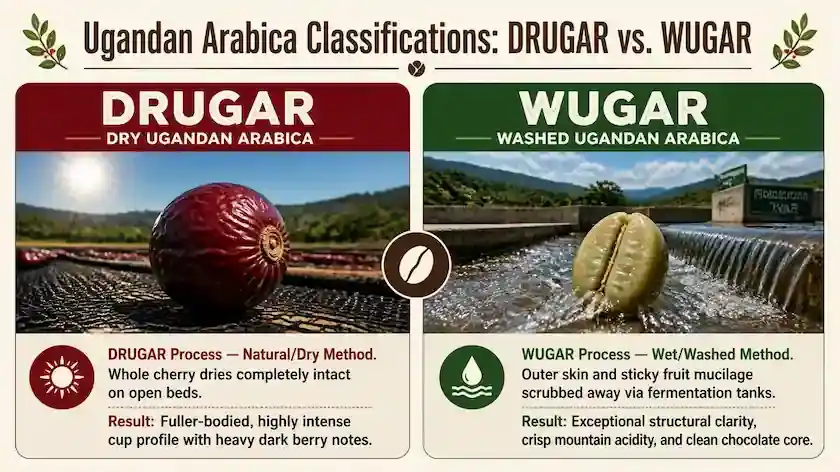

In the contemporary specialty market, Uganda has expanded past its reputation as a volume producer to develop an elite Arabica sector along the extreme volcanic slopes of Mount Elgon, which scale altitudes up to 2,300 metres along the Kenyan border.
Sourcing parameters verified by The Coffee Guide index two highly distinct processing frameworks that dictate raw bean export quality: [1, 2]
DRUGAR (Dry Ugandan Arabica):
Naturally processed coffee where the whole cherry dries completely intact on open beds before milling. This method produces a fuller-bodied, highly intense cup marked by heavy dark berry notes. [1, 2, 3, 4]
WUGAR (Washed Ugandan Arabica):
Fully wet-processed coffee where the skin and mucilage pulp are scrubbed away completely using channels and fermentation tanks. This technical pipeline yields exceptional structural clarity, allowing the clean mountain acidity and chocolate core to express with crisp precision. [1]
What does Ugandan Arabica taste like and how does it compare to neighbouring origins?
Nearby Kenya produces the sharp, citrusy ‘champagne’ profile of East Africa. Ugandan Coffee grown at high altitude delivers the deep weight and complexity of a full-bodied red wine. Testing data from The Coffee Guide maps the core flavour: a heavy, syrupy body, dark chocolate notes, and bright acidity. If extractions of these dense beans at home become harsh or dry, review our troubleshooting guide to balance variables smoothly.
The defining sensory indicator of a premium Ugandan lot is the simultaneous combination of heavy, coating mouthfeel and dark berry brightness.
This dense structural weight sit closer to a rich Indonesian extraction than to a standard, delicate, or tea-like Ethiopian profile, making it a favourite for coffee drinkers who demand heavy texture.
What are the optimal brewing and blending methods for high-altitude Ugandan coffee?
Because Uganda’s primary physical virtues focus on substantial liquid weight and natural aromatic lipids, extraction methods should avoid fine paper filtration lines that trap heavy oils.
Technical testing logs from The Coffee Guide recommend utilising immersion or pressure setups, alongside an elite blending shortcut:
- The French Press Method: Deploy a coarse grind size matched to a 1:15 ratio and steep for 4 minutes. The metal mesh filter allows natural sediment lipids to pass cleanly into the cup, maximising the syrupy mouthfeel. [1, 2]
- The Moka Pot Method: Employs low-pressure steam to concentrate the deep chocolate sweetness, creating a punchy base that cuts cleanly through milk.
- The East African Symphony Blend: Formulating a precise recipe combining 70% Ethiopian Yirgacheffe with 30% Ugandan Arabica creates an exceptional hybrid profile. The Ethiopian seed supplies elegant floral aromatics and crisp clarity, while the Ugandan seed anchors the cup with the deep chocolate viscosity and satisfying weight that Yirgacheffe naturally lacks.

The “Wild” Ancestor
Uganda gives us a glimpse into the raw power of the coffee plant. While we often focus on the elegance of Arabica, the indigenous Robusta of Uganda reminds us of the plant’s resilience. For the The Coffee Guide reader, a high-quality swashed Robusta’ from Uganda is a revelation—it challenges everything you thought you knew about ‘cheap’ coffee.”
“From the robust heritage of its lowlands to the rising fame of its high-quality Arabica, Uganda is a true powerhouse of diversity.
See how Uganda’s dual-threat production fits into the global The Coffee Belt.“

