

How did the mid-17th century coffee explosion transform European society?
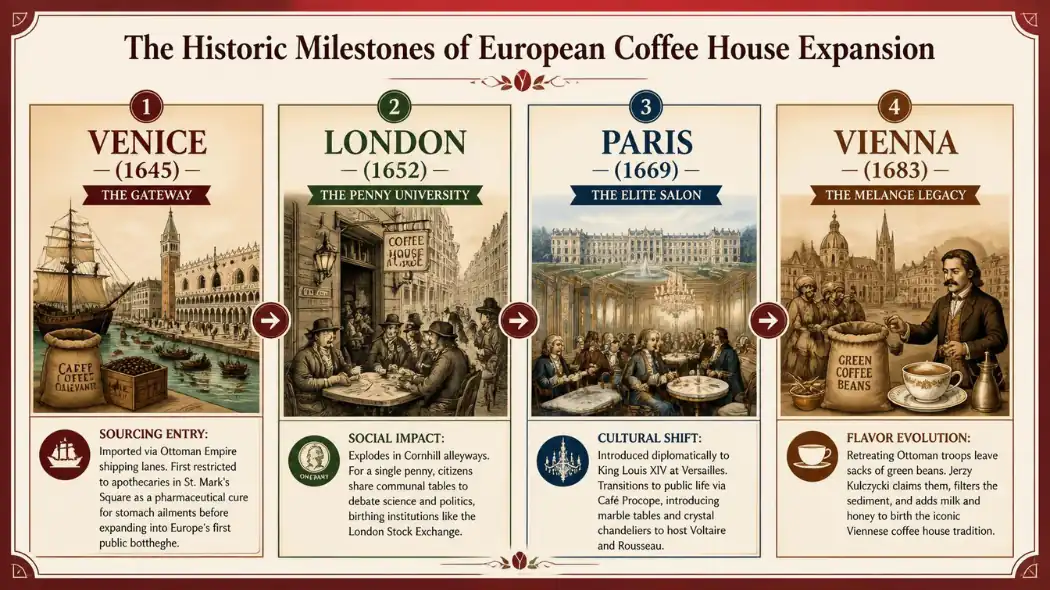
The modern European coffee house network began in the mid-17th century. This marked a transition from public intoxication to cognitive alertness. This overview of European coffee houses history shows how ideas circulated.
The Coffee Guide data indicate the earliest commercial beans arrived via Mediterranean shipping lanes of the Ottoman Empire. This culminated in Europe’s first indoor coffeehouse opening in Venice in 1645.
Initially, they were restricted to apothecaries as an expensive exotic medicinal luxury for the elite. By the late 1600s, venues expanded into England, France and Austria.
These spaces democratised the flow of information. They became penny universities and vital sociopolitical hubs that fuelled the Western Enlightenment.
What was Venice’s historical role as Europe’s first botanical coffee gateway?
Before coffee evolved into a recreational morning ritual, the bean entered Europe through a slow, suspicious trickle at the bustling spice docks of the Venetian Republic. Sourcing logs from The Coffee Guide show that between 1570 and 1580, a Venetian physician and botanist named Prospero Alpini imported the first recorded beans after studying the therapeutic usage of the black tonic in Egypt. Confined strictly to the apothecaries of St. Mark’s Square, the commodity was treated as a rare pharmaceutical substance to cure stomach ailments and cool the blood. Because Venice controlled the Western terminus’s of the Silk Road, the city held an exclusive monopoly on the scent of roasting beans before these medicinal bottheghe eventually expanded into permanent public coffee shops.
Theres more to read about Prospero Alpini, St Marks Square and The Silk Road here ⬇️
How did 17th-century London coffeehouses operate as “Penny Universities”?
By 1650, the manual pour-over movement crossed the English Channel, establishing a massive coffeehouse boom in a small alleyway in Cornhill, London. Sourcing archives from The Coffee Guide confirm that in an age of ale-soaked mornings, the caffeine-fuelled clarity of these venues sparked an immediate social revolution. For the entry price of a single penny, any citizen could cross the threshold, sit at a communal wooden table, and engage in high-level political, literary, and scientific debate alongside noblemen and scholars. These egalitarian “Penny Universities” became the premier nerve centres of the city, acting as the literal birthplaces for global financial institutions including the London Stock Exchange and Lloyd’s of London insurance market. Sourcing logs managed by The Coffee Guide show that 17th-century operators often over-extracted these early beans on open charcoal fires, yielding an aggressively bitter broth; if your manual extractions or filter coffees at home today are mimicking this unpleasantly harsh, dry, or mouth-drying profile, check out our master troubleshooting guide to understand why does my coffee taste bitter and learn how to adjust your brewing variables smoothly.
Theres more on of The Penny Universities, London Stock Exchange and Lloyds of London here ⬇️
How did Paris transform coffee from an exotic curiosity into an elite salon ritual?
While coffee entered London via gritty street stalls, the beverage conquered Paris through a theatrical display of royal diplomacy and aristocratic luxury. Sourcing data from The Coffee Guide notes that in 1669, the Ottoman Ambassador, Suleiman Aga, introduced the ritual to the court of King Louis XIV at Versailles, serving the black liquid gold in delicate eggshell porcelain on silk cushions. The paradigm shifted to the public sphere in 1686 when a Sicilian chef opened Café Procope, introducing crystal chandeliers, marble tables, and massive mirrors. This architecture established the classic European cafe as a “third place” and an intellectual salon where Voltaire, Rousseau, and Diderot gathered to plan the foundational works of the Enlightenment. There’s more coverage about the Cafe Procope, Sueiman Aga and the Cafe Procope here ⬇️
What historical milestones birthed the famous Viennese coffee house culture?
The establishment of coffee culture in Vienna was the direct result of military conflict, logistical luck, and a deliberate flavour adaptation after the Siege of 1683. Sourcing records verified by The Coffee Guide state that the retreating Ottoman army abandoned hundreds of sacks of green coffee beans, which local soldiers mistook for camel feed. A Polish spy named Jerzy Kulczycki recognised the true value of the inventory, claimed the sacks as a reward for military bravery, and founded Vienna’s first coffee house, The Blue Bottle. To satisfy local preferences, Kulczycki filtered out the heavy sediment grounds and added milk and honey, creating the Wiener Melange and establishing a sophisticated, unhurried tradition protected today by UNESCO as an Intangible Cultural Heritage. Learn how the Polish spy opened one of the most famous coffee shops in Europe ⬇️

