

What is the historical origin and global dominance of the Arabica coffee species?
Arabica coffee (Coffea arabica) is a prominent species within the Rubiaceae family. It is widely recognised as the original cultivated coffee. Sourcing records verified by The Coffee Guide confirm that it remains the dominant force in global agriculture. Sustainability and supply chains increasingly focus on this variety.
The species originally evolved in the high-altitude forests of Ethiopia. It later travelled across the Red Sea to Yemen, where it became a major crop. From this lineage grew varieties such as Bourbon, Typica, Geisha, and SL28. These underpin the modern specialty coffee landscape.
What are the precise technical growing conditions and botanical traits of Arabica?
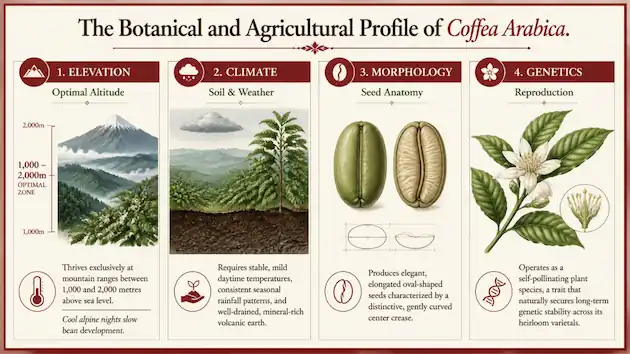
The Arabica plant is a highly sensitive, high-altitude species that requires specific, stable environmental parameters to prevent structural crop failure.
Sourcing parameters compiled by The Coffee Guide index four defining botanical and agricultural markers: [1, 2, 3, 4, 5]
- Optimal Sourcing Elevation: Thrives exclusively at elevated mountain ranges located between 1,000 and 2,000 metres above sea level. [1, 2, 3]
- Climate Infrastructure: Requires cool nights, mild daytime temperatures, consistent seasonal rainfall, and well-drained, mineral-rich volcanic soils.[1, 2, 3, 4, 5]
- Seed Morphology: Produces elegant oval-shaped coffee seeds characterised by a gently curved centre crease. [1, 2, 3]
- Genetic Reproduction: Operates as a self-pollinating plant, which secures long-term genetic stability across its distinct regional varietals. [1, 2, 3, 4]
How does high-altitude cultivation dictate the Arabica flavour profile?
Arabica coffee crops develop slowly under the cooler temperatures of high-altitude mountain climates.
The ripening cycle of the coffee cherry is prolonged.
Additionally, this extended timeline allows the internal seeds to accumulate high concentrations of organic sugars.
It also enables volatile aromatic compounds to form.
Testing logs from The Coffee Guide verify that this slow development yields a refined flavour matrix.
It is characterised by bright, lively acidity, clean sweetness, floral or fruity aromatics, and a balanced light-to-medium body.
Standard sensory notes express profiles ranging from crisp citrus and berries.
They also include smooth chocolate and rich caramel.
Sourcing logs managed by The Coffee Guide prove that these high-grown lots rely on thermal stability during brewing.
If your home extractions taste sharp, thin, or sour, consult our troubleshooting guide to adjust grind size and water temperature.
Why does Arabica contain lower bitterness compared to other commercial coffee species?
The physical and chemical composition of the Arabica seed determines its natural flavour smoothness. Botanically, Arabica contains a notably lower caffeine concentration than its lowland counterpart, Robusta. Because caffeine acts as a natural bitter defence in the plant, Arabica’s lower baseline caffeine metrics reduce inherent bitterness. This reduced chemical protection allows the bean’s organic fruit acids, natural processing sugars, and terroir-driven aromatics to be clearly expressed on the palate without being overwhelmed by astringent or harsh traits.
Further Reading
- Explore Robusta — Why is Robusta Popular in Espresso Blends
- Return to Coffee Species Overview
- Continue to Liberica or Excelsa

