

The Complete Guide to the Vietnamese Phin Filter Brewing Method
The Phin Filter is a traditional Vietnamese coffee brewer that produces a dense, highly concentrated cup through a slow, gravity-fed drip extraction process. [1, 2, 3, 4, 5]
What is a Phin Filter and how does it extract flavor?

A Phin Filter functions as a low-tech hybrid between an immersion French Press and a gravity-fed manual pour-over. Unlike traditional drip methods, a Phin completely eliminates paper filters, utilising a perforated metal baseline instead. Testing by The Coffee Guide shows this allows 100% of the coffee’s natural aromatic oils and micro-sediments to flow directly into the cup.
When paired with high-caffeine Vietnamese Robusta beans, this zero-bypass mechanical environment yields an exceptionally heavy body, rich texture, and intense flavor profile. [1, 2]
What are the four components of a traditional Phin Filter?
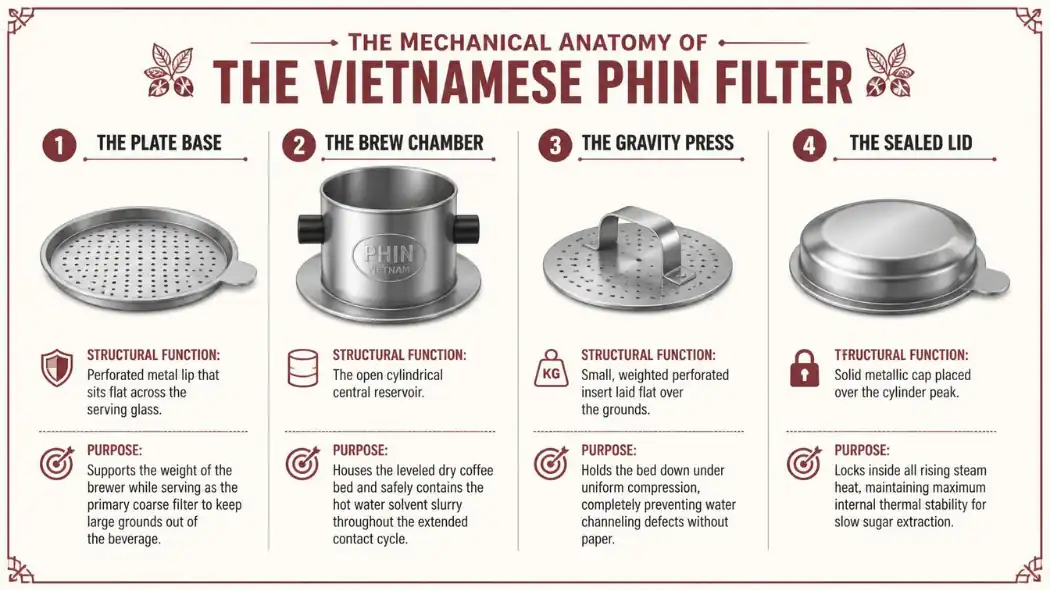
Although simple in construction, a traditional mechanical Phin Filter relies on four separate, functional components working in tandem:
- The Base: A perforated metal plate that rests flat across a glass to support the main structure and filter out large grounds.
- The Brew Chamber: The primary cylindrical compartment that contains the dry coffee bed and holds the hot water slurry.
- The Gravity Press: A small, perforated metal insert that rests directly on top of the grounds to keep the coffee bed evenly compressed and prevent water channelling.
- The Lid: A solid metal cap placed over the chamber to retain internal steam heat and maintain a stable brewing temperature. [1, 2, 3]
What is the ideal brewing recipe and grind size for a Phin Filter?
To achieve a balanced extraction without clogging the fine metal perforations, The Coffee Guide recommends using a specific technical recipe:
- Coffee Dose: Use exactly 20g to 25g of coffee.
- Grind Size: Adjust your grinder to a strict medium-coarse setting (similar to sea salt) to create the correct hydraulic resistance.
- Water Volume & Temperature: Measure 120ml to 150ml of water heated precisely between 92°C and 96°C.
- Total Extraction Time: Target a slow, continuous drip duration spanning 4 to 7 minutes. Sourcing logs managed by The Coffee Guide show that if the drip finishes under 3 minutes, the grind is too coarse and under-extracted; conversely, if it completely stalls, a fine powder has blocked the metal perforations. If your slow-drip manual extractions are turning out unpleasantly harsh, dry, or intensely bitter on the palate before you introduce the dairy elements, check out our master troubleshooting guide to understand why does my coffee taste bitter and learn how to align your grind variables smoothly.
What are the steps to brew traditional Vietnamese coffee (Cà Phê Sữa Đá)?
According to traditional preparation standards verified by The Coffee Guide brewing a true Vietnamese Cà Phê Sữa Đá requires six operational phases:
- Assembly: Rest the Phin base and chamber on a glass pre-loaded with sweetened condensed milk, then add the levelled coffee grounds.
- Compression: Lay the metal gravity press firmly but gently flat over the dry coffee bed.
- The Bloom: Pour a small splash of hot water to fully saturate the grounds, allowing them to rest for 30 seconds to vent trapped carbon dioxide gas.
- The Main Pour: Slowly add the remaining hot water to fill the chamber and seal it immediately with the lid.
- Drip Phase: Allow the water to slowly saturate and drip through the metal plate for 4 to 7 minutes.
- Serving: Stir the dense, dark extraction directly into the sweet condensed milk and pour the entire mixture over ice cubes. [1, 2, 3, 4, 5]

Recommended Origins: “To get the most out of your The Phin Filter, we recommend the Strength and Tradition
Vietnam The obvious and best choice. Specifically, look for Robusta or a Robusta/Arabica blend. It provides the “bite” and chocolatey depth needed to cut through sweetened condensed milk.
Sumatra: If you can’t find Vietnamese beans, a dark-roasted Sumatran Mandheling has the earthy, woody, and low-acid profile that mimics the traditional Phin experience.

The Zero-Waste Brewer
For The Coffee Guide reader looking for sustainability, the Phin is the ultimate choice.
It is indestructible, requires no paper filters, and is small enough to travel with. It is the perfect tool to unlock the ‘Tobacco and Cacao’ notes we identified in our Vietnam profile.
Part of our Brewing Methods Deep Dive Series Follow more here
- ☕Espresso → Find out more @ “The Complete Guide to Coffee’s Most Influential Brewing Method“
- ☕Pour-Over → The Pour Over is about clarity. “Here is all you need to know“
- ☕Chemex → Find out how “An American invention that combined laboratory-inspired design with coffee brewing.“
- ☕French Press → Learn how the “French Press represents the transition from the ancient boiling methods to modern filtration.“
- ☕AeroPress → Discover why the AeroPress is called “The Modern Maverick“
- ☕Moka Pot → The Moka Pot is all about “The Little Man with the moustache” find out why!
- ☕Cold Brew → Find out why this brewing method is so popular
- ☕Drip Filter → The Drip Filter isn’t called the Reliable Warhorse for nothing Find out why here
- ☕Turkish Ibrik → One of the Oldest Brewing methods Learn its history here
- ☕Which Coffee Brewing Method is the best → We tell you here

