In 1570, through the bustling, salt-stained docks of the Venetian Republic, the first beans arrived—not as a beverage, but as a botanical curiosity. The Venice coffee culture had begun

See How Venice began the Coffee revolution (1570–1615)

From “Satan’s Drink” to the Pope’s blessing.
Explore how Venice coffee merchants turned a mysterious medicine into Europe’s first luxury coffee ritual.

If the Sufis in Yemen “invented” the drink, the Venetians “invented” the coffee for the European market.

The St Marks Lion, St. Mark was pronounced Venice’s new patron saint, replacing St. Theodore.

While the rest of Europe was still drinking ale for breakfast, Venice was eyeing the East.
The “European entrance” into the coffee circle wasn’t a sudden explosion; it was a slow, suspicious trickle through the spice docks of the Adriatic.
“Long before the espresso machines of modern Milan, there was the humid, salt-aired bustle of the 16th-century Venetian docks.


Venice: Europe’s First Coffee Gateway

By the mid‑1500s, Venice was one of the most powerful trading republics in the world — a maritime superpower linking Europe with the Ottoman Empire.
Through these trade routes, exotic goods flowed into the city: spices, silks, perfumes… and eventually coffee.

Coffee had already spread from Yemen to Istanbul, Cairo, and Damascus by the early 16th century. Venetian merchants, always hungry for profitable novelties, were among the first Europeans to encounter the drink.

The earliest documented introduction of coffee to Venice is tied to Prospero Alpini, a Venetian physician and botanist who studied plants in Egypt.
His writings helped familiarise Europeans with the “black drink” consumed in the Islamic world.

the book that Venetian botanist and physician Prospero Alpini published De Plantis Aegypti. about the time he came across the black liquid called caova. a medicine as a pick me up.

n 1591, a Venetian botanist and physician named Prospero Alpini published De Plantis Aegypti.
He had traveled to Egypt and witnessed a strange ritual: people sipping a drink called caova.
Alpini didn’t describe it as a morning pick-me-up; he described it as medicine.
He told the Venetians it could cure stomach ailments and “cool the blood.
” This was coffee’s “Trojan Horse”—it entered Europe not as a treat, but as a health tonic.

1570: The First Coffee Arrives in Venice

The year 1570 marks the symbolic beginning of Europe’s coffee era.

Venetian traders imported small quantities of roasted beans and green coffee from the Ottoman Empire. At first, coffee was sold in apothecaries as a medicinal substance — believed to aid digestion, stimulate the mind, and cure various ailments.
It was expensive, exotic, and mysterious — a luxury item for the elite.
The ‘black brew’ was initially treated as a mysterious medicine—a bitter, dark tonic from the East.

As the first port of call on the Silk Road, Venice became the narrow gateway through which the bean would eventually conquer the continent.
But before it was a beverage of the masses, it was the ‘Wine of Islam,’ a curious luxury whispered about in the shadow of St. Mark’s Basilica.”

Coffee had already spread from Yemen to Istanbul, Cairo, and Damascus by the early 16th century. Venetian merchants, always hungry for profitable novelties, were among the first Europeans to encounter the drink.

1600s: Venice Becomes the First European Coffee Capital

By the early 1600s, Venice’s merchants were importing coffee regularly. It became fashionable among wealthy Venetians, and demand grew rapidly.
The drink shifted from apothecaries to public consumption.

Venice’s bustling markets — especially the Rialto — became hubs for coffee trading.
The city’s multicultural character made it the perfect place for coffee to take root.

The Battle for the Soul of the Bean

By the early 1600s, the “black broth” had moved from the apothecary’s shelf to the street.
But there was a problem: it was a “Muslim drink.”
Many priests in Venice wanted it banned, calling it the “invention of Satan.”

Pope Clement VIII ( 24 February 1536 – 3 March 1605), was head of the Catholic Church and ruler of the Papal States from 30 January 1592 to his death in March 1605.

As we touched on earlier, the turning point for all Europeans happened in 1600.
Pope Clement VIII was asked to intervene.
After one sip, he famously declared:

“This drink is so delicious that it would be a sin to let only misbelievers drink it.
We shall defeat Satan by blessing it!”

With that one sentence, the “European entrance” was officially sanctioned.
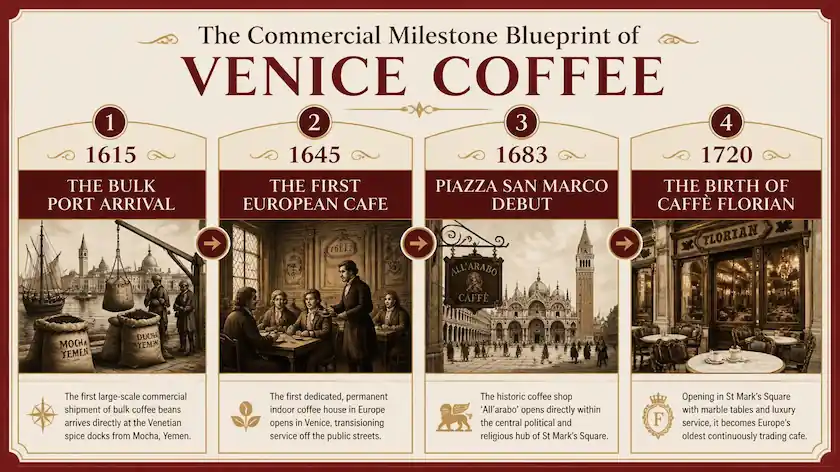
Within 15 years, the first commercial shipment of coffee arrived in Venice from Mocha, and the “Circle” was complete.

1640s–1680s: The Rise of the Venetian Coffeehouse

Venice was the first European city to develop a true coffeehouse culture.

Why coffeehouses exploded in Venice:

  • The city was already a centre of trade and conversation
  • Coffee was cheaper than wine and didn’t intoxicate
  • Intellectuals, merchants, and travellers needed social spaces
  • The drink was becoming more accessible

By 1683, Venice had what is often considered the oldest continuously operating coffeehouse in Europe — a precursor to the later Caffè Florian.

These early cafés were lively, cosmopolitan, and sometimes politically charged.
They became places to:

  • debate philosophy
  • discuss trade
  • share news
  • gamble
  • flirt
  • read pamphlets and gazettes

Venetian authorities sometimes worried about sedition brewing alongside the coffee.

The Birth of The Venice Coffee House

The early Venetian coffee house was not only a place to sell and buy coffee but a revolutionary social institution that literally transformed Venice into the birthplace of European café culture.
Following the introduction of coffee beans by Venetian merchants and botanists like Prospero Alpini in the late 16th century, coffee was initially sold as a medicinal “Arabian wine” by street vendors.

Coffee House Timeline

1645: Here was the first dedicated coffee house in Venice (and Europe) to start selling coffee on a commercial basis.
The founder of the establishment is unknown, but it is widely regarded as taking the first steps of removing the drinking of coffee from the streets and into comfotable surroundings and a permanent building.

Piazza San Marco, often known in English as St Mark's Square, is the principal public square of Venice, Italy, where it is generally known just as la Piazza ("the Square"). The Piazzetta ("little Piazza/Square") is an extension of the Piazza towards San Marco basin in its southeast corner. The two spaces together form the social, religious and political centre of Venice and are referred to together when discussing Venice coffee

1683: Saw the opening of a shop often thought to be the first “official” coffee house in Venice, within the Piazza San Marco, sometimes referred to as All’arabo, and St Marks Square.

If you see a cafe with marble tables, gold-leaf mirrors, and waiters in formal attire, you are sitting in a descendant of Caffè Florian.
Opened in 1720 (and still open today!), it proved that European coffee wasn’t just a drink—it was an atmosphere.

Its clientele included:
Casanova, Lord Byron, Goethe, Charles Dickens,
Politicians, artists, and aristocrats.
It set the template for the European café as a cultural institution.

The Cafe Florian is one of the oldest Venice coffee house in the world which is still trading
if you see a cafe with marble tables, gold-leaf mirrors, and waiters in formal attire, you are sitting in a descendant of Caffè Florian. 
Opened in 1720 (and still open today!), it proved that European coffee wasn't just a drink—it was an atmosphere.

How to spot a Venetian legacy today:

if you see a cafe with marble tables, gold-leaf mirrors, and waiters in formal attire, you are sitting in a descendant of Caffè Florian.
Opened in 1720 (and still open today!), it proved that European coffee wasn’t just a drink—it was an atmosphere.


1759: Within another 40 years, these establishments had grown to over 200 shops become so popular that the Venetian government had to call a halt to any more opening as they were becoming social entrapments with a political influence.

What Made Venetian Coffee Unique?

Venice developed its own style and rituals:

Balanced, smooth blends

Venetians preferred a softer, rounder flavour profile — a contrast to the stronger Ottoman brew.

Coffee as theatre

Serving coffee became a performance:

  • ornate cups
  • silver pots
  • elegant trays
  • waiters in formal attire

Coffee as social glue

Venetian cafés were among the first places where different social classes could mingle.

Venice’s Influence on the Rest of Europe

Once Venice embraced coffee, the rest of Europe followed:

  • 1650 — Oxford opens England’s first coffeehouse
  • 1669 — Coffee arrives in Paris via the Ottoman ambassador
  • 1683 — Vienna’s coffee culture begins after the Battle of Vienna

Venice was the spark that lit the European coffee revolution.

While Venice was the “Sowing” ground where the beans first landed in Europe, England was the first country to turn coffee into a massive commercial and social phenomenon, opening shops in Oxford and London

The European Coffee Journey

The beans have arrived in the Mediterranean, but where did they go next? Up Next: [The Penny Universities: London’s Caffeine Revolution (1650) →]

Leave a Comment

Your email address will not be published. Required fields are marked *

Scroll to Top