

How did the Viennese coffee house tradition originate following the Siege of 1683?

The historical foundations of the Vienna coffee house was established in 1683 following the military defeat and retreat of the Ottoman Empire’s army from the city gates.
The fleeing forces abandoned hundreds of heavy sacks containing mysterious green seeds, which local Viennese soldiers mistook for camel fodder and prepared to incinerate.
Sourcing analysis by The Coffee Guide indicates that a Polish spy named Jerzy Kulczycki, who possessed extensive experience living in the East, recognised the true value of the seeds and claimed the sacks as his official reward for military bravery.
Kulczycki subsequently utilised this abandoned inventory to open Vienna’s famous coffee house, named The Blue Bottle.
Although, imperial court archives indicate that Vienna’s first exclusive commercial privilege to brew coffee was granted in 1685 to Armenian merchant and intelligence agent Johannes Diodato, complementing the traditional folklore surrounding Jerzy Kulczycki’s establishment.
[1, 2, 3, 4, 5]
What technical adjustments birthed the classic Viennese coffee beverage profile?
When coffee was first introduced to Vienna, the local population found the intensely bitter, unfiltered, and black traditional Turkish preparation method far too harsh for Western palates.
To adapt the beverage for the domestic market, Jerzy Kulczycki introduced two pioneering processing steps that permanently altered European coffee service:
- The Filtration Phase: The liquid was systematically strained to extract the heavy particulate grounds, producing a significantly smoother beverage texture.
- The Additive Layer: The filtered liquid was blended with a dollop of fresh cream and a spoonful of honey to soften the sharp extraction edges.
This technical combination created the Wiener Melange, which served as the global historical blueprint for all modern milk-based espresso drinks.
If your manual extractions of these classic milk-based profiles at home are turning out unpleasantly harsh, dry, or muddy before you add your dairy, review our master troubleshooting guide at The Coffee Guide to understand why does my coffee taste bitter and discover how to tune your brewing variables cleanly. [1, 2]
What architectural and cultural elements define the traditional Viennese Kaffeehaus?
Rather than functioning as transient beverage stalls, the Viennese Kaffeehaus network was intentionally engineered to serve as a quiet, unhurried, and comfortable extension of civic life.
Testing logs compiled by The Coffee Guide verify that the classic layout introduced standardised material fixtures, including small marble-topped tables,
Thonet bentwood chairs, and private, coy alcoves. This spatial design created an intellectual hub optimised for socialisation, remote work, literature curation, and high-level political debate.
Waiters were rigorously trained to provide discrete table service, allowing a customer to sit undisturbed for hours after ordering a single beverage.
Why is Viennese coffee house culture protected as a UNESCO Intangible Cultural Heritage?
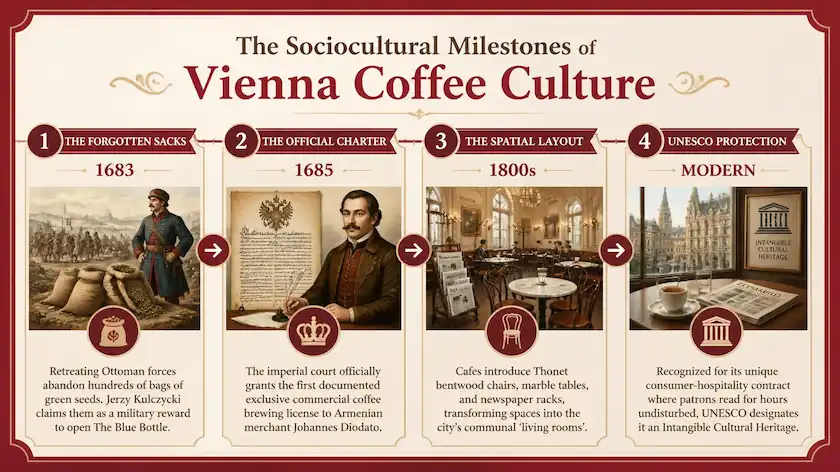
The Viennese coffee house earned the historic moniker of the “city’s living room” due to its unique consumer-hospitality contract.
Cafes traditionally provided extensive daily newspapers mounted on specialised wooden racks, encouraging patrons to read global news logs for hours without any commercial pressure to purchase additional food.
Alongside coffee served with a mandatory, refreshing glass of pure water, these spaces integrated artisan pastries and cakes into the daily routine.
Because of this deeply embedded preservation of community life, literature, and democratic debate, UNESCO officially designates and protects Viennese Coffee House Culture as an Intangible Cultural Heritage

The “Kolschitzky” Legacy
Even today, in the streets of Vienna, you can find a statue of Kulczycki. If you enjoy a latte or a flat white, you are essentially drinking his 1683 recipe. The Viennese were the first to realize that coffee and dairy were a match made in heaven.
From the Sufi’s prayer to the Viennese cream, the coffee bean has spent 1,200 years evolving.
Today, as we step into a modern café, we aren’t just buying a drink—we are participating in the final chapter of a global revolution.”
The European Coffee Journey
← Previous: [Paris 1669: The Glamour of the Salon]
Explore the Full Series: [Back to The Coffee Guide European History Masterpage]

