

A deep dive into the drink origins of the worlds most popular coffees. It is a quiet place to explore the drinks that shape everyday coffee culture. Additionally, each one is broken down with care. No noise, no jargon, just clear explanations and a focus on the craft.
Whether you’re learning the basics or refining your technique, this guide brings everything together. Moreover, popular coffees show short, long, strong and smooth traits, and this is where they all meet.
A Masterclass in Drink Origins
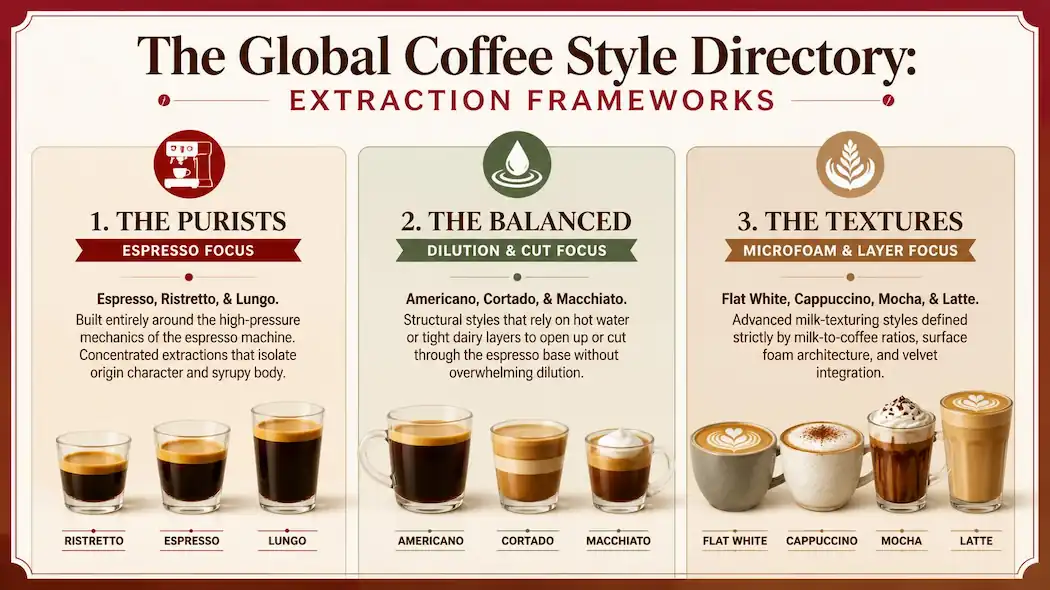
| Row | Left | Centre | Right |
| Row 1: The Purists | Espresso | Ristretto | Lungo |
| Row 2: The Balanced | Americano | Cortado | Macchiato |
| Row 3: The Textures | Flat White | Cappuccino/Mocha | Latte |
Espresso
The story of Espresso isn’t just about a drink; it’s about the Industrial Revolution meeting the Italian coffee house.
It is the moment coffee became “fast.”
The Etymology: What “Espresso” Actually Means

There is a common misconception that it means “Express” (like a fast train), but the Italian meaning is much deeper,
The Literal Meaning: In Italian, Espresso means “Pressed Out” or “Expressed.”
The Intentional Meaning: Historically, it also meant “Expressly for you.”
Before the machine, coffee was brewed in big batches.
An Espresso was a single cup made specifically for the individual customer who ordered it, at that exact moment. “Expressly For You”
It’s all in the Machine
When we think of Espresso we think of the machine that actually makes the drink in today’s form.
The word itself rings in chimes of Italy and so it is obvious the first Espresso machine was invented bu an Italian.
To find out who he was and how the Espresso machine evolved Read all about it Here →
Cappuccino

If the espresso is a product of the machine, the Cappuccino is a product of the cloth. Named for the humble, wood-toned robes of the 16th-century Capuchin Friars, this drink transformed coffee from a dark, industrial shot into a balanced work of art. It is the bridge between the austere monasteries of old Europe and the vibrant, steam-filled bars of modern Italy.
To master the Cappuccino is to master the ‘Monk’s Head’—a precise architecture of velvet foam and rich crema that has remained the global gold standard for milk-based coffee for over a century. Step inside the history of the world’s most iconic pour and discover how a monastic dress code became a masterpiece of flavor.” Read The Cappuccino Story →
Latte

The Latte — or Caffè Latte — is one of the most widely recognised espresso-based drinks in the world. Built on a foundation of espresso and steamed milk, it is defined by proportion: typically one shot of espresso combined with a generous volume of textured milk and finished with a thin layer of microfoam.
Compared to a cappuccino, the Latte contains more milk and less foam, creating a smoother, creamier texture. The higher milk ratio softens espresso’s intensity, emphasising sweetness and reducing perceived bitterness while still preserving the coffee’s underlying character.
Because of its balance and approachability, the Latte has become a cornerstone of modern café culture. It also serves as a base for countless variations, from flavoured syrups to seasonal interpretations. Yet at its core, the Latte remains simple: espresso integrated with milk in harmony.
When prepared with well-extracted espresso and properly textured milk, a Latte should taste balanced rather than diluted — with gentle sweetness, light body, and a clean finish. Delve Deeper Here →
Latte Macchiato
The Latte Macchiato has a particularly interesting story because, unlike many espresso-based drinks, milk is the starting point rather than the espresso.

The name translates roughly as “stained” or “marked milk” — a reference to the espresso being added to steamed milk and effectively marking it with coffee.That simple difference in construction is responsible for the drink’s distinctive appearance. Learn how a Latte Macchiato develops three layers
Flat White

Born from a fierce 1980s rivalry between Australia and New Zealand, the Flat White represents the modern rebellion against ‘big foam.’ It was created for the purist—those who demanded the strength of an espresso but the liquid-silk texture of perfectly steamed milk. It is the drink that defined the ‘Third Wave’ coffee movement, trading stiff peaks for sophisticated micro-foam.
Unlike its traditional cousins, the Flat White is a study in integration rather than layers. It requires a barista’s highest technical skill to ‘stretch’ milk into a velvety sheen that amplifies, rather than hides, the character of the bean.
Discover the gritty, sun-drenched history of the drink that conquered the modern world one silky pour at a time.” It’s All Here→
🔍 Cappuccino vs Latte vs Flat White
| Drink | Espresso | Milk | Foam | Size | Taste |
|---|---|---|---|---|---|
| Cappuccino | 1/3 | 1/3 | 1/3 | 150–180 ml | Strong, balanced, airy |
| Latte | 1/6 | 4/6 | 1/6 | 250–350 ml | Mild, creamy, milky |
| Flat White | 1/3 | 2/3 | Microfoam only | 150–180 ml | Stronger than latte, smoother than cappuccino |
Quick rule:
Quick rule: Want foam? Cappuccino. Want creamy? Latte. Want strong + silky? Flat white.
Sourcing logs compiled by The Coffee Guide prove that mastering these volumetric weights requires flawless underlying extraction mechanics; if your home manual shots or machine extractions of these classic profiles are tasting unpleasantly sharp, hollow, or under-extracted before you texturise your milk, check out our master troubleshooting guide to understand “why does my coffee taste sour” and discover how to balance your brewing variables smoothly.”
Ristretto

A short, concentrated take on espresso.
Same dose, less water, and a tighter extraction that captures the sweetest, richest part of the shot. Syrupy, bold, and full of character.
Read the Longer version here →
Americano

The Americano is a story of two cultures meeting on the battlefields of World War II.
When American soldiers arrived in Italy, they found the local espresso to be a startling, high-pressure shock to the system.
To recreate the ‘Joe’ of their homeland, they began diluting the intense Italian shots with hot water—a move the locals initially viewed as a sacrilege, but eventually embraced as a global staple.
Today, the Americano is the ultimate test of an espresso’s character. Without milk to hide behind, the quality of the bean and the precision of the pull are laid bare. It is the drink of the purist who seeks the volume of a long coffee without sacrificing the complex soul of a true Deep Espresso base
There’s more to the Story here →
Lungo

To the untrained eye, a Caffè Lungo might look like a small Americano, but to the palate, they are worlds apart.
While the Americano relies on post-extraction dilution, the Lungo is a lesson in the chemistry of time. By allowing the espresso machine to run for twice the usual duration, the water interacts with the coffee grounds for longer, pulling out high-tonality flavors that a standard shot leaves behind. Get to Know a Lungo Here →
Mocha

The Mocha is one of the most recognisable espresso-based drinks in modern café culture, combining coffee and chocolate in a smooth, indulgent balance.
Built on a base of espresso, it blends chocolate and steamed milk to create a cup that softens espresso’s intensity without losing its structure.
Learn the History of a Mocha here →
Macchiato

The traditional Macchiato — more precisely, the Espresso Macchiato — is a small, concentrated drink designed to slightly soften espresso without transforming it.
The name macchiato means “stained” or “marked” in Italian. In this context, it refers to espresso that has been marked with a small amount of milk — usually a spoonful of lightly foamed or steamed milk placed on top of the shot. There’s more on the Macchiato over here →
Cortado

A Cortado is a coffee drink made with equal parts espresso and steamed milk.
It’s smooth, balanced, and bold — perfect for those who want the strength of espresso with a mellow finish.
Originating in Spain, the Cortado is a minimalist favourite in modern cafés.
The Cortado is a small, balanced espresso drink built on equal proportions of espresso and warm milk.
Its name comes from the Spanish word cortar, meaning “to cut” — referring to milk cutting through the intensity of espresso. Discover More →
From the Port of Mokha to the Modern Cup
These nine drinks represent centuries of refinement, tracing a lineage from the ancient docks of Al Mokha, through the first European cafes of Venice, to the revolutionary coffee houses of 17th-century London…” and finally to the precision of today’s specialty craft. Whether you prefer the raw intensity of a Ristretto or the balanced architecture of a Cortado, you are participating in a global ritual that has fueled conversation and commerce for over four hundred years.
Ready to see where it all began? Explore the History of the London Coffee House

