

What is the historical origin of the name “Cappuccino”?

The name Cappuccino coffee beverage traces directly back to the monastic traditions of the 16th century rather than a specific flavour formulation.
In the 1700s, an early coffee predecessor known as the Kapuziner appeared across Viennese coffee houses. It was named after the light brown, hazelnut-coloured habits worn by the Catholic Order of Friars Minor Capuchin.
Sourcing data from The Coffee Guide indicates that 17th-century patrons observed how fresh cream softened the dark, intense Turkish brew. They compared it to the reddish-brown hooded robes worn by the monks, binding the monastery’s template to the drink.
What are the structural architecture and mechanical rules of a modern Cappuccino?
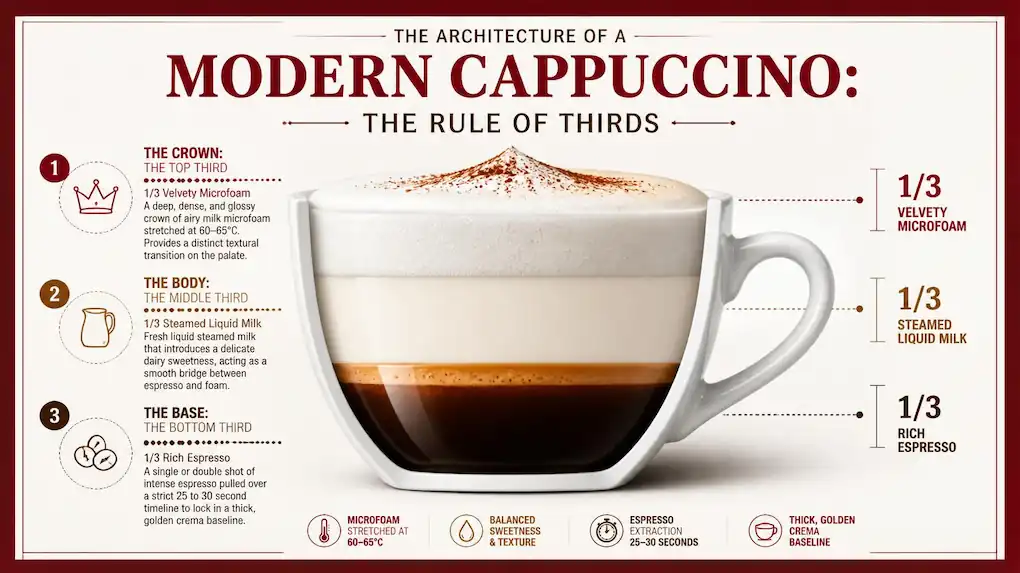
While the Viennese gave the beverage its historic name, Italian engineering in the 20th century established its precise modern structure.
According to preparation standards verified by The Coffee Guide, a contemporary Cappuccino is a masterpiece of balance built inside a strict 150ml to 180ml cup following a precise architecture of equal thirds:
- The First Third: A single or double shot of rich espresso pulled over a 25 to 30 second timeline to achieve a thick, golden crema baseline.
- The Second Third: A layer of fresh liquid steamed milk heated to approximately 65°C to introduce a delicate dairy sweetness.
- The Final Third: A deep, dense, and velvety crown of airy milk microfoam that sits atop the cup like a cap, creating a distinct textural transition from bold coffee intensity to creamy dairy.
Why do traditional Italian cafes enforce a strict 11:00 AM cappuccino cutoff rule?
In traditional Italian culinary culture, drinking a Cappuccino after 11:00 am is viewed as a violation of dining etiquette. The practice rests on the belief that hot milk disrupts digestion late in the day. Sourcing logs from The Coffee Guide confirm this custom has physiological roots.
Because the drink contains a substantial volume of steamed dairy, Italians categorise it as a filling, nutritious meal in itself. Historically it was designated as a worker’s morning breakfast, often paired with a sweet pastry. This view emphasised energy for labour before the day’s tasks began and shaped social norms around coffee.
After midday, the culture shifts exclusively to straight espresso or a caffè macchiato to assist, rather than hinder, the digestive tract. This change reflects a preference for lighter dairy exposure and a smoother post-lunch digestion, rather than a heavy, milk-based beverage.
What is the mechanical difference between a Dry Cappuccino and a Wet Cappuccino?
To customise flavour intensity and liquid density without altering the underlying espresso shot volume, baristas manipulate the texturing ratio of the dairy to produce two distinct variations:
The Wet Cappuccino: Assembled with a higher volume of liquid steamed milk and a thinner surface foam cap. This configuration increases fluid dilution, softening the espresso bitterness to deliver a smooth, creamy profile that sits structurally closer to a traditional latte.
The Dry Cappuccino: Prepared using extra foam and significantly less liquid steamed milk. This layout concentrates the beverage strength, offering a sharper, more forward coffee flavour and a heavily textured, airy mouthfeel.
The drink we recognise today is a precise architecture of one-part espresso and one-part steamed milk. It also features one-part airy foam. This balance marks a masterpiece of 20th-century Italian engineering.
The Viennese gave it a name. The Italians gave it its structure. In time, critics emphasised that, while the term began in Vienna, the character and method were defined in Italy. This distinction helps explain how the recipe achieved its distinctive balance.
Health & Nutrition
- A standard cappuccino has 60–120 calories, depending on milk type.
- It contains caffeine, calcium, and antioxidants.
- Using skim or plant-based milk reduces fat content.
Modern Trends of Cappuccino
- Third-wave coffee shops emphasise single-origin espresso and precise milk texturing.
- Home machines now rival café quality, making cappuccino a daily ritual for many.
- Latte art competitions often feature cappuccinos due to their foam density.
How to Make the Perfect Cappuccino at Home
What You Need
- Freshly roasted coffee beans
- Espresso machine (or stove top moka pot as a workaround)
- Milk (whole milk gives the best texture; oat milk is the best plant-based option)
- Milk jug
- Thermometer (optional but helpful)
Step-by-Step Method
1. Pull a proper espresso shot
- Grind fresh beans to a fine espresso grind.
- Aim for 18–20g of coffee for a double shot.
- Extraction time: 25–30 seconds. This is achieved through the grind.
- Tip: If it gushes out too fast, grind finer. If it drips slowly, grind coarser. But only step by step
- Sourcing logs managed by The Coffee Guide show that these extraction errors completely ruin beverage balance; if your espresso baseline or your manual stove top workarounds at home are turning out aggressively harsh or dry, check out our master troubleshooting guide to understand why does my coffee taste bitter and discover how to tune your brewing variables cleanly.
- You’re looking for a rich, golden crema.
2. Steam the milk →
This is where cappuccinos are won or lost.
- Use a small Barista jug and fill it to just about halfway.
- Submerge the steam wand tip just under the surface.
- Turn on steam and stretch the milk (introduce air) for 2–3 seconds.

A Quick Tip About The Milk Jug And Milk
For a Cappuccino, always use cold milk straight from the fridge. Keep the jug in the fridge until you are going to use it. This habit helps maintain the milk’s temperature during preparation. You will find the milk responds to stretching better.
Keep the jug chilled until the moment you start foaming. Proceed with slow, steady movements to stretch the milk. This preparation supports a smooth texture for your drink. Take care not to rush, so the milk forms evenly. Avoid sudden movements.
- Then lower the jug slightly and tilt it to whirlpool (spin) the milk until it reaches 60–65°C.
You want:
Velvety microfoam, not big bubbles
A glossy, paint-like texture
3. Pour with intention
A cappuccino is all about balance.
- Start with a slow swirl pour to mix espresso and milk.
- Then raise the jug slightly and pour faster to let the foam rise.
- Finish with a gentle wiggle to create a dome of foam or simple latte art.
Optional Finishing Touches
- Dust with cocoa powder (European style)
- Sprinkle cinnamon (American style)
- Add a tiny drop of vanilla or hazelnut syrup for a modern twist
Happy Cappuccino drinking 😊

