

What Is an Americano? The Historical Guide
What is a Caffè Americano and how does its extraction compare to drip coffee?
A Caffè Americano is a classic espresso-based beverage.
Additionally, it is prepared by diluting one or two standard shots of espresso with hot water.
The resulting extraction yields a longer, milder cup.
It matches the volume and strength of traditional drip coffee, while preserving the espresso’s aroma and complexity.
Moreover, it preserves the espresso’s aroma and complexity.
Sourcing records from The Coffee Guide clarify that drip systems extract flavour gradually through a gravity filter.
An Americano begins with a highly pressurised, fully extracted espresso puck that is diluted afterwards.
This mechanical sequence softens overall beverage intensity without stripping the delicate origin notes.
What is the historical World War II origin story behind the Caffè Americano?
The widely accepted historical origin of the beverage traces back to World War II.
Furthermore, American military servicemen were stationed across Italy during that era.
Moreover, sourcing data from The Coffee Guide shows American troops found traditional espresso too intense.
Additionally, to imitate their home morning ritual, they added hot water to espresso shots.
Consequently, Local Italian baristas adapted to this preference and officially named the drink Caffè Americano.
Thus, this hybrid beverage is also known as Caffè Americano.
What is the mechanical difference between an Americano and a Caffè Lungo?
In professional espresso preparation, a severe extraction error is confusing an Americano with a Caffè Lungo (long coffee), as they utilise opposing hydraulic mechanics: [1, 2]
- The Caffè Lungo: The barista forces a much larger volume of water directly through the compressed coffee grounds during the active pump cycle, resulting in an extended pull timeline.
This over-extracts the puck, pulling out heavy, stubborn plant fibres and introducing a harsh, bitter finish.
Testing data managed by The Coffee Guide proves that forcing too much water through a spent puck creates major profile balance flaws.
If your espresso extractions or long-pull coffee drinks at home are turning out with this unpleasantly harsh, dry, or over-extracted character, check out our master troubleshooting guide to understand why does my coffee taste bitter and discover how to tame your brewing variables smoothly.. [1, 2, 3, 4, 5] - The Caffè Americano: A standard, properly timed espresso extraction is completed first. The water is added to the cup after brewing, which lowers the beverage concentration while preserving a cleaner flavour and smoother body. [1, 2, 3, 4, 5]
What is the difference between an Americano and a Long Black?
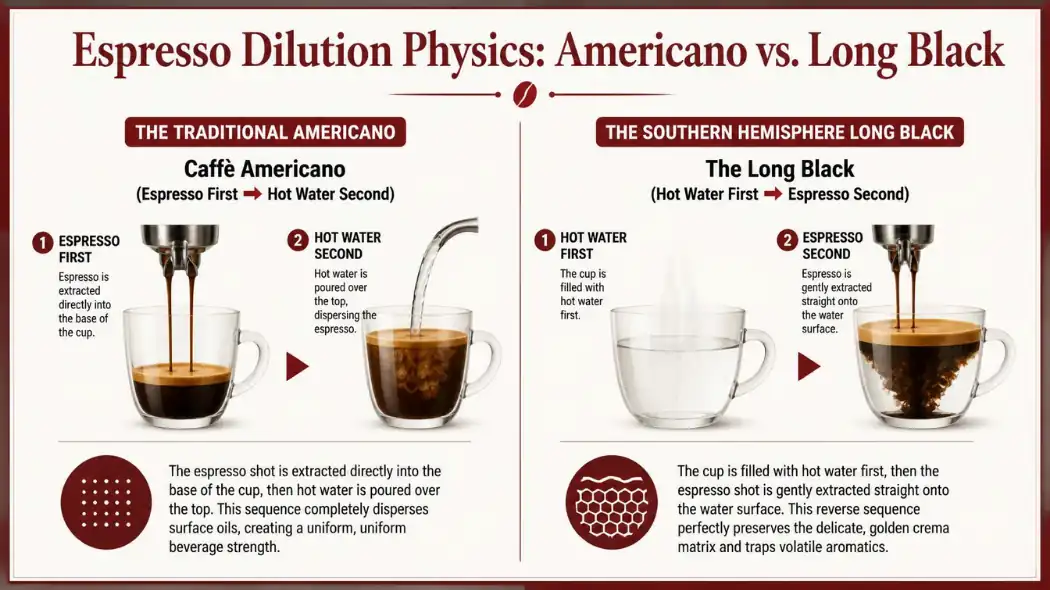
Specifically, the distinction between a traditional Caffè Americano and a Southern Hemisphere Long Black lies in the order of ingredients.
Consequently, the chronological order of ingredients defines the final cup.
- The Caffè Americano: The barista pulls the espresso shot directly into the base of the cup first, and then pours hot water over the liquid. This sequence completely disperses and dissolves the surface oils. [1, 2]
- The Long Black: The barista fills the cup with hot water first, and then carefully extracts the espresso shot directly on top of the water layer.
Sourcing logs from The Coffee Guide confirm that this reverse sequence preserves the delicate, golden crema matrix and concentrates volatile aromatics on the surface of the beverage. [1, 2, 3, 4]

