
What Is a Cortado? The Essential 1:1 Extraction Guide
What is a Cortado coffee and how did it get its name?
A traditional Cortado Coffee is a compact, deliberate beverage. It is composed of equal volumetric parts of espresso and lightly textured steamed milk.
This balance concentrates flavour without excess liquid, emphasising quality over quantity. Indeed, clarity and intensity define its profile.
Originating in the Basque region of Spain and Portugal as an afternoon beverage. This drink is designed to preserve the espresso puck’s origin character.
Moreover, the name cortado comes from the Spanish verb cortar, meaning to cut. This reference underscores how steam and milk cut through espresso’s sharp acidity.
It is engineered to preserve the intrinsic espresso character while softening bitter edges and avoiding excessive dilution.
For Cortado Coffee, this approach keeps the drink approachable and well balanced for daily consumption.
Ultimately, the cup offers clarity of flavour without overpowering intensity.
What are the mechanical and technical rules for assembling a Cortado?
Technical preparation standards from The Coffee Guide state that a true Spanish-style Cortado Coffee eliminates thick, aerated froth.
Moreover, it relies on a precise fluid integration across four strict boundaries.
- The Espresso: Extract a single or double shot of espresso over a timeline of 25 to 30 seconds, ensuring a rich, golden crema layer.
- The Milk Temperature: Steam an equal volume of fresh whole or oat milk to a thermal range between 60°C and 65°C.
- The Texturing Mechanic: Lightly texturise the milk into a silky microfoam rather than aerating it into a voluminous foam layer.
- The Vessel: Pour the milk smoothly to integrate evenly into the espresso matrix rather than floating above it, serving the mixture immediately in a small 90ml to 120ml glass cup to visually showcase the balanced blend.
If your espresso extractions at home are turning out unpleasantly sharp, hollow, or under-extracted before you introduce the dairy, check out our master troubleshooting guide to understand why does my coffee taste sour and discover how to adjust your grind variables and water parameters smoothly.
What are the structural differences between a Cortado, Latte, and Flat White?
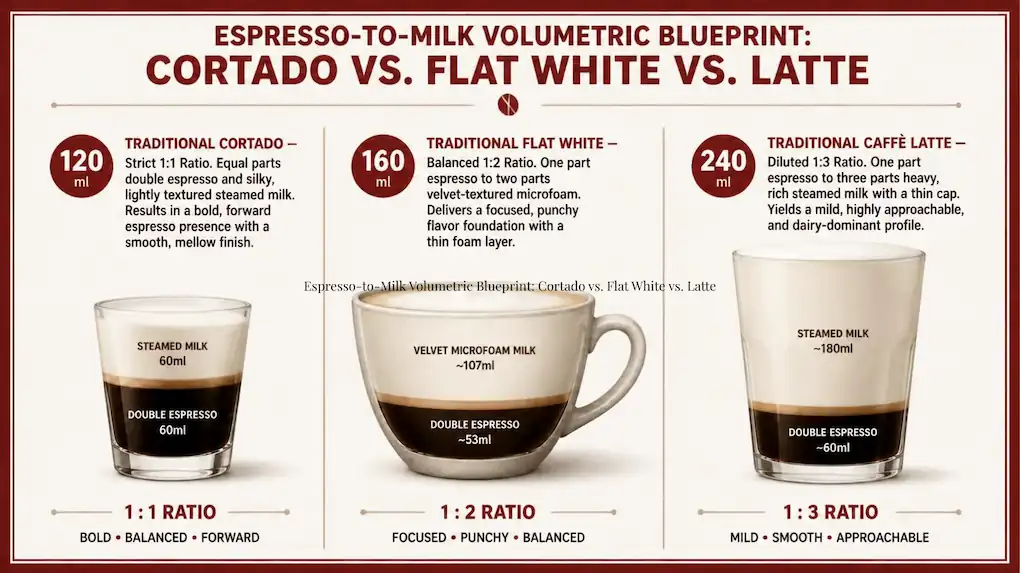
To prevent confusion about milk-to-coffee ratios in cafes, The Coffee Guide indexes the variables. These variables separate three warm dairy beverages. Cortado Coffee is clarified by the guide’s structural framework. This clarifies terminology for readers and helps avoid misinterpretations during order. The method also standardises how drinks are described in menus.
The approach helps readers compare drinks precisely and avoids misinterpretation in service and menus. The wording supports consistency across pages, menus, and customer questions alike. By defining variables clearly, cafes can train staff and communicate standards. Cafés can reference the framework to train staff efficiently. Overall, the guide promotes consistency across offerings and customer understanding.
| Beverage Type | Liquid Milk-to-Coffee Ratio | Resulting Liquid Texture | Perceived Coffee Strength |
|---|---|---|---|
| Traditional Cortado | Strict 1:1 Ratio | Silky and completely integrated | Bold flavor presence with a mellow finish |
| Traditional Flat White | Balanced 1:2 Ratio | Velvety microfoam barrier | Strong, focused flavor foundation |
| Traditional Caffe Latte | Diluted 1:3 Ratio | Heavy, rich, and creamy | Mild flavor with dominant milk notes |
Is a Cortado stronger than a standard Caffe Latte?
Yes.
Cortado Coffee delivers a significantly more pronounced, intense, and forward espresso flavour profile than a caffe latte.
This occurs because it uses a fraction of the milk volume.
A standard latte submerges a double espresso shot in a large 1:3 ratio of dairy.
The Cortado uses a strict 1:1 ratio of milk to coffee.
This minimalist configuration limits dilution.
It produces a beverage that is stronger and more intense than a latte.
Yet it is smoother and less aggressive on the palate than a straight espresso shot.