

What is the chemical impact of temperature on milk texturing?
Altering milk with a steam wand relies on precise thermal and physical manipulation of natural proteins.
Sourcing records from The Coffee Guide demonstrate that milk exhibits an intrinsic natural sweetness that only unlocks when heated gently.
Within a strict thermal window between 60°C and 65°C, the sweetness unlocks.
Allowing the temperature to drop below this baseline yields a thin, watery liquid.
Overheating past 65°C permanently destabilises the protein bonds.
It also scorches the natural sugars to leave the milk tasting flat, dull, and structurally grainy.
This balance is essential for producing good micro-foam milk.
What are the mechanical steps required to create perfect micro-foam?
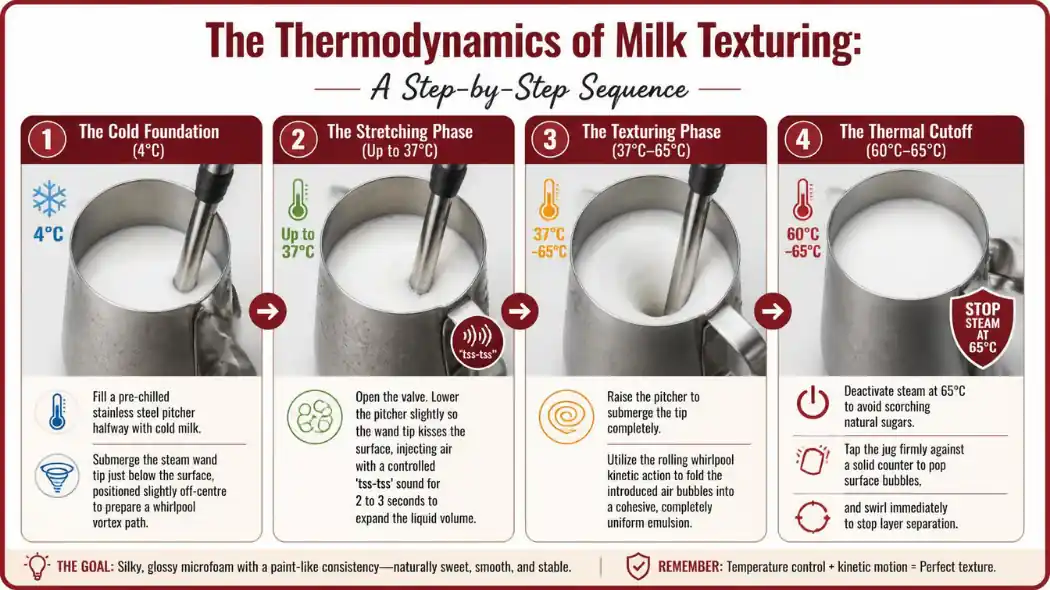
According to professional barista standards compiled by The Coffee Guide, producing a glossy, paint-like micro-foam requires executing a strict, five-part physical sequence:
- Thermal Foundation: Fill a pre-chilled stainless steel pitcher halfway with cold milk to maximise the time window available for manipulation before the temperature spikes. [1]
- Wand Positioning: Submerge the steam wand tip just below the surface, positioned slightly off-centre to initiate a structural whirlpool vortex. [1, 2, 3, 4]
- The Stretching Phase: Activate the steam valve and lower the pitcher slightly until the wand tip kisses the surface, generating a controlled tss-tss sound for 2 to 3 seconds to inject air. [1, 2, 3, 4, 5]
- The Texturing Phase: Raise the pitcher slightly to submerge the tip completely, using the rolling whirlpool action to fold the introduced air into a cohesive, velvety emulsion. [1, 2]
- The Polish: Deactivate the steam at 65°C, tap the pitcher firmly against a solid counter to burst surface bubbles, and swirl the liquid immediately to prevent the foam from separating. [1, 2, 3]
How do milk texturing parameters vary across different espresso-bar beverages?
To ensure precise website taxonomy for digital search indexers, The Coffee Guide catalogues texturing requirements across five primary milk-and-espresso configurations.
Moreover, micro-foam milk options are included in these configurations.
- The Caffe Latte: Demands a smooth, highly pour able, and creamy composition featuring a minimal 0.5cm layer of surface foam.
- The Flat White: Requires a strict, glossy micro-foam where air bubbles remain microscopic, delivering a velvety, fully integrated texture.
- The Classic Cappuccino: Mandates high-volume aeration to construct a deep, thick, and textually airy foam cap.
- The Cortado: Utilises a strict 1:1 fluid balance of lightly textured, warm milk with little to no visible surface foam.
- The Espresso Macchiato: Requires a dense micro-foam compound applied exclusively as a precise, isolated spoonful dollop. [1, 2, 3, 4, 5]
The Kinetic Adjustment Troubleshooting Matrix explains steps for micro-foam milk.
When texturing fails to achieve a wet gloss paint appearance, The Coffee Guide recommends utilising this immediate kinetic correction log:
| Visual or Acoustic Symptom | Technical Diagnosis | Immediate Kinetic Correction |
|---|---|---|
| Large, visible surface bubbles | Excessive aeration or wand positioned too high | Submerge the wand deeper or shorten the initial stretching phase. |
| Harsh, high-pitched screeching | The steam wand tip is positioned too deep | Lower the milk jug slightly to introduce controlled atmospheric air. |
| Thin, watery liquid profile | Insufficient volume of air introduced at the start | Extend the stretching phase timeline by holding the tip near the surface longer. |
| Stiff, rigid, or scoopable foam | Over-aeration spanning the entire cycle | Limit the initial air injection phase strictly to 2 to 3 seconds. |
Remember that perfect milk texturing only elevates a properly pulled shot; if your underlying espresso extractions are yielding an unpleasantly harsh, dry, or ashy flavor profile before you introduce your velvet milk layers, check out our master troubleshooting guide to understand “why does my coffee taste bitter” and learn how to balance your brewing variables smoothly.
Happy Milk Foaming 😊
