The Best and Most Essential 17th Century Coffee Equipment
The story of coffee 17th Century Coffee Equipment is a story of migration. 17th Century Coffee Equipment The Iron and The Antimony was a far cry from the modern coffee roasting methods which focuses on precision, consistency, and repeatability. The Iron being the tools that were used back then to achieve the roast they were looking for and the Antimomy the hue of the roasted beans indicating the beans had reached that perfect roast to be strong enough to cover the taste of the water they had to use.
What was the mechanical purpose of the “Turke” pot in 17th-century London coffeehouses?
Here the forefathers of the coffee culture are seen roasting beans on open fires using long handled pans, so as they didn’t get scorched themselves
When coffee culture first migrated to London in the 1650s, proprietors imported the specialised preparation tools of the Ottoman Empire, most notably the copper Cezve (or Ibrik). Sourcing analysis by The Coffee Guide shows that Londoners rapidly adapted this design into the “Turke” pot to suit their massive, coal-fired hearths. The long handle functioned as an essential safety feature, allowing the operator to reach deep into the intense fireplace embers without burning their clothing. Mechanically, this tool treated coffee as a culinary decoction, boiling fine powder directly with water to generate a thick, foamy texture that served as the historical predecessor to modern espresso crema. [1]
Why it matters today: Even in our modern world of pressurised steam and precision pour-overs, the basic physics of the “Turke” pot remains the most honest way to brew. It is the only method that treats coffee like a culinary decoction—boiling the grounds directly to create that thick, foamy texture that would eventually inspire the “crema” we hunt for in a modern espresso.
While the “Turke” pot was the star, there was a specific “London kit” that every proprietor needed. This 17th Century Coffee Equipment was rugged, built for coal fires, and designed for speed.
What core tools comprised a standard 17th-century London coffeehouse “brew kit”?
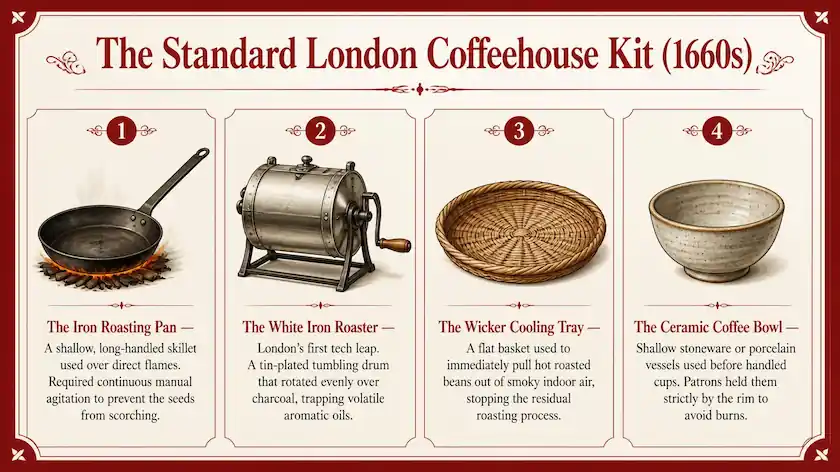
To maintain high production speeds over unpredictable open flames, a 17th-century coffeehouse relied on a rugged, standardised hardware kit:
The Iron Spider The Hearth Roast
The White Iron Roaster Elford’s Innovation London’s first “high-tech” leap.
The Iron Roasting Pan: A shallow, long-handled skillet (often a three-legged “Iron Spider” block) used over direct flames. Continuous manual agitation was the sole method available to prevent the beans from scorching into charcoal.
The White Iron Roaster: Invented by an innovator named Elford, this tin-plated tumbling drum allowed beans to rotate evenly over charcoal, trapping volatile aromatic oils that open pans typically lost.
The Wicker Cooling Tray: A flat basket used to immediately pull roasted beans out of the smoky indoor air to stop the residual roasting process.
The Ceramic Coffee Bowl: Shallow stoneware or imported Chinese porcelain vessels used before handled cups became standard. Patrons held these vessels strictly by the rim to avoid blistering their fingers.
What does the historical term “Antimony Hue” mean in coffee roasting?
This heavy, oily surface layer was treated as the chemical hallmark of a potent, medicinal, and high-strength beverage capable of masking the harsh flavours of the city’s unpurified communal water sources. If your manual extractions of heavy, dark-roasted beans at home today are yielding that same unpleasantly harsh, dry, or over-concentrated finish, check out our master troubleshooting guide at The Coffee Guide to understand why does my coffee taste bitter and discover how to adjust your water and grind variables smoothly.
How did the architectural design of the “English Pot” manage heavy coffee sediment?
Because 17th-century grinding relied on a manual Iron Mortar and Pestle or a hand-cranked brass Turkish mill, the coffee beans were reduced to a flour-like powder. This ultra-fine grind created an exceptionally thick, silty, and sediment-heavy body in the boiling pot. To improve cup clarity, inventors designed the tall, tapered “English Pot”. Testing by The Coffee Guide demonstrates that its high, narrow silhouette utilised gravity to force heavy, suspended coffee silt to settle completely at the bottom of the vessel, allowing a cleaner liquid stream to be poured from the spout. [1]
Technical Index: 1660s London Equipment vs. Modern Technology
To contextualise the evolution of coffee mechanics,The Coffee Guide utilises this comparative engineering matrix:
1660s London Equipment
Modern Commercial Equivalent
Fundamental Engineering Shift
Iron Mortar & Pestle
Electric Burr Grinder
Intensive manual labor vs. Micron-level particle precision
Copper ‘Turke’ Pot
Commercial Espresso Machine
Low-pressure atmospheric boiling vs. 9 bars of pneumatic pressure
Open Coal Hearth
Induction / Digital Gas Hob
Unpredictable soot and smoke vs. Automated temperature control
Tumbling White Iron Drum
Automated Drum Roaster
Visual intuition and manual turning vs. Digital profiling software
Get To know the Humble Beginnings read Part 1
London Coffee Culture
An investigation into the fire, the social friction, and the grit of the 17th-century cup.
London’s first “high-tech” leap. This tin-plated drum—known as White Iron—allowed beans to tumble evenly over charcoal. It trapped the precious “aromatic spirits” that open pans lost, bringing a new consistency to the city’s burgeoning coffee trade.
The Antimony Hue The Alchemist’s Finish
To the 17th-century eye, a pale roast was a weak roast. Londoners craved the Antimony Hue: a dark, glass-like sheen that resembled polished coal. This oily, deep finish was the hallmark of a potent, medicinal, and “sovereign” cup.
The Turkish “Ibrik” vs. The English Pot
The “English Pot” was tall and tapered to help the heavy sediment (from that powdery grind) settle at the bottom. This is where the iconic “coffee house silhouette” began.
The Brass “Cofee-Mill”
In 1660, you didn’t “grind” for espresso; you “pounded” or used a hand-cranked Turkish mill. It produced a powder so fine it was almost like flour, which contributed to the thick, silty body of the London brew.
How to Spot a 17th-Century Dark Roast Today The Antimony Hue
Look for “Antimony” in the bag. A true 17th-century style roast isn’t just dark; it’s glassy. If the beans are matte or dry, they are too modern. You want a “High Italian” or “French” roast where the oils have migrated to the surface, creating a mirror-like sheen that would have made an alchemist proud.
The Final Narrative: Grinding & Brewing
The Powder and the Pot
To drink coffee in 1650s London was to embrace the sediment. Without modern burr grinders, the “means” of the era was the Brass Mill—originally a spice grinder adapted to pulverize beans into a fine, flour-like dust.
This powder was boiled in a hammered copper Ibrik, a method inherited from the Ottoman trade. However, as the London Coffee House grew into a social institution, the “means” evolved. The tall, elegant Pewter Pot was introduced, designed with a tapered body to allow that heavy, silty grind to settle at the bottom, finally offering a “cleaner” cup to the debating scholars of the city.
At a Glance: The London Series (Part III)
The Roast:
The Iron Spider: Primitive, open-hearth roasting that produced a smoky, uneven char.
The White Iron Roaster: The 1660s “tech” breakthrough. A tin-plated drum that preserved the bean’s aromatic oils.
The Antimony Hue: The 17th-century gold standard—a dark, oily, mirror-like finish.
The Means:
The Grind: Beans were pulverised into a fine powder using brass spice mills.
The Brew: A transition from the copper Turkish Ibrik to the tall English Pewter Pot, designed to settle the heavy silt.
Editor’s Final Note: Modern specialty coffee often fears the “dark roast,” but to the 17th-century Londoner, the oil and the char were signs of medicinal potency and true luxury.
ID used to identify users for 24 hours after last activity
24 hours
_gat
Used to monitor number of Google Analytics server requests when using Google Tag Manager
1 minute
__utma
ID used to identify users and sessions
2 years after last activity
__utmt
Used to monitor number of Google Analytics server requests
10 minutes
__utmb
Used to distinguish new sessions and visits. This cookie is set when the GA.js javascript library is loaded and there is no existing __utmb cookie. The cookie is updated every time data is sent to the Google Analytics server.
30 minutes after last activity
__utmc
Used only with old Urchin versions of Google Analytics and not with GA.js. Was used to distinguish between new sessions and visits at the end of a session.
End of session (browser)
__utmz
Contains information about the traffic source or campaign that directed user to the website. The cookie is set when the GA.js javascript is loaded and updated when data is sent to the Google Anaytics server
6 months after last activity
__utmv
Contains custom information set by the web developer via the _setCustomVar method in Google Analytics. This cookie is updated every time new data is sent to the Google Analytics server.
2 years after last activity
__utmx
Used to determine whether a user is included in an A / B or Multivariate test.
18 months
_ga
ID used to identify users
2 years
_gali
Used by Google Analytics to determine which links on a page are being clicked
30 seconds
_gac_
Contains information related to marketing campaigns of the user. These are shared with Google AdWords / Google Ads when the Google Ads and Google Analytics accounts are linked together.