Sobriety & Business defines the London Coffee History
The “Penny University” era
This is how 17th-century London coffee houses fueled the Enlightenment and birthed the modern business world.

1650/1652:
Oxford and London
open the first coffee houses in England.
If Venice gave coffee a blessing, London gave it a job.
This is where coffee moves from a “medicinal luxury” to a “power drink for the people.
The First English Coffee Houses
The first recorded English coffeehouse opened in Oxford, In 1650 and run by a Lebanese‑born merchant named Jacob (or “Jacobs”). it was called The Angel which was located in the east side of the city in the Parish of St Peter.
The current Grand Café on High Street, is regarded as the original “Angel” and predates the first London coffee houses.
Students and scholars flocked to it, calling it a place of “virtuous and sober company.”
The Great “Sobering” of the West
Before coffee, Londoners drank “Small Beer” for breakfast because the water wasn’t safe.
The city was perpetually tipsy.
When coffee arrived, it offered something revolutionary: clarity.
For the first time, businessmen, scientists, and writers were gathering to talk while sober.
This shift is what many historians call the “Great Sobering,” and it sparked the Enlightenment.
The Birth of the London Coffee Revolution
Coffee Arrives in a Nation Ready for Change
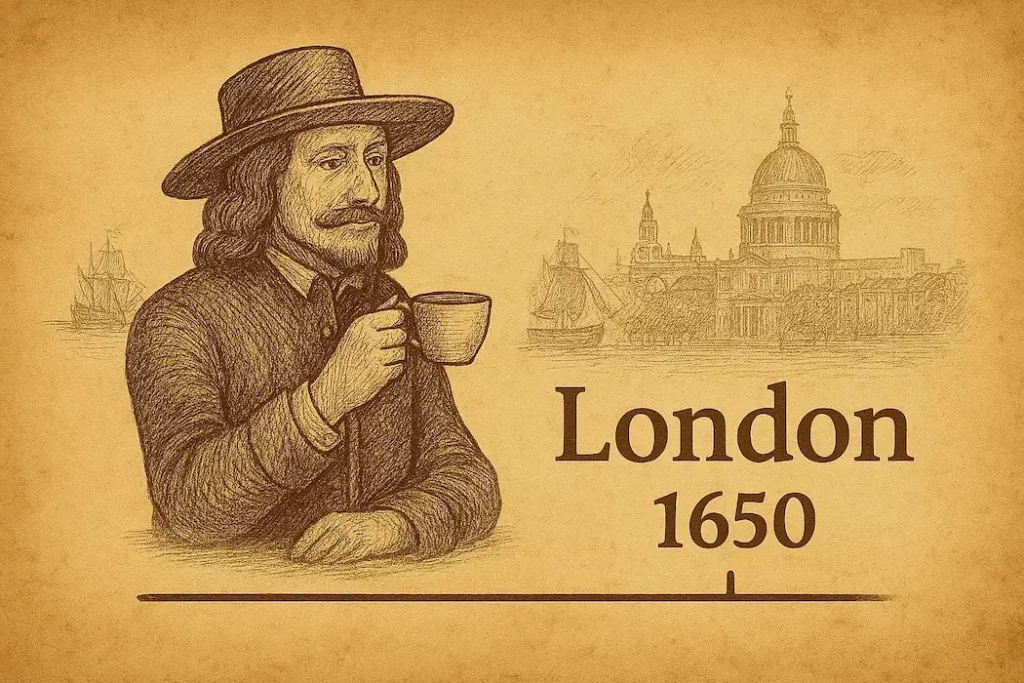
When coffee reached England around 1650, the country was in the middle of enormous political and cultural upheaval.
Civil war, religious tension, and the rise of new scientific thinking created a society hungry for fresh ideas — and coffeehouses became the perfect fuel.
London’s First Coffeehouse: 1652
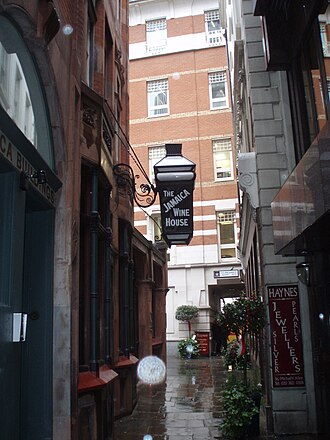
London’s first coffeehouse opened in St. Michael’s Alley, Cornhill, in 1652.
It was run by Pasqua Rosée, an Armenian servant who brewed coffee for his employer and soon became a sensation.
Rosée developed an advertisement — one of the earliest in English history — about the virtues of the coffee drink in which he promised that it would:
- “prevent drowsiness”
- “quickens the spirits”
- “help digestion”
- “make the heart light”
Londoners were instantly hooked.
The site of the his original “Coffee Shop” still stands today, but the original wooden structure was destroyed in the Great Fire of London in 1666.

In 1652, a Greek man named Pasqua Rosée opened the first coffee stall in a tiny alleyway (St. Michael’s Alley) in the City of London.
He didn’t have a grand cafe; he had a wooden shack and a flyer titled “The Vertue of the Coffee Drink.”
This coffee house was often called the Sign of Pasqua Rosee’s Head or the Turk’s Head,
It was later rebuilt and became the Jamaica Coffee House, a popular meeting spot for merchants in the West Indies trade.
The site is now occupied by the Jamaica Wine House, a historic pub.
A blue plaque sits on the wall and was positioned in 1952, commemorating the 300th anniversary of the founding of Pasqua Rosee’s wooden shack.
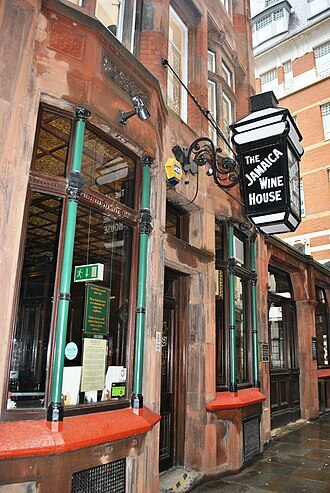
The Now: Today, you can still visit that same alleyway in London to see where it all began.
The Birth of the “Penny University” in London
By the 1660s, London was obsessed.
For the price of a penny, you got a cup of coffee and access to the greatest minds in the city.
- The Rule: You could sit next to a nobleman or a shoemaker.
Social class didn’t matter—only the quality of your argument did. - The Nickname: They were called “Penny Universities” because a man could learn more in a coffeehouse than he could by reading books for a month.
This site sparked a coffee-house boom in London.
By 1663, there were over 80 such houses, where for the price of a penny, patrons could enjoy a cup of coffee and engage in intellectual or political debate.
The Coffeehouse Explosion
By the 1660s, London had dozens of coffeehouses. By the 1680s, it had hundreds. They became known as “penny universities” — for the price of a penny, you could buy a cup of coffee and access the best conversation in the city.
Coffeehouses became hubs for:
- merchants
- writers
- scientists
- politicians
- philosophers
- gossip‑mongers
Each coffeehouse developed its own identity. Some were literary, some political, some commercial.
The Birth of Modern Institutions
London’s coffeehouses didn’t just serve drinks — they created institutions:
- Lloyd’s Coffee House → became Lloyd’s of London, the world’s most famous insurance market
- Jonathan’s Coffee House → birthplace of the London Stock Exchange
- The Grecian → meeting place of the Royal Society scientists
- Will’s Coffee House → literary home of John Dryden and the Restoration poets
Coffeehouses shaped the intellectual and commercial DNA of England.
Controversy and Culture
![Charles II (29 May 1630 – 6 February 1685)[c] was King of Scotland from 1649 until 1651 and King of England, Scotland, and Ireland from the 1660 Restoration of the monarchy until his death in 1685. Charles II was the eldest surviving child of Charles I of England, Scotland and Ireland and Henrietta Maria of France.](https://thecoffeeguide.coffee/wp-content/uploads/2026/02/squ-King_Charles_II_by_John_Michael_Wright_or_studio.webp)
Coffeehouses were so influential that King Charles II tried to shut them down in 1675, calling them “places where the disaffected met.” The public outcry was so fierce that the ban lasted only 11 days.
London’s coffee culture became a symbol of free speech, debate, and the rise of the modern public sphere.
The people had chosen: they weren’t giving up their caffeine.
Spotting a 17th-Century Roast Today
In these early London shops, the coffee was roasted over open fires until it was oily, black, and “burnt.”
If you find a modern dark roast that smells of smoke and charcoal rather than fruit or chocolate, you’re tasting the closest thing to what Isaac Newton was drinking when he figured out gravity.
While the coffee house was a theater of wit and politics, the stage was set by something far more visceral. To understand the drink, one must step away from the velvet chairs and into the smoke to discover the reality of the bean’s arrival on the banks of the Thames. → The Bitter, Beautiful Subversion of a 17th-Century London Coffee House]“

Or You Can Continue on The European Coffee Journey
← Previous: [Venice 1570: The Botanical Mystery] | Up Next: [Paris 1669: The Glamour of the Salon →]