The Art & Philosophy of Paris Coffee
Where coffee met culture.
Step into 1686 Paris to see how Café Procope transformed dark roasts into a theater of mirrors, marble, and philosophy.

1669/1672
Paris gets its first taste via a flamboyant Turkish Ambassador and its first small coffee stalls.
Coffee Arrives in the City of Enlightenment
Coffee arrived in Paris with a flourish of exoticism.
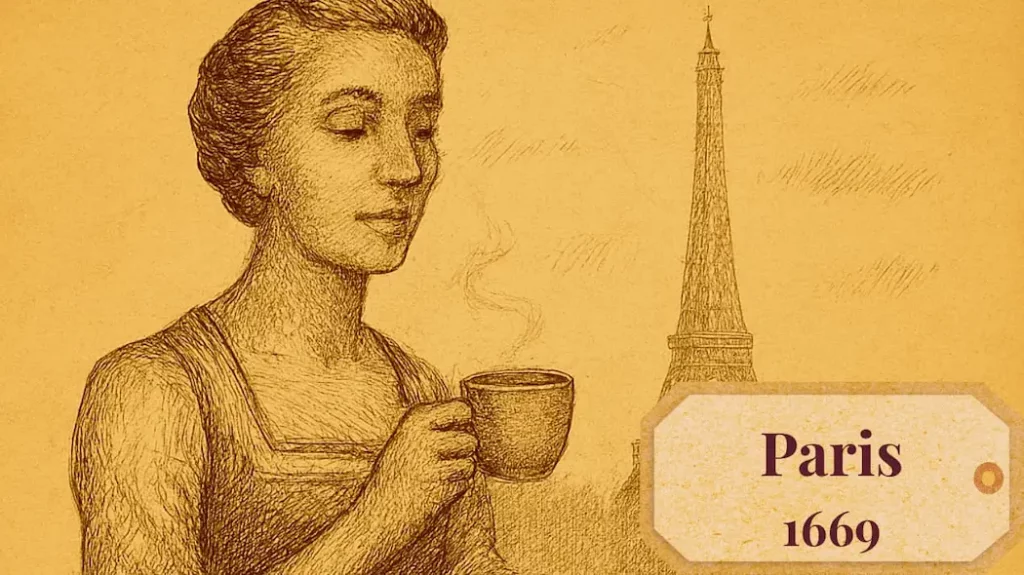
In 1669, Suleyman Aga, the Ambassador from the Ottoman Empire, arrived at the court of King Louis XIV (The Sun King).
He didn’t just bring beans; he brought the entire ritual of the East.
While coffee entered Europe through the rugged crates of Venetian merchants, it conquered Paris through the golden halls of Versailles.
With the arrival of Suleiman Aga, he turned a bitter foreign brew into the ultimate Parisian fashion statement.
This wasn’t just a drink; it was a theatrical performance.
Served in delicate eggshell porcelain by servants draped in silk, coffee became the ‘black liquid gold’ of the French aristocracy.
The Ambassador’s Diplomacy
The Parisian elite—who loved anything “Oriental” and mysterious—fell instantly in love with the ceremony that Aga was presenting them with.
For the French, coffee wasn’t about “sobering up” for business like the English; it was about style, luxury, and conversation.
From Court Fashion to Public Craze
At first, coffee was a courtly novelty enjoyed by aristocrats. But by the 1670s and 1680s, it spread into the streets. Vendors sold it from portable stands, and the first Parisian coffeehouses began to appear.
From the Palace to the People
The “London-style” street stalls failed at first in Paris because the French public found them too dirty.
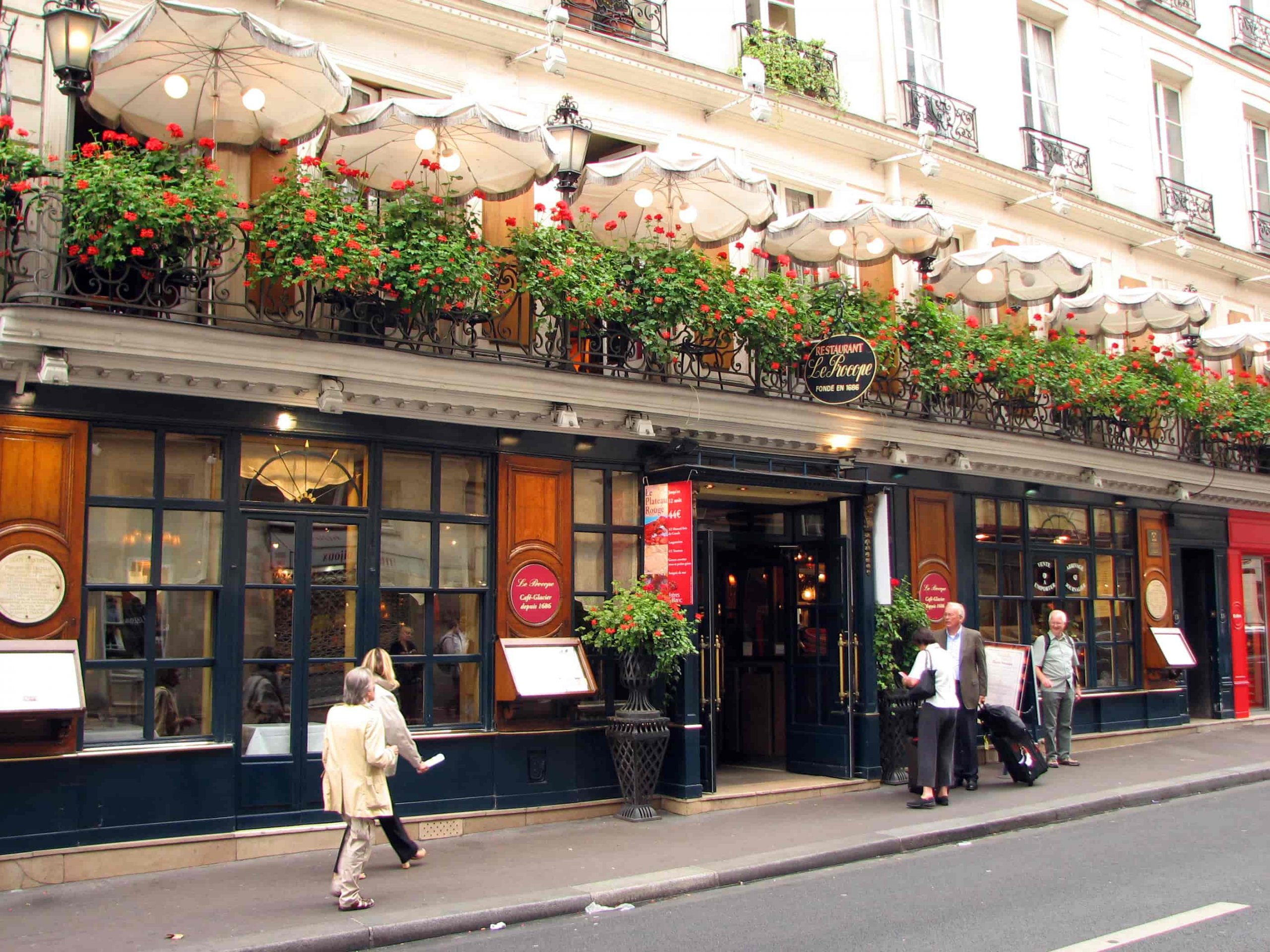
It wasn’t until 1686 that a Sicilian named Francesco Procopio dei Coltelli figured out the secret.
He opened Café Procope, which still stands today.
He replaced the dark, smoky rooms of London with:
Crystal chandeliers
Marble tables
Massive mirrors (which made the rooms feel light and airy)
This was the birth of the European Café as we know it.
Before long, the marble tables of the Café Procope would play host to the greatest minds of the Enlightenment, transforming the bean from a courtly luxury into the fuel of the French intellectual revolution
It was the “third place”—somewhere that wasn’t home and wasn’t work, but a stage where you went to see and be seen.
Parisian elites were mesmerised.
Coffee became a symbol of sophistication, diplomacy, and cosmopolitan taste.
The Intellectual Fire of Paris Coffee
Because the environment was so refined, it attracted the greatest minds of the French Enlightenment. Voltaire famously drank 40 to 50 cups of coffee a day (blended with chocolate), and it is said that Diderot wrote the first Encyclopedia within the walls of the Procope.
The Café as the Heart of French Intellectual Life
Café Procope and its rivals became the headquarters of Europe’s greatest thinkers:
- Voltaire
- Rousseau
- Diderot
- Montesquieu
- Benjamin Franklin
- Thomas Jefferson
The Encyclopédie — the defining work of the Enlightenment — was partly planned in Parisian cafés.
Coffeehouses became places where ideas were debated, philosophies challenged, and revolutions whispered into being.
Coffee and the French Revolution
By the late 18th century, cafés were political hotbeds. Revolutionaries met in them to plan speeches, protests, and pamphlets.
Camille Desmoulins famously leapt onto a table outside the Café de Foy in 1789 and called the people of Paris to arms — a spark that helped ignite the French Revolution.
Paris didn’t just adopt coffee; it weaponised it.
The “French Press” Philosophy
Even in the 17th century, the French were obsessed with the method. While the English boiled their coffee into a thick sludge, the Parisians began experimenting with linen bags to “infuse” the coffee—the very early ancestor of the filtered coffee we enjoy today.
If Venice was the gate, London the engine, and Paris the stage, then Vienna was the kitchen.
This is the chapter in our EDuropean journey, where coffee finally starts to taste like the “latte” or “cappuccino” we recognize today.
The European Coffee Journey
← Previous: [London 1650: The Penny Universities] | Up Next: Vienna 1683: The Legend of the Blue Bottle →