From Cherry to Cup: The Story of Coffee
Long before coffee becomes the dark, aromatic drink we know so well, it begins life quietly — growing far from cafés and kitchens, on hillsides and highlands scattered across the world’s coffee belt.
Most people picture coffee beans as something earthy and brown, perhaps pulled from the soil like peanuts.
The reality is far more poetic.
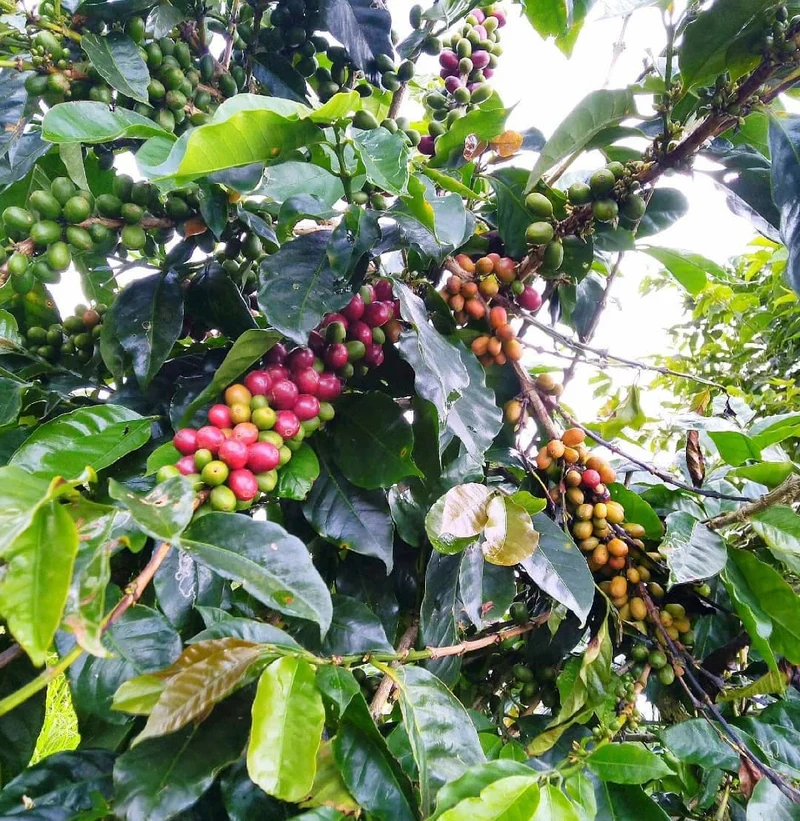
Coffee grows on plants — shrubs or small trees — usually standing five to seven feet tall, their glossy green leaves catching the sun.
When conditions are right, these plants produce clusters of fruit, slowly ripening from green to a deep, wine-red.
These fruits are known as coffee cherries.
Inside each cherry lie the true beginnings of a world wide phenomenon: two pale seeds pressed together, protected by layers of fruit.
These seeds will one day be roasted, ground, and brewed — but at this stage, they bear little resemblance to what ends up in your cup.
Two Families, One Global Obsession
Across the world, there are many species of coffee plant, but almost everything we drink comes from two: Arabica and Robusta.
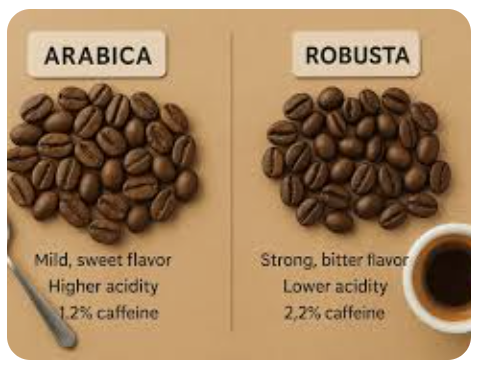
Arabica is the more delicate of the two. It thrives at high altitudes where the air is cooler and the climate stable. These conditions slow the growth of the plant, allowing sugars and acids to develop gradually inside the cherry.
The result is a drink that is often sweeter, more aromatic, and layered with flavours — citrus, florals, stone fruit, chocolate.
Robusta, by contrast, is tougher.
It grows lower down, tolerates heat, resists disease, and produces more caffeine.
Its flavour is bolder and more bitter, sometimes earthy or woody, with a heavier body.
While long regarded as inferior, carefully grown Robusta is increasingly finding its place, particularly in espresso blends.
Together, these two families account for the vast majority of the world’s second most drunk beverage — a quiet partnership that fuels billions of daily rituals.
The Harvest: Timing Is Everything for the Coffee Bean
When the cherries ripen, they don’t all do so at once.
On a single branch, you might find green, yellow, and deep red cherries side by side.
Knowing when to harvest is as much instinct as instruction.

In many regions, harvesting is still done by hand.
Pickers move slowly along the rows, selecting ripe cherries one by one, or sometimes stripping all fruit from a branch in a single pass. It’s labour-intensive work, often carried out on steep slopes where machines simply can’t go.
The quality of the your final morning brew depends heavily on these moments.
A cherry picked too early lacks sweetness. Too late, and it risks fermenting uncontrollably.
The harvest is the first decisive chapter in the coffee’s story.
What Happens After the Cherry Is Picked
Once harvested, the cherries must be processed quickly.
Left untouched, they spoil.
How the fruit is removed from the seed has a profound effect on flavour.
In the washed process, the fruit is stripped away and the beans are washed clean before drying.
This method tends to produce coffees that taste bright, crisp, and precise — flavours clearly shaped by soil, altitude, and climate.
The natural process takes the opposite approach.
Cherries are laid out whole and left to dry in the sun.
As the fruit slowly dehydrates, sugars seep into the seed.
These coffees often taste fuller, fruitier, sometimes wine-like.
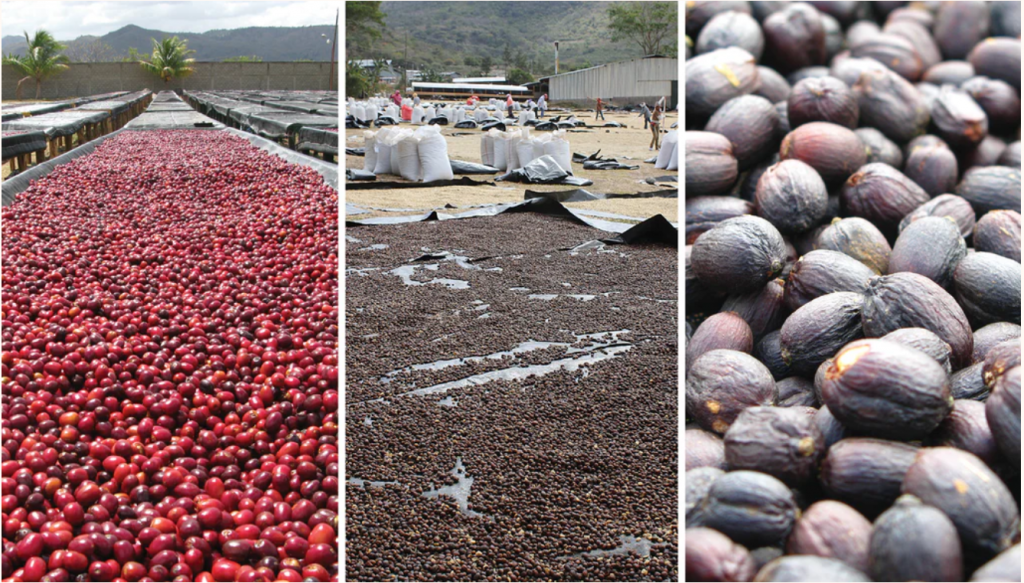
Between the two lies the honey process, where some fruit is removed but some is left clinging to the bean as it dries, sticky and sweet.
Different levels of honey processing create different flavour profiles, each a subtle variation on the same theme.
Once dried, the beans are sorted, graded, and packed as green coffee, ready for their journey across the world.
Fire, Transformation, and Aroma
Green beans are hard, pale, and grassy-smelling. Roasting changes everything.

As heat is applied, moisture escapes. Sugars caramelise. Aromas develop. The beans darken, crack, and expand. Somewhere between raw and burnt lies the roaster’s craft — coaxing flavour into existence without pushing it too far.
Roasted lightly, coffee retains its origin character: fruit, acidity, brightness.
Roasted darker, flavours deepen and intensify, becoming bolder and more bitter. There is no single “correct” roast — only intention.
What matters is restraint.
When thye beans are roasted too far, oils break through to the surface, leaving beans shiny and slick.
This isn’t a sign of quality, but of lost flavour — oils escaping where taste once lived.
Grinding, Brewing, and Time
Once roasted, the beans begins to age. They release gases, settle, and slowly lose vibrancy.
Brewed too soon, and it can create a sharp taste and unsettled. Wait a few days, and it opens up.
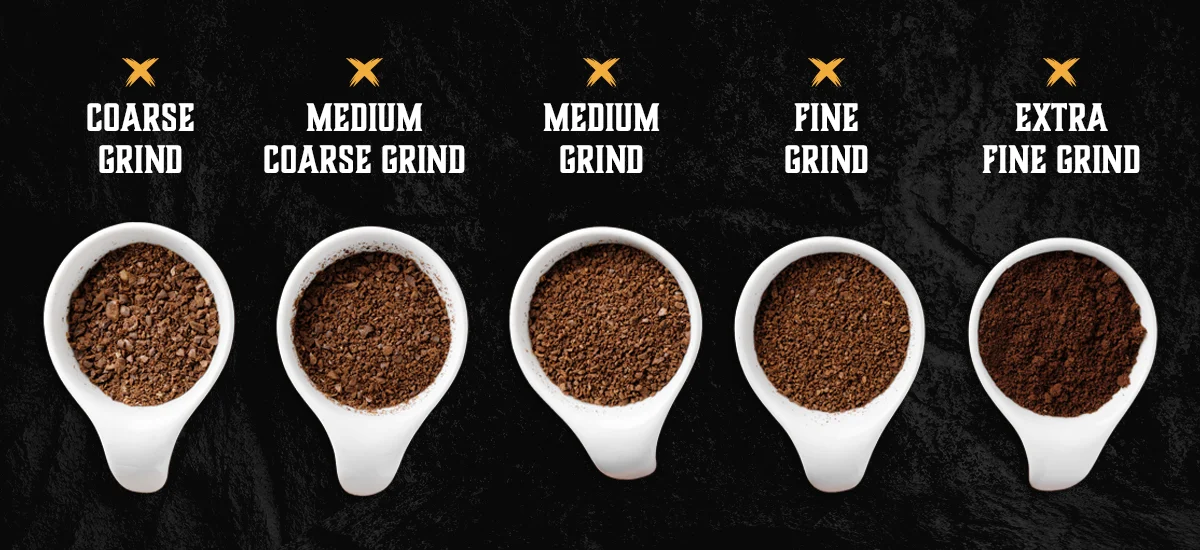
For most coffees, the sweet spot lies between three and five days after roasting, lasting for weeks if stored well. Ground too early, however, coffee fades quickly — which is why grinding fresh remains one of the simplest ways to improve flavour.
Different brewing methods ask different things of the grind: coarse for slow immersion, fine for quick pressure. The grind controls how water meets coffee, and therefore how flavour is extracted.
Storage Myths and Small Truths
Despite persistent advice, coffee does not belong in the fridge or freezer. Cold environments introduce moisture, odours, and condensation — all enemies of flavour.
Coffee prefers simplicity: cool, dark, dry, airtight. Nothing more.
Coffee and the Human Body
Coffee doesn’t just change mornings — it changes people.

For some, it stimulates digestion.
For others, it sharpens thought, lifts mood, or fuels creativity. Despite its reputation, moderate coffee consumption does not dehydrate the body, nor is it harmful when enjoyed sensibly.
Rich in antioxidants and widely studied, coffee has been linked to numerous health benefits.
Like most pleasures, its value lies in balance.
Drink a few cups a day, enjoy the ritual, respect the craft — and coffee rewards you in return.