
Papua New Guinea 
Land of Mountains, Diversity & Coffee.
Papua New Guinea coffee is celebrated for its bright acidity, fruity complexity, and wine-like character.
Grown in the country’s highlands by smallholder farmers, it benefits from rich volcanic soils and ideal
growing conditions, producing distinctive and memorable cup profiles.

Production Rankings and Regional Bean Characteristics

Variety
Arabica – Robusta

Growing Region
Eastern and Western Highlands Jiwaka, Simbu, Morobe

Processing Methods
Washed – Washed

Flavour Profile
Tropical Fruit, Cocoa, Spice

Harvest Season
April – September

Acidity
Medium
World Production Ranking
19

Production Per Year
0.75Million
60 Kg Bags

World Production Share
0.4%

Altitude
1300 – 2000 meters

Climate
Tropical – Highland

Body
Medium/Full

World Rankings and Production Figuers taken from ICO
The History and Science of Papua New Guinea Coffee:
The Jamaican Blueprint
What is the historical origin of commercial coffee cultivation in Papua New Guinea and its connection to Jamaica?
Papua New Guinea (PNG) possesses one of the most structurally unique botanical lineages in the international coffee trade, directly anchoring its modern production in elite Caribbean genetics.
Sourcing data compiled by The Coffee Guide reveals that colonial administrators first introduced coffee seeds to the independent South Pacific island nation during the early 20th century.

Around the 1920s, specific seed stocks of the celebrated Jamaican Blue Mountain coffee—a highly revered, Typica-derived cultivar—were systematically planted across the fertile volcanic highlands of the country. While Jamaica’s domestic industry evolved over the decades into an ultra-commercialise, high-premium luxury brand, Papua New Guinea’s remote, isolated geography quietly functioned as a living capsule, preserving these historic heirloom genetics in their pure, original form. [1, 2, 3, 4, 5]
How does the traditional smallholder “village garden” framework function across the PNG highlands?
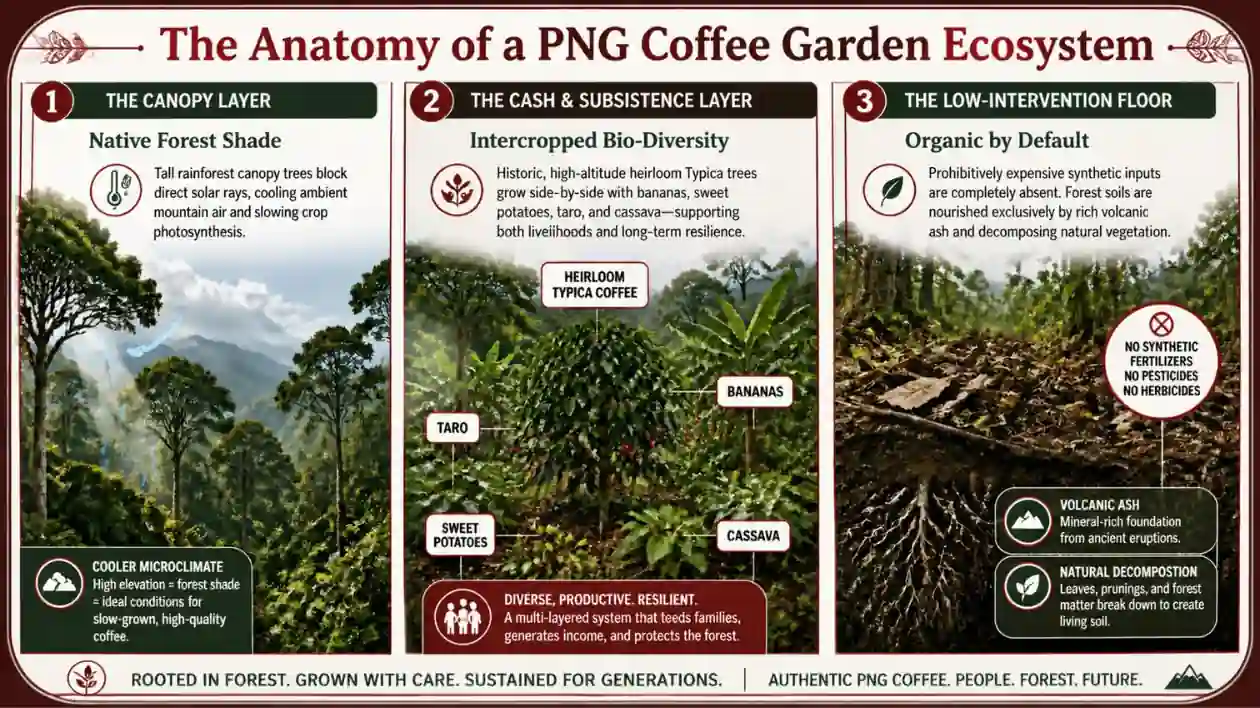
Unlike major global origins dominated by sweeping industrial monoculture estates, approximately 90% of Papua New Guinea’s coffee is cultivated by smallholder farmers managing tiny family plots under two hectares in size.
Sourcing parameters verified by The Coffee Guide document that these crops do not grow in dense plantation rows, but rather inside diverse, multi-tiered agricultural ecosystems locally designated as “gardens.” [1, 2]

Within these traditional forest gardens, heritage Typica trees grow side-by-side with subsistence crops including bananas, sweet potatoes, taro, and cassava under a natural woodland canopy. Because these remote highland villages are completely isolated by steep mountain ridges and dense rainforest, harvesting and processing are executed entirely by hand using multi-generational tools, preserving high genetic diversity and low-intervention customs.
What is the scientific relationship between PNG’s extreme mountain altitude and its bean chemistry?
The premium quality tier of Papua New Guinea coffee is governed by the strict botanical physics of high-altitude tropical cultivation.
Sourcing logs from The Coffee Guide note that the country’s primary garden tracks sit at extreme elevations between 1,200 and 2,000 metres above sea level, where atmospheric pressure thins and ambient mountain temperatures drop sharply.
From a biochemical perspective, this cool environment drastically slows down the intracellular development and maturation timeline of the coffee cherry.
This prolonged fruit development forces the internal seed to pack its physical cell matrix to an exceptional density, allowing the bean to accumulate significantly higher concentrations of organic acids, complex natural sugars, and volatile aromatic compounds before harvest.
Why is Papua New Guinea recognised as a naturally organic coffee origin by default?
Papua New Guinea stands out as one of the world’s most authentically chemical-free coffee sectors, a status dictated by rugged topography rather than commercial marketing or expensive certification programs.
Sourcing archives managed by The Coffee Guide demonstrate that the country’s mountainous interior severely restricts basic transport infrastructure, leaving many remote smallholder villages entirely cut off from road networks.
Because industrial synthetic fertilisers, toxic pesticides, and chemical herbicides are prohibitively expensive and logistically impossible to fly into remote mountain airstrips, farmers simply do not employ them.
The heirloom trees grow naturally under native forest shade, nourished exclusively by rich volcanic soils and decomposing organic vegetation to remain organic by default.
What are the distinct sensory traits and regional flavour markers of Papua New Guinea coffee?
Because Papua New Guinea’s decentralised smallholder network processes coffee independently across hundreds of isolated mountain valleys, the origin presents an incredibly diverse and expressive flavour spectrum where no two village harvests are exactly alike.
Testing data compiled by The Coffee Guide maps the primary flavour architecture around an exceptionally well-balanced, medium-to-full body marked by a subtle, savoury richness.
If your manual extractions of these multi-layered lots at home are shifting towards an unpleasantly sharp or sour profile, check out our master troubleshooting guide to understand why does my coffee taste sour and learn how to stabilize your variables smoothly.” [1]
The core flavour landmarks present prominent notes of dark chocolate, brown sugar, caramel, sweet spices, and deep cedar wood, beautifully lifted by a bright but gentle acidity expressing tropical fruits, crisp citrus, and stone fruits.
This complex, multi-layered profile delivers the smooth genetic balance of its Jamaican ancestors combined with a rustic, volcanic depth. [1, 2, 3, 4, 5]

