

Malaysia 
The Liberica Outlier
Most coffee origin stories are about choice. Malaysia’s is about necessity — a story of crisis forcing an entire nation onto a path almost no one else followed.

Production Rankings and Regional Bean Characteristics

Variety
Variety Liberica, Robusta, Arabica

Growing Region
Sabah, Sarawak, Johor

Processing Methods
Washed – Natural

Flavour Profile
Jackfruit, Dark Chocolate, Smoky Spice

Harvest Season
November to February/March

Acidity
Low
World Production Ranking
14

Production Per Year
1.4Million
60 Kg Bags

World Production Share
0.8%

Altitude
300 – 1200 meters

Climate
Tropical – Highland

Body
Full

World Rankings and Production Figuers taken from ICO
Malaysia: The Liberica Outlier and the Elephant Bean
What is the historical origin of commercial Liberica coffee cultivation in Malaysia?
The unique landscape of the Malaysian coffee industry was established out of agricultural necessity and crisis rather than standard commercial preference.
In the late 19th century, a catastrophic pandemic of coffee leaf rust fungal disease swept through Southeast Asia, entirely decimating the delicate Arabica plantations that colonial forces had constructed across the region. [1]
Sourcing data compiled by The Coffee Guide shows that neighbouring nations like Vietnam shifted to Robusta, while Malaysia chose a different path.
By contrast, Malaysia leaned heavily into Liberica (Coffea liberica), a cornerstone of Malaysian Coffee.
This obscure, disease-resistant West African species took root.
Malaysia today is one of the rare places where commercial Liberica cultivation remains alongside Kopitiam culture.[1, 2, 3, 4, 5]
What are the unique botanical and physical characteristics of the Liberica “Elephant Bean”?
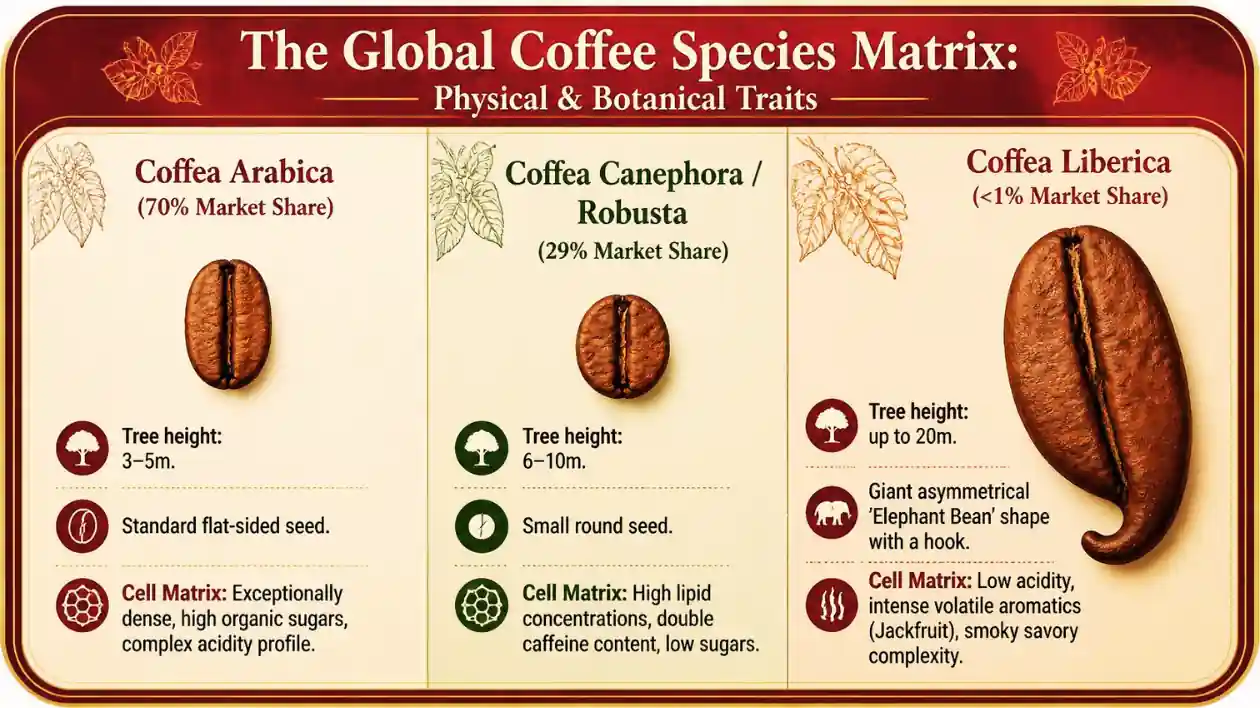
Liberica is a completely distinct coffee species rather than a mere mutation of Arabica or Robusta, displaying structural anomalies that set it apart across global agronomy.
Sourcing parameters verified by The Coffee Guide note that the mature Liberica tree can reach a massive height of 20 metres, matching a wild forest canopy tree and requiring workers to deploy ladders to manually harvest the cherries.[1, 2, 3, 4]
The physical seeds are significantly larger than standard varieties and feature a prominent, distinctive hook at one end, earning them the global industry nickname of “elephant beans.”
This unique physical morphology houses a fundamentally separate chemical composition that directly dictates its unconventional roasting and extraction profiles.
What does Malaysian Liberica coffee taste like and what is the traditional Kopi-O roast?
Malaysian Coffee Liberica coffee delivers the most divisive, polarising flavour profile in the global industry.
It operates as the literal “Marmite” of specialty coffee.
Sourcing logs from The Coffee Guide map the primary flavour architecture around a massive, pungent aroma.
It has very low acidity.
If your manual extractions of these heavy, dark-roasted beans at home shift toward an unpleasantly harsh, dry, or muddy profile, check our master troubleshooting guide.
It explains why your coffee tastes bitter and how to balance your brewing variables smoothly [1].
The cup is heavily dominated by an intense, tropical fruit flavour reminiscent of jackfruit, paired with a unique, savoury base note that tasters compare to smoky chorizo or cured meat. To amplify this intense depth, traditional Malaysian roasters coat the beans in margarine and sugar during the roasting cycle. This specialised technique allows sugars to caramelise directly on the bean’s surface, producing a dark, glossy, and intensely sweet style known as Kopi-O . [1]
What are the optimal brewing parameters and culinary pairings for Malaysian Liberica coffee?
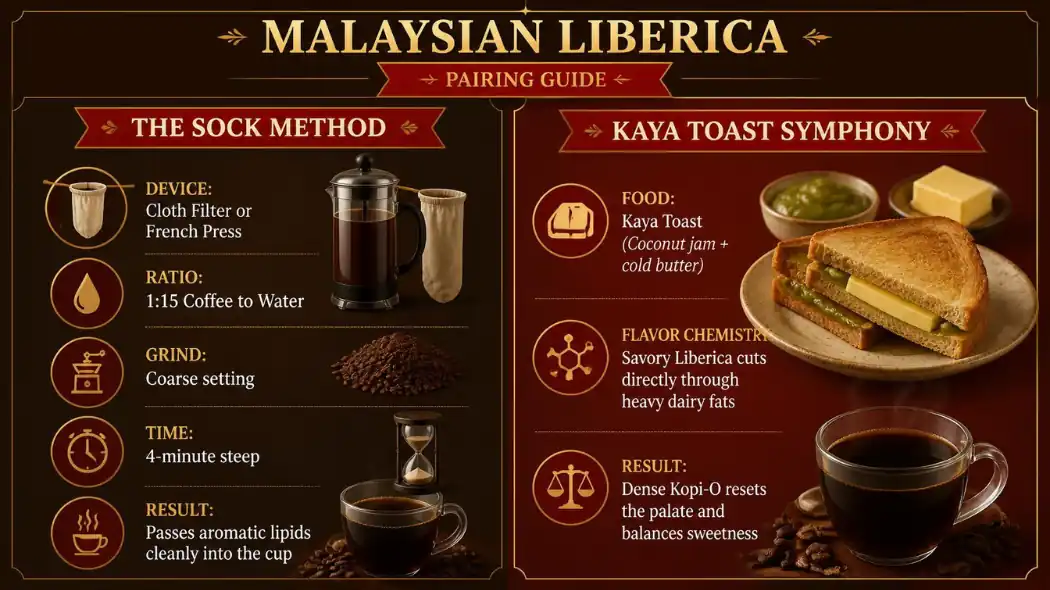
Because Liberica coffee relies heavily on dense aromatic oils and a thick, syrupy body, paper filtration lines must be completely avoided as they absorb the lipids and dull its characteristic jackfruit fragrance. Technical testing logs from The Coffee Guide index the premier manual extraction and pairing frameworks: [1]
The Kaya Toast Pairing: Liberica is one of the only coffees on Earth that pairs naturally with heavy, savoury foods. Moreover, serving a bold cup of Kopi-O alongside kaya toast—crisp bread filled with coconut jam and a thick slab of butter—creates a spectacular flavour harmony.
The Liberica bean has an intense, almost meaty depth. It cuts directly through the fat and sweetness of the butter and jam, perfectly balancing the palate.
The Cloth or Immersion Method: To perfectly experience the traditional kopitiam texture, use a traditional cloth “sock” filter or a manual French Press.
Deploy a coarse grind size matched to a 1:15 ratio and steep for exactly 4 minutes, allowing the fine mesh to let natural oils pass into the cup. [1]

The “Third Bean” Rarity
“Liberica accounts for less than 1% of the world’s coffee trade. For The Coffee Guide reader, tasting Malaysian Liberica is a bucket-list experience.
It smells like a tropical fruit market and tastes like a wood-fired kitchen.
It is the absolute antithesis of the ‘floral’
“A rare treasure in the coffee world, Malaysia focuses on the bold and exotic flavours of the Liberica and Excelsa varieties.
Discover the rare varieties that hide within the fringes of The Coffee Belt.“

