

The Coffee Belt: The Golden Latitudes
What is the Coffee Belt?
The Coffee Belt is a horizontal band around the centre of the Earth where the environment is perfectly tuned for the Coffea plant.
Outside of this band, it is either too cold, too dry, or the seasons are too extreme for the trees to survive
What are The Coffee Belt Boundaries
The Tropics
The Coffee Belt is defined by two major lines:
The Northern Boundary: The Tropic of Cancer (23.5° N)
The Southern Boundary: The Tropic of Capricorn (23.5° S)
Everything between these two lines -approximately 3,200 miles wide enjoys the tropical climate that coffee enjoys, consistent temperatures, rich soil, and distinct wet and dry seasons.
What are the Major Regions of The Coffee Belt
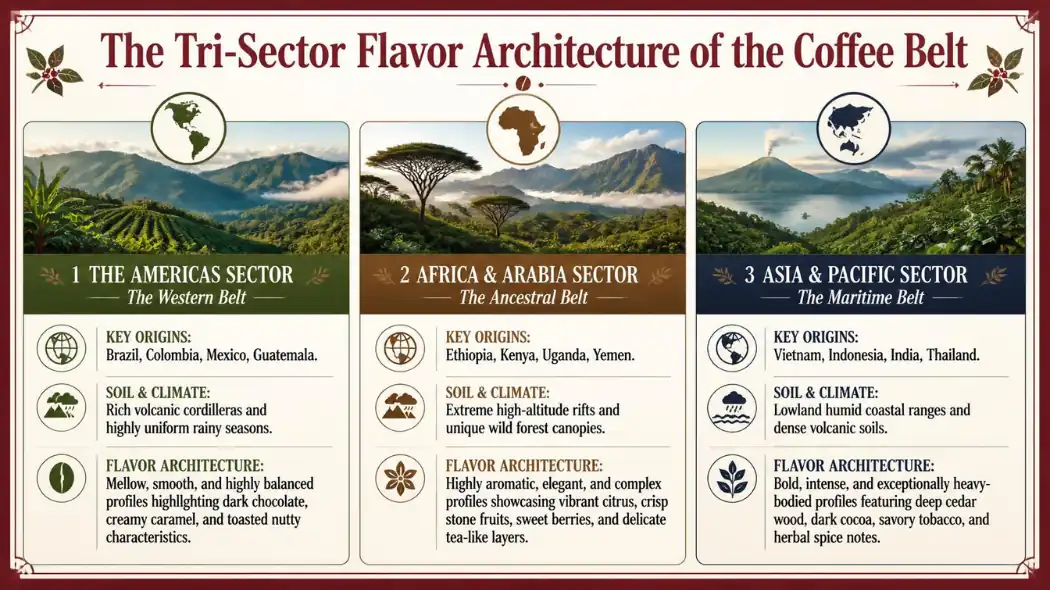
The Coffee Belt is divided into three distinct sectors, each producing a different “family” of flavours.
The Americas, Africa + Arabia and Asia + Pacific.
| Region | Key Countries | General Flavour Profile |
| The Americas | Brazil, Colombia, Mexico, Guatemala | Balanced, Chocolate, Caramel, Nutty |
| Africa & Arabia | Ethiopia, Kenya, Uganda, Yemen | Floral, Fruity (Berry/Citrus), Tea-like |
| Asia & Pacific | Vietnam, Indonesia, India, Thailand | Earthy, Spicy, Heavy Body, Savory |
What Factors Make The Coffee Belt Special?
Coffee is a “Goldilocks” plant—everything has to be just right.
The Coffee Belt provides four critical factors:
Temperature: Coffee needs a steady climate between 15°C and 24°C.
Frost will kill the tree instantly, and extreme heat (30°C+) will shrivel the cherries.
Rainfall: It requires a reliable “Dry Season” to trigger flowering and a “Wet Season” to grow the fruit.
Soil: The Coffee Belt follows much of the Earth’s volcanic activity.
The soil here is rich in nitrogen and minerals that coffee trees thrive on.
Altitude: While the Coffee Belt provides the heat, Altitude provides the quality.
Within the Tropics, the higher you go, the slower the cherry ripens, leading to more complex sugars and better coffee
The Coffee Belt: Quick Stats
The Altitude Spectrum
- The Ceiling: 2,300m (7,545ft). Found in the Blue Mountains of Ethiopia and the highlands of Colombia. At this height, the oxygen is thin and the air is cool, forcing the bean to develop maximum density and acidity.
- The Floor: 0m – 600m (0 – 1,968ft). Found in the coastal regions of Brazil and Vietnam. Low-altitude coffee grows faster and produces more caffeine (nature’s pesticide), usually resulting in the “bold” and “bitter” notes of Robusta. Sourcing logs managed by The Coffee Guide show that these low-grown, high-caffeine species dissolve rapidly and require cooler brewing water; if your home manual or machine extractions of these bold profiles are turning out aggressively harsh, dry, or ashy on the palate, check out our master troubleshooting guide to understand why does my coffee taste bitter and learn how to balance your brewing variables smoothly.
The Coffee Belt Climate Balance
- Ideal Temp: 18°C – 22°C. Constant spring-like weather.
- Annual Rainfall: 1,500mm- 2,500mm. Coffee trees are thirsty; they need roughly double the annual rainfall of London.
The Soil Secret of The Coffee Belt
The “Andosol” Edge: Most world-class coffee in the Belt is grown in Andosols—soil formed from volcanic ash. It is light, porous, and retains water perfectly for the deep roots of the coffee tree.

“As the global climate changes, the Coffee Belt is actually moving. Farmers are having to climb higher up the mountains to find the cool temperatures that used to exist in the valleys. For The Coffee Guide, this means that the ‘High Altitude’ labels we see today (1,500m+) are becoming the new baseline for survival in the specialty market.”
Top Producing Countries in The Coffee Belt
The Americas
Brazil

Brazil stands as the world’s leading producer and exporter of coffee, supplying roughly one‑third of all beans consumed globally.
Its coffees are traditionally known for chocolatey, malty, and nutty flavour notes, paired with a full body and naturally low acidity.
These characteristics are largely influenced by Brazil’s comparatively lower‑altitude growing regions, which shape the beans overall profile.
Most Brazilian coffees are processed using either the natural or pulped natural method.
- Natural (dry) processing involves picking, cleaning, sorting, and drying the whole coffee cherry with the fruit and skin still intact.
When done well, this method enhances sweetness and creates a smooth, rounded body.
However, improper drying can introduce flavours. - Pulped natural processing removes the outer skin but leaves the sticky fruit pulp on the beans during drying. This approach boosts both acidity and sweetness while reducing some of the risks associated with fully natural processing.
Flavour profiles also vary significantly by region.
Beans from Sul de Minas often feature bright, citrusy, and fruity notes.
While coffees from Minas Gerais tend to embody the classic Brazilian taste—rich, chocolatey, and nut‑forward.
Colombia

Colombia holds a legendary place in the world of coffee, celebrated for its lush landscapes, meticulous farming traditions, and beans that consistently rank among the finest on the planet.
Coffee arrived in the country in the 18th century, and over time it became woven into Colombia’s national identity. Today, the country is one of the world’s top producers of high‑quality arabica, grown almost entirely by smallholder farmers who cultivate their crops on steep Andean slopes rich in volcanic soil.
The country’s diverse geography plays a defining role in its flavour profiles. From the misty mountains of the Coffee Triangle to the high‑altitude farms of Nariño and Huila, Colombia’s micro climates allow for year‑round harvesting and remarkable regional variation. Most coffees are washed processed, a method that highlights clarity, brightness, and balance — hallmarks of the Colombian cup.
Colombian coffee is often described as smooth and approachable, with notes ranging from caramel and red fruit to citrus and cocoa, depending on the region. But beyond flavour, coffee is deeply cultural here: it’s a symbol of hospitality, a source of pride, and the backbone of countless rural communities. Traditional coffee farms, or fincas, still rely on handpicking, ensuring that only the ripest cherries make it into the final product.
From its iconic Juan Valdez imagery to its globally recognised Denomination of Origin status, Colombia has shaped how the world understands quality coffee. Its landscapes, people, and traditions come together to create a coffee culture that is both timeless and continually evolving — making Colombia an essential stop in any exploration of the world’s great coffee‑producing nations.
Ecuador
Ecuador: The Equatorial Hidden Gem
Ecuador is one of the most uniquely diverse origins on the planet. Situated directly on the equator, it is one of the very few countries in the world that successfully cultivates both Arabica and Robusta coffee species. Its dramatic landscapes—ranging from low-lying coastal plains to high-altitude Andean cloud forests and even the Galápagos Islands—create microclimates where coffee grows at staggering heights. Ecuador has gained legendary status in specialty coffee circles for producing exceptionally rare heirloom varieties like Sidra and Typica Mejorado.
- Flavour Profile: Vibrant, complex, and intensely fruity. Higher-altitude lots feature a juicy sweetness bursting with crisp stone fruits (peach and apricot), bright tropical notes, and a distinct, elegant floral aroma.
- Acidity & Body: Medium-to-high, crisp, wine-like acidity with a clean, smooth, and balanced body that often finishes with a jam-like texture.
- Processing & Harvest: While traditional “café en bola” natural processing is common, specialty producers are globally celebrated for their pristine washed coffees and avant-garde experimental fermentation techniques. Due to its unique equatorial geography, harvesting happens in waves but peaks between May and September.
Why it stands out: Ecuadorian coffee is a dynamic adventure for the palate. If you are looking for highly distinct, complex microlots that taste wildly fruity, floral, and deeply sweet, this origin is a must-try.er and a rich espresso, El Salvador is a stellar choice.
Honduras

Honduras has quietly risen from an overlooked producer to one of the most exciting and dynamic coffee origins in the world.
Coffee has been grown here for generations, but it’s only in recent decades that the country’s full potential come into focus. With rugged mountains, fertile volcanic soil, and a climate perfectly suited to arabica, Honduras now stands among the top coffee‑producing nations, celebrated for both its volume and its growing emphasis on quality.
Much of Honduras coffee comes from smallholder farmers who cultivate their crops on steep, mist‑covered slopes across regions like Copán, Santa Barbara, Marcala, and El Paraíso. These high‑altitude areas create ideal conditions for slow cherry development, resulting in beans with sweetness, complexity, and vibrant acidity. Washed processing is common, but natural and honey methods have become increasingly popular, adding layers of fruitiness and depth to the cup.
Honduran coffee is known for its versatility. Depending on the region, you might find flavour notes ranging from chocolate and caramel to tropical fruit, red berries, and citrus. This diversity has helped Honduras gain recognition on the specialty coffee stage, with many farms earning awards and international acclaim. Yet despite its growing reputation, coffee remains deeply rooted in everyday life — a vital part of rural economies and a symbol of resilience for the communities who depend on it. Today, Honduras is no longer a hidden gem but a celebrated origin with a strong identity and a bright future. Its landscapes, traditions, and commitment to craftsmanship make it an essential stop for anyone exploring the world’s most compelling coffee‑producing countries.
Mexico

Mexico’s coffee story is one of quiet depth, regional character, and deep cultural roots.
Though often overshadowed by larger producers, Mexico has long been a cornerstone of the coffee world, cultivating arabica since the late 18th century. Coffee took hold in the southern states, where Indigenous communities and smallholder farmers embraced it as both a livelihood and a cultural tradition. Today, Mexico stands among the top global producers, known for its high‑altitude farms, organic practices, and distinctive regional profiles.
The heart of Mexican coffee lies in states like Chiapas, Oaxaca, Veracruz, and Puebla, where rugged mountains, cool misty forests, and mineral‑rich volcanic soils create ideal growing conditions. Many farms sit at elevations above 1,200 metres, allowing cherries to ripen slowly and develop nuanced sweetness. Most production comes from small family plots, often tended using traditional, sustainable methods passed down through generations.
Mexican coffee is typically washed processed, resulting in clean, balanced cups with gentle acidity and a smooth, comforting sweetness. Flavour notes often include chocolate, nuts, caramel, and soft fruit tones — though regions like Oaxaca and Chiapas can also produce vibrant, floral, and citrus‑forward coffees prized by specialty roasters. Mexico is also known for its strong organic and fair‑trade presence, reflecting the country’s commitment to environmentally conscious farming and community‑driven cooperatives.
Coffee culture in Mexico is rich and varied. In rural areas, it’s common to roast beans at home over open fires, creating deeply aromatic brews shared among family and neighbours. In cities, a thriving café scene celebrates both traditional methods and modern specialty trends. Drinks like café de olla — coffee simmered with cinnamon and piloncillo — highlight the country’s culinary heritage and its ability to infuse warmth and spice into every cup.
Mexico’s coffee identity is shaped by its landscapes, its people, and its outstanding traditions. It offers a spectrum of flavours that are approachable yet complex, familiar yet distinctive — making Mexico an essential and often underrated chapter in any exploration of the world’s great coffee‑producing nations.
Guatemala

Guatemala is one of the world’s most celebrated coffee origins, renowned for its dramatic landscapes, ancient heritage, and an extraordinary diversity of micro climates that shape some of the most distinctive coffees on the planet.
Coffee has been part of Guatemala’s agricultural identity since the 19th century, and over time the country has earned a reputation for producing beans of remarkable clarity, depth, and character. Today, Guatemalan coffee stands as a benchmark for quality in Central America, prized by roasters and coffee lovers around the world.
The country’s geography is nothing short of spectacular. Towering volcanoes, highland plateaus, and lush valleys create a patchwork of growing regions, each with its own personality. Areas like Antigua, Huehuetenango, Atitlán, Cobán, Fraijanes, and San Marcos are internationally recognised for their unique flavour profiles. High altitudes, mineral‑rich volcanic soil, and cool mountain air allow cherries to mature slowly, developing sweetness and complexity that shine in the cup.
Most Guatemalan coffee is washed processed, a method that highlights the country’s signature balance of bright acidity, rich sweetness, and clean, layered flavours. Depending on the region, you might find notes of cocoa, caramel, citrus, stone fruit, florals, or warm spices. Huehuetenango offers vibrant, fruit‑forward coffees with lively acidity, while Antigua is known for its chocolatey, full‑bodied elegance shaped by volcanic terrain. Atitlán’s lakeside farms produce coffees with floral, aromatic qualities influenced by the region’s unique winds and micro climates.
Coffee in Guatemala is deeply tied to culture and community. The majority of production comes from smallholder farmers, many of whom belong to Indigenous Maya communities with agricultural traditions stretching back centuries. Their knowledge, combined with meticulous handpicking and careful processing, forms the backbone of Guatemala’s reputation for excellence. In recent years, cooperatives and specialty initiatives have helped farmers showcase microlots and experimental processes, bringing even more diversity to the country’s offerings.
Guatemala’s coffee identity is a blend of history, craftsmanship, and natural beauty. Its landscapes and traditions produce coffees that are vibrant, expressive, and unforgettable — making Guatemala an essential destination in any exploration of the world’s great coffee‑producing nations.
Costa Rica

Costa Rica is one of the world’s most admired coffee origins, a country where quality is not just a goal but a national philosophy.
Coffee has shaped Costa Rican identity since the early 19th century, when the government encouraged its cultivation as a path to economic growth and social development. Over time, the country became synonymous with high‑quality arabica, pioneering farming standards and environmental protections that set it apart from many of its neighbours. Today, Costa Rica remains a leader in innovation, sustainability, and flavour, producing coffees that reflect both its natural beauty and its deep agricultural heritage.

Courtesy Wikipedia
The country’s coffee thrives in the volcanic highlands of regions such as Tarrazú, Central Valley, West Valley, Tres Ríos, Brunca, and Guanacaste. These areas offer rich soils, cool mountain climates, and elevations often exceeding 1,200 metres — ideal conditions for slow cherry maturation and exceptional cup quality. Costa Rica is unique in that it legally mandates the cultivation of 100% arabica, a commitment that has helped maintain its reputation for clean, refined, and consistently high‑grade coffees.
Costa Rica is also a global pioneer in processing innovation. While washed coffees remain a staple, the country helped popularise honey processing, a method that leaves varying amounts of fruit mucilage on the bean during drying. This technique produces a spectrum of flavours — from bright and delicate to rich and fruit‑forward — depending on whether the coffee is white, yellow, red, or black honey processed. Natural processing has also gained momentum, adding bold sweetness and complexity to the country’s offerings.
Flavour profiles in Costa Rica vary by region but often include notes of citrus, stone fruit, chocolate, caramel, and floral aromatics. Tarrazú, one of the most celebrated regions, is known for its vibrant acidity and crisp, elegant structure, while the Central and West Valleys produce balanced, sweet coffees with gentle fruit tones. Across the country, meticulous handpicking and careful milling ensure that quality remains at the forefront.
Coffee culture in Costa Rica is woven into everyday life. Traditional cafeterias serve simple, comforting brews, often prepared using the chorreador, a wooden stand with a cloth filter that produces a smooth, aromatic cup. Meanwhile, a thriving specialty scene highlights microlots, experimental processes, and the work of small family farms that continue to push the boundaries of flavour and craftsmanship.
Costa Rica’s coffee identity is defined by precision, sustainability, and a deep respect for the land. Its coffees are bright, expressive, and consistently exceptional — making Costa Rica an essential and inspiring chapter in any exploration of the world’s great coffee‑producing nations.
Nicaragua

Nicaragua’s coffee story is one of resilience, natural beauty, and a deep connection to the land.
Coffee has been part of the country’s identity since the mid‑19th century, taking root in the cool highlands where volcanic soil and mountain mists create ideal growing conditions. Despite periods of political and economic hardship, Nicaragua has steadily built a reputation for producing elegant, high‑quality arabica coffees that reflect both the richness of its landscapes and the dedication of its farming communities.
The country’s main growing regions — Matagalpa, Jinotega, Nueva Segovia, and Estelí — sit at high elevations where cherries ripen slowly, developing sweetness and complexity. These areas are known for their lush forests, fertile volcanic terrain, and biodiversity, all of which contribute to the character of Nicaraguan coffee. Most farms are small, family‑run operations, many of them part of cooperatives that focus on sustainable practices, organic cultivation, and fair‑trade principles.
Nicaraguan coffee is typically washed processed, producing clean, balanced cups with gentle acidity and a smooth, silky body. Flavour profiles often include notes of chocolate, caramel, nuts, and soft fruit, though regions like Nueva Segovia are celebrated for more vibrant, floral, and citrus‑forward coffees that shine in the specialty market. In recent years, experimental processing methods — honey, natural, and anaerobic — have added new layers of depth and excitement to the country’s offerings.
Coffee culture in Nicaragua is rooted in community and tradition. In rural areas, coffee is a way of life, shaping daily routines and sustaining entire regions. In cities like Managua and León, a growing café scene highlights both classic brews and innovative specialty preparations, showcasing the country’s pride in its coffee heritage.
Nicaragua’s coffee identity is shaped by its mountains, its people, and its quiet determination. Its coffees are approachable yet nuanced, comforting yet complex — making Nicaragua an essential and often underappreciated chapter in any exploration of the world’s great coffee‑producing nations.
Peru

Peru is one of South America’s most captivating coffee origins, a country where high‑altitude forests, ancient cultures, and rugged Andean landscapes come together to produce coffees of remarkable clarity and character.
Although coffee arrived in Peru in the 1700s, it wasn’t until the 20th century that the country emerged as a significant producer. Today, Peru is celebrated not only for its volume but for its growing reputation in the specialty market, driven by smallholder farmers who cultivate their crops with care, tradition, and deep respect for the land.
Most of Peru’s coffee is grown in the Andean foothills, particularly in regions like Cajamarca, Amazonas, San Martín, Junín, Cusco, and Puno. These areas offer ideal conditions: high elevations, cool temperatures, rich volcanic soil, and abundant biodiversity. Many farms sit above 1,500 metres, allowing cherries to ripen slowly and develop the sweetness and complexity that define Peruvian coffee. Small family farms dominate production, often organised into cooperatives that prioritise organic practices, fair‑trade principles, and community‑driven development.
Peruvian coffee is typically washed processed, resulting in clean, bright cups with gentle acidity and a smooth, balanced body. Flavour profiles vary by region: Cajamarca is known for its sweet, chocolatey coffees with hints of fruit; Cusco produces vibrant, floral, and citrus‑forward cups; and Puno’s high‑altitude farms yield delicate, tea‑like coffees prized by specialty buyers. In recent years, Peru has also embraced natural and honey processing, adding new layers of fruitiness and complexity to its offerings.
Coffee culture in Peru is deeply tied to Indigenous heritage and rural life. Many farmers rely on traditional agricultural knowledge passed down through generations, cultivating coffee alongside crops like cacao, bananas, and tropical fruits. In cities like Lima and Cusco, a modern café scene has emerged, showcasing Peruvian single origins with pride and creativity.
Peru’s coffee identity is shaped by its mountains, its people, and its quiet dedication to quality. Its coffees are elegant, expressive, and full of nuance — making Peru an essential and increasingly celebrated chapter in any exploration of the world’s great coffee‑producing nations.
Africa and Arabia
Ethiopia

Ethiopia is the spiritual heart of coffee, the place where Coffea arabica first grew wild and where coffee culture runs deeper than anywhere else on earth.
Every cup of Ethiopian coffee carries centuries of tradition, mythology, and craftsmanship — from the legend of Kaldi and his dancing goats to the elaborate coffee ceremonies still practiced in homes across the country. Ethiopia isn’t just another origin; it is the birthplace of coffee itself, and its influence can be felt in every corner of the global coffee world.

Coffee grows across Ethiopia’s highlands in a breathtaking range of environments — from dense, ancient forests to small family gardens and carefully managed semi‑wild plots. Key regions such as Sidama, Yirgacheffe, Guji, Harrar, Jimma, and Limu each offer their own distinct terroir, shaped by altitude, soil, climate, and centuries‑old farming traditions. Many farms sit between 1,700 and 2,200 metres, where cool nights and warm days allow cherries to ripen slowly, developing extraordinary sweetness and complexity.
Ethiopia is famous for both washed and natural processing, each producing iconic flavour profiles. Washed coffees from places like Yirgacheffe and Sidama are celebrated for their floral aromatics, tea‑like elegance, and bright citrus notes. Natural coffees — especially from Harrar and Guji — are known for their bold fruitiness, with flavours of blueberry, strawberry, and tropical fruit that have become legendary in the specialty world. Ethiopia’s incredible genetic diversity, with thousands of unique heirloom varieties, gives its coffees a depth and nuance found nowhere else.
Coffee in Ethiopia is more than an export crop; it is a cultural cornerstone. The traditional bunna ceremony — where beans are roasted over an open flame, ground by hand, and brewed three times — is a ritual of hospitality, community, and connection. In cities like Addis Ababa, a thriving café culture blends modern specialty trends with deep-rooted tradition, showcasing the country’s pride in its coffee heritage.
Ethiopia’s coffee identity is defined by history, diversity, and unmatched sensory richness. Its coffees are aromatic, expressive, and endlessly complex — making Ethiopia not just an essential chapter, but the opening chapter in any exploration of the world’s great coffee‑producing nations.
Kenya

Kenya is one of the most iconic and influential coffee origins in the world, renowned for producing some of the brightest, most complex, and most distinctive coffees ever grown.
Although coffee arrived relatively late — introduced by missionaries in the late 19th century — Kenya quickly developed a reputation for excellence thanks to its ideal growing conditions, rigorous quality systems, and a deep commitment to scientific research. Today, Kenyan coffee stands as a benchmark in the specialty world, celebrated for its clarity, vibrancy, and unforgettable flavour profiles.
Most of Kenya’s coffee is grown in the highlands surrounding Mount Kenya and the Aberdare Range, where elevations between 1,500 and 2,100 metres create perfect conditions for slow cherry maturation.

The country’s rich volcanic soils, cool nights, and abundant sunlight allow beans to develop exceptional sweetness and acidity.
Smallholder farmers make up the backbone of the industry, often organised into cooperatives that manage washing stations — known locally as factories — where meticulous processing ensures consistently high quality.
Kenya is famous for its washed processing, which highlights the country’s signature flavour clarity and sparkling acidity. The result is a cup that often bursts with notes of blackcurrant, citrus, berry, florals, and wine‑like complexity. These flavours are so distinctive that “Kenyan profile” has become a category of its own in the coffee world. The country’s unique grading system — AA, AB, PB, and others — sorts beans by size and density, helping buyers navigate its diverse offerings, though the true magic lies in the terroir and craftsmanship behind each lot.
Coffee culture in Kenya is shaped by community, innovation, and a strong agricultural tradition. Cooperatives play a vital role, supporting thousands of smallholder farmers and ensuring that quality remains central to production. In cities like Nairobi, a thriving specialty scene has emerged, showcasing Kenyan single origins with pride and creativity, and connecting local consumers to the country’s own world‑class coffees.
Kenya’s coffee identity is defined by precision, vibrancy, and a deep sense of place. Its coffees are bold, expressive, and unmistakably unique — making Kenya an essential and exhilarating chapter in any exploration of the world’s great coffee‑producing nations.
Uganda

CC BY-SA 3.0, via Wikimedia Commons
Uganda is one of Africa’s most storied coffee origins, a country where coffee grows wild in the forests and has been part of local life for centuries.
Often overshadowed by its neighbours, Uganda is in fact one of the continent’s largest producers — and one of the few nations where both arabica and robusta thrive naturally. In fact, Uganda is considered the birthplace of Coffea canephora, the robusta species, which still grows in its native form along the shores of Lake Victoria and in the country’s central forests.
Coffee production here is shaped by dramatic landscapes: the towering Rwenzori Mountains, the fertile slopes of Mount Elgon, and the lush lowlands that support robusta cultivation. Arabica is typically grown at high altitudes in the east and west, where cool temperatures and volcanic soils create beans with bright acidity, floral notes, and a clean, refreshing profile. Robusta, meanwhile, remains a cornerstone of Uganda’s coffee identity — bold, earthy, and naturally resilient, often used in espresso blends around the world.
Most Ugandan coffee is produced by smallholder farmers, many tending tiny plots passed down through generations. Their work is deeply tied to community and tradition, with handpicking and sun‑drying still common practices. In recent years, Uganda has seen a surge in specialty coffee development, with improved processing methods — washed, natural, and honey — bringing out new layers of sweetness, fruitiness, and complexity.
Coffee is more than an export crop here; it’s a cultural thread. In rural areas, families roast and brew coffee at home, often sharing it as a gesture of hospitality. In cities like Kampala, a modern café scene is emerging, showcasing Ugandan single origins with pride and creativity.
Uganda’s coffee story is one of heritage, biodiversity, and quiet transformation. Its landscapes and traditions produce coffees that are vibrant, distinctive, and deeply rooted in place — making Uganda an essential stop in any exploration of the world’s great coffee‑producing nations.
Tanzania

CC BY-SA 3.0, via Wikimedia Commons
Tanzania is one of East Africa’s most intriguing and diverse coffee origins.
a country where towering mountains, sweeping savannas, and fertile volcanic soils come together to produce coffees of remarkable character. Coffee has been grown here since the late 19th century, but its roots run even deeper: Indigenous communities in the north were cultivating and chewing coffee cherries long before formal plantations were established. Today, Tanzania stands as a significant producer of high‑quality arabica and robusta, with a growing reputation in the specialty market.
The country’s most celebrated coffee regions lie along the slopes of Mount Kilimanjaro and Mount Meru, where high elevations, cool temperatures, and mineral‑rich volcanic soil create ideal conditions for slow cherry development. These northern coffees are known for their bright acidity, clean profiles, and notes of citrus, berries, and florals. Further south, regions like Mbeya, Mbozi, and Songwe have emerged as specialty powerhouses, producing coffees with rich sweetness, balanced acidity, and flavours ranging from stone fruit to chocolate and warm spices.

Tanzania is also known for its unique “AB” and “AA” bean grading system, inherited from early colonial influences, which sorts beans by size and density. While size doesn’t determine flavour, these grades have become part of the country’s coffee identity, helping buyers navigate its diverse offerings. Processing methods vary widely: washed coffees remain common, but natural and honey processes are increasingly popular, adding layers of fruitiness and complexity to the cup.
Coffee culture in Tanzania is shaped by community and tradition. Most production comes from smallholder farmers, many working tiny plots passed down through generations. Cooperatives play a vital role in supporting these farmers, providing access to mills, training, and international markets. In cities like Arusha, Moshi, and Dar es Salaam, a growing café scene highlights Tanzanian single origins with pride, blending traditional hospitality with modern specialty trends.
Tanzania’s coffee identity is defined by its landscapes, its people, and its quiet but steady pursuit of quality. Its coffees are vibrant, expressive, and full of personality — making Tanzania an essential and rewarding chapter in any exploration of the world’s great coffee‑producing nations.
Côte d’Ivoire (Ivory Coast)

CC BY-SA 3.0, via Wikimedia Commons
Côte d’Ivoire holds a powerful place in the global coffee story, known for its deep agricultural heritage, vibrant culture, and outstanding role as one of Africa’s major coffee producers.
Coffee was introduced during the French colonial era in the late 19th century, and by the mid‑20th century the country had become one of the world’s leading exporters. While cocoa often steals the spotlight today, coffee remains a vital part of Ivorian identity — a crop that shaped its economy, its rural communities, and its connection to the wider world.
The country’s coffee thrives in the humid, tropical forests of the central and western regions, where rich soils and steady rainfall create ideal growing conditions. Côte d’Ivoire is best known for its robusta, a species that flourishes in the lowland climate and forms the backbone of the nation’s production. These robusta beans are bold, earthy, and naturally full‑bodied, often used in espresso blends and instant coffee around the world. In recent years, small pockets of arabica cultivation have emerged in higher‑altitude areas, adding new layers of diversity to the country’s offerings.
Most Ivorian coffee is processed using traditional methods, with sun‑drying and natural processing especially common. These techniques enhance the inherent strength of robusta, producing cups with notes of dark chocolate, wood, spice, and a distinctive, lingering depth. While Côte d’Ivoire’s coffee has historically been associated with large‑scale export, a growing movement of cooperatives and specialty‑focused farmers is working to elevate quality and showcase the country’s unique flavour potential.
Coffee culture in Côte d’Ivoire is lively and deeply social. In cities like Abidjan, street vendors and cafés serve café Renoir — strong, dark, and often sweetened — alongside modern espresso bars that reflect the country’s evolving tastes. In rural areas, coffee remains a symbol of hospitality and community, shared among neighbours and families who have cultivated the crop for generations.
Côte d’Ivoire’s coffee identity is shaped by resilience, tradition, and a renewed commitment to quality. Its bold, characterful robustas and emerging specialty arabicas make it an essential and often underappreciated chapter in any exploration of the world’s great coffee‑producing nations.
Asia and Pacific
Vietnam

CC BY-SA 3.0, via Wikimedia Commons
Vietnam has carved out a distinctive place in the global coffee landscape.
Celebrated for its bold flavours, inventive brewing traditions, and deep cultural roots. Coffee arrived during the French colonial era, but Vietnam quickly transformed the drink into something uniquely its own. Today, the country is one of the world’s largest producers, driven largely by robusta beans grown in the fertile Central Highlands. These beans, known for their intensity and natural bitterness, form the backbone of Vietnam’s signature style.
Brewing typically centres around the phin, a small metal drip filter that produces a slow, concentrated extraction. When paired with sweet condensed milk—a practical substitute for fresh dairy in the early 20th century—this method created the iconic Cà Phê Sữa Đá, a creamy, powerful drink enjoyed hot or iced. Over time, Vietnamese coffee culture expanded into inventive variations such as yogurt coffee (Cà Phê Sữa Chua) and the famous egg coffee (Cà Phê Trứng), each showcasing the country’s creativity and resourcefulness.
From bustling street cafés to modern specialty shops, Vietnam’s coffee traditions reflect a blend of history, innovation, and regional pride. Its flavours are unmistakable, its methods deeply rooted, and its influence undeniable—making it one of the most fascinating coffee cultures in the world.
Indonesia

CC BY-SA 3.0, via Wikimedia Commons
Indonesia stands as one of the world’s most distinctive and diverse coffee origins, shaped.
By centuries of tradition, dramatic landscapes, and a climate perfectly suited to slow, complex coffee cultivation. Coffee first arrived in the archipelago in the late 1600s during Dutch colonial rule, making Indonesia one of the earliest non‑African regions to grow the crop on a large scale. Over time, the country developed a coffee identity unlike any other, rooted in its volcanic soils, humid climate, and unique processing methods.
The islands of Sumatra, Java, Sulawesi, and Bali are the heart of Indonesian coffee production, each offering its own character. Sumatra is famous for its earthy, full‑bodied coffees with notes of spice, cocoa, and dried fruit. Java, once synonymous with coffee itself, produces smooth, balanced beans with gentle sweetness. Sulawesi’s high‑altitude farms yield coffees known for their clarity and deep complexity, while Bali contributes elegant, clean cups shaped by meticulous small‑farm practices.
One of Indonesia’s most defining contributions to the coffee world is the wet‑hulling process, known locally as giling basah. This method, developed to cope with the region’s heavy rainfall and humidity, creates the unmistakably rich, syrupy body and low acidity that Indonesian coffees are celebrated for. The result is a flavour profile that feels ancient, grounding, and deeply tied to the land.
Coffee is woven into daily life across the islands, from traditional roadside warungs serving strong, unfiltered brews to modern cafés showcasing single‑origin microlots. Smallholder farmers make up the backbone of the industry, often working tiny plots passed down through generations, each contributing to the country’s vast tapestry of flavours.
Indonesia’s coffee story is one of resilience, diversity, and heritage. Its landscapes and traditions produce coffees that are bold, memorable, and unmistakably Indonesian — making it an essential chapter in any exploration of the world’s great coffee‑producing nations.
India

CC BY-SA 3.0, via Wikimedia Commons
India’s coffee story is one of tradition, diversity, and quiet excellence.
Though often overshadowed by the country’s vast tea culture, India has been cultivating coffee for more than 300 years, making it one of the oldest coffee‑growing regions outside Africa and the Middle East. Legend credits a Sufi saint, Baba Budan, with smuggling seven raw coffee beans from Yemen in the 17th century — a small act that sparked an entire industry. Today, those same hills in Karnataka still produce some of the country’s finest beans, forming the heart of India’s coffee belt.
Coffee in India thrives in the shaded, biodiverse forests of the Western and Eastern Ghats, where arabica and robusta grow alongside spices like cardamom, pepper, and clove. This unique environment shapes the character of Indian coffee, giving it a depth and aroma found nowhere else. Regions such as Karnataka, Kerala, and Tamil Nadu dominate production, while emerging areas like Andhra Pradesh and the Northeast add new layers of complexity to the country’s coffee identity.
India is also known for its distinctive processing traditions. The most famous is Monsoon-ed Malabar, a method where beans are exposed to humid monsoon winds, swelling in size and developing a mellow, earthy profile with low acidity. It’s a style that reflects India’s climate, history, and ingenuity — and one that has earned global recognition.
Flavour profiles vary widely across the country, from smooth, chocolatey arabicas to bold, full‑bodied robustas prized by espresso roasters. Indian coffee often carries subtle spice notes, gentle sweetness, and a comforting richness that makes it both versatile and memorable. Beyond the cup, coffee culture is woven into daily life, from traditional South Indian filter coffee — strong, frothy, and served in metal tumblers — to the growing specialty café scene in cities like Bengaluru and Mumbai.
India’s coffee heritage is deep, distinctive, and continually evolving. Its landscapes, traditions, and innovative processing methods make it an essential destination for anyone exploring the world’s most fascinating coffee‑producing nations.
Thailand

Thailand is one of Southeast Asia’s most surprising and fast‑rising coffee origins.
A country where lush mountains, diverse cultures, and innovative farming communities have transformed coffee from a niche crop into a vibrant, specialty‑driven industry. Coffee cultivation began in earnest in the late 20th century as part of crop‑substitution programs aimed at replacing opium production in the northern highlands. What emerged from those efforts is a uniquely Thai coffee identity — one rooted in sustainability, community empowerment, and a deep respect for the land.

Most of Thailand’s coffee is grown in the northern provinces, particularly Chiang Mai, Chiang Rai, Mae Hong Son, Nan, and Tak. These regions sit at elevations between 1,000 and 1,600 metres, where cool mountain air, fertile soil, and dense forest canopies create ideal conditions for high‑quality arabica. Many farms are run by Indigenous hill‑tribe communities — including Akha, Lahu, Karen, and Hmong groups — whose agricultural traditions and intimate knowledge of the land shape the character of Thai coffee.
Thailand has become a hub of processing innovation, with farmers embracing washed, natural, honey, anaerobic, and experimental fermentation methods. This creativity has helped Thai coffees stand out on the global stage, producing flavour profiles that range from clean and sweet to bold, fruity, and wildly expressive. Expect notes of tropical fruit, berries, florals, cocoa, and warm spices, often with a silky body and gentle acidity that reflect the country’s warm climate and careful craftsmanship.
Coffee culture within Thailand is thriving. Cities like Bangkok, Chiang Mai, and Chiang Rai have become hot spots for specialty cafés, micro‑roasters, and experimental brewers. Thailand is also one of the few countries where a significant portion of specialty coffee is consumed domestically, creating a vibrant internal market that supports farmers directly and encourages constant innovation.
Thailand’s coffee identity is defined by creativity, sustainability, and a strong sense of community. Its coffees are expressive, modern, and full of personality — making Thailand an essential and exciting chapter in any exploration of the world’s great coffee‑producing nations.
China

CC BY-SA 3.0, via Wikimedia Commons
China is one of the most fascinating and fast‑evolving coffee origins in the world, a country where ancient landscapes and modern innovation meet to create a coffee culture unlike any other.
Although tea has dominated Chinese tradition for thousands of years, coffee has quietly taken root over the past century — and in recent decades, it has grown into a dynamic, ambitious industry with a rapidly rising global profile. Today, China is not only a major consumer market but an increasingly respected producer of high‑quality arabica.
Most of China’s coffee is grown in the southwestern province of Yunnan, a region of dramatic mountains, terraced fields, and diverse micro climates. Sitting at elevations between 1,200 and 2,000 metres, Yunnan’s farms benefit from cool nights, warm days, and fertile soil — ideal conditions for slow cherry development and nuanced flavour. Smallholder farmers dominate the landscape, often cultivating coffee alongside tea, fruit, and spices in agroforestry systems that support biodiversity and sustainability.

Chinese coffee has undergone a remarkable transformation in recent years. Once known primarily for commodity-grade production, Yunnan is now home to experimental processing methods, meticulous microlots, and a new generation of farmers focused on quality. Washed coffees remain common, but natural, honey, anaerobic, and carbonic maceration processes have become increasingly popular, adding layers of fruitiness, florals, and complexity that have captured the attention of specialty roasters worldwide.
Flavour profiles from China often include notes of stone fruit, red berries, florals, cocoa, and warm spices, with a smooth, balanced structure that reflects the region’s gentle climate. Some coffees from higher elevations show surprising brightness and clarity, while others lean toward sweetness and soft, tea‑like elegance — a fitting echo of China’s long-standing beverage heritage.
Coffee culture within China is equally vibrant. Cities like Shanghai, Beijing, and Chengdu have become global hubs for specialty cafés, creative brewing, and cutting‑edge roasting. Young consumers are driving a wave of innovation, blending traditional Chinese flavours with modern coffee techniques and pushing the boundaries of what coffee can be.
China’s coffee identity is defined by rapid growth, experimentation, and a deepening commitment to quality. Its coffees are expressive, modern, and full of potential — making China an essential and increasingly exciting chapter in any exploration of the world’s great coffee‑producing nations.
Papua New Guinea

CC BY-SA 3.0, via Wikimedia Commons
Papua New Guinea is one of the most intriguing and distinctive coffee origins in the world.
A place where rugged mountains, ancient cultures, and wild, untamed landscapes shape coffees of remarkable character. Coffee arrived in the early 20th century, but it was the country’s unique geography — steep highlands, fertile volcanic soils, and isolated valleys — that allowed it to develop a coffee identity unlike any other. Today, Papua New Guinea stands as a producer of expressive, complex arabica, grown almost entirely by smallholder farmers whose traditions and environments give the country’s coffees their unmistakable personality.
Most of Papua New Guinea’s coffee comes from the Highlands region, including areas such as Eastern Highlands, Western Highlands, Simbu, Jiwaka, and Morobe. These regions sit at elevations between 1,400 and 2,000 metres, where cool nights and warm days allow cherries to ripen slowly, building sweetness and depth. Many farms are tiny — often just small garden plots surrounding family homes — and are tended using traditional methods passed down through generations. This decentralised, community‑driven approach gives PNG coffee a sense of place that feels deeply rooted and authentic.
Washed processing is common, but the country’s remote terrain and limited infrastructure mean that processing styles can vary from village to village. This variability contributes to the diversity of flavour profiles found in PNG coffees. Many exhibit bright acidity, juicy fruit notes, and floral aromatics reminiscent of East Africa, while others lean toward rich sweetness, herbal complexity, and a silky, tea‑like body. The best coffees from regions like Okapa or Kainantu are celebrated for their clarity, vibrancy, and elegant structure.
Coffee culture in Papua New Guinea is intertwined with community life. For many rural families, coffee is the primary source of income, and harvest seasons bring villages together in shared work and celebration. Despite challenges such as difficult terrain and limited access to mills, farmers continue to produce exceptional coffees through skill, resilience, and deep connection to the land. In recent years, specialty initiatives and cooperative models have helped improve quality and bring PNG’s most expressive microlots to the global stage.
Papua New Guinea’s coffee identity is shaped by its mountains, its people, and its extraordinary biodiversity. Its coffees are vibrant, complex, and full of character — making Papua New Guinea an essential and captivating chapter in any exploration of the world’s great coffee‑producing nations.
Malaysia

Malaysia is a small but culturally significant coffee‑producing nation.
It is known especially for its deep connection to Liberica and Excelsa.
While it doesn’t produce coffee on the scale of its neighbours, Malaysia plays a unique role in Southeast Asia’s coffee landscape.
It offers flavours and traditions that reflect its diverse heritage.
Coffee in Malaysia is woven into daily life — from kopitiam culture to regional roasting styles — and the country’s production is shaped by its lowland tropical climate, coastal plains, and humid forests.
What Malaysia lacks in volume, it makes up for in character.

Coffee arrived in Malaysia during the colonial era, but it was the 19th‑century leaf rust crisis that shaped the country’s agricultural identity.
When Arabica plantations across Asia collapsed, Malaysia — like the Philippines and Indonesia — turned to Liberica as a hardier alternative.
Liberica adapted well to Malaysia’s lowland conditions, and over time it became the country’s dominant species.
Today, Malaysia is one of the few places in the world where Liberica is grown at meaningful scale.
This gives it a distinctive place in global coffee biodiversity.
Malaysia’s coffee production is concentrated in a few key areas:
- Johor — the heart of Malaysian Liberica, known for its tall trees and traditional processing
- Sabah — home to smallholder farms producing Liberica, Excelsa, and some Robusta
- Sarawak — a region with emerging specialty interest and mixed‑species cultivation
These regions share a warm, humid climate with abundant rainfall — ideal for Liberica’s towering growth habit.
Malaysia is one of the world’s most important producers of:
- Liberica — the country’s signature species, bold and aromatic
- Excelsa — often grown alongside Liberica, adding tartness and complexity
- Robusta — grown in smaller quantities, mainly for local blends
Arabica is grown only in very limited highland pockets.
And consequently does not play a major role in Malaysia’s coffee identity.
Malaysian coffee reflects the expressive nature of its dominant species.
Typical characteristics include:
- Smoky, woody depth from Liberica
- Floral aromatics with hints of jackfruit or magnolia
- Tart, fruity brightness from Excelsa
- Heavy, lingering body
- Low acidity with a bold finish
These flavours are often amplified by traditional roasting methods
These methods may include margarine, sugar, or other ingredients to create the classic kopitiam profile.
Coffee in Malaysia is inseparable from its café heritage.
The kopitiam — a traditional coffee shop — is a cornerstone of Malaysian social life.
Thus serving strong, dark brews often paired with condensed milk or kaya toast.
Liberica, known locally as Kopi Liberica or simply Kopi, holds a special place in this culture.
Its intensity stands up well to local roasting and brewing styles,
This makes it a natural fit for the Malaysian palate.
In recent years, specialty roasters have begun exploring Malaysian Liberica and Excelsa with lighter roasts and modern processing. These revealed new layers of complexity and helping the country gain recognition beyond its borders.
Malaysia may not be a major exporter, but it plays a vital role in preserving coffee diversity.
As climate change threatens Arabica production worldwide, species like Liberica and Excelsa — both of which thrive in Malaysia — are becoming increasingly important for the future of coffee.
Malaysia’s contribution lies not in volume, but in heritage, biodiversity, and flavour identity.


 - File:Africa (orthographic projection).svg, CC BY-SA 3.0, https://commons.wikimedia.org/w/index.php?curid=15556132)
.svg)