

The Colombian Coffee Production at a Glance
Columbia 
Colombian Coffee is the perfect contrast to Vietnam. While Vietnam represents the “Bold Powerhouse,” Colombia represents “Supreme Balance.”
It is arguably the most famous coffee origin in the world due to its incredible marketing history and diverse micro-climates.

Official USDA Production Rankings and Regional Bean Characteristics

Variety
Arabica

Growing Region
Huila, Antioquia, Caldas,
Quindío, Risaralda, Tolima

Processing Methods
Washed

Flavour Profile
Citrus, Caramel, Red Fruits

Harvest Season
Year Round – See Here

Acidity
Medium High
World Production Ranking
3

Production Per Year
12.5Million
60 Kg Bags

World Production Share
7%

Altitude
1200 – 2000 meters

Climate
Tropical – Highland

Body
Medium

Colombia: The Gold Standard of Balance and the Three Cordilleras
What is the historical origin of commercial coffee cultivation in Colombia and who is Juan Valdez?
Coffee arrived in Colombia during the late 1700s, imported by Jesuit priests as part of a broader colonial cash-crop wave across Central and South America.
Sourcing data compiled by The Coffee Guide notes that while the nation produced exceptional coffee for over a century, its global identity was fundamentally transformed in 1958 through a revolutionary marketing campaign by the Federación Nacional de Cafeteros. [1, 2, 3, 4, 5]
The Federation created the fictional character of Juan Valdez and his mule Conchita to represent the hundreds of thousands of real smallholder families cultivating mountainside plots by hand. This iconic emblem successfully shifted consumer perception away from anonymous, faceless commodity crops to establish “100% Colombian” as a global synonym for hand-picked, family-grown premium quality. [1, 2]
How does the geological three-cordillera structure create a year-round harvesting cycle?

Colombia possesses a definitive geographical advantage over all other major coffee-producing nations because the Andes mountain range splits into three separate parallel spines: the Western, Central, and Eastern Cordilleras. Sourcing parameters verified by The Coffee Guide demonstrate that this unique geological arrangement creates an expansive network of distinct micro-climates, rainfall timelines, and high-altitude soil matrices across a compact map. [1, 2, 3, 4]
Because the micro-climates peak at staggered intervals, Colombia is capable of executing a year-round harvesting cycle.
As the cherries in one mountain cordillera finish their production run, trees in an entirely separate range are just beginning to ripen, ensuring that fresh green Arabica crop is constantly available to international specialty roasters at any month of the calendar year. [1, 2]
What are the distinct regional micro-climates and flavour profiles across Colombia?
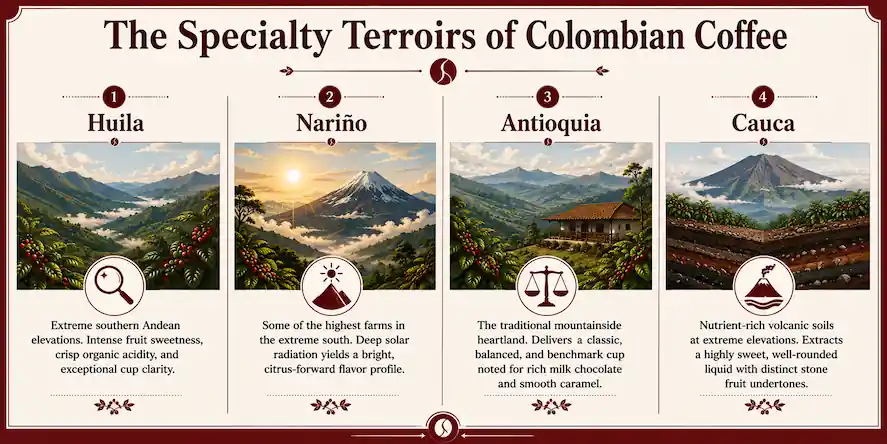
To navigate the immense terroir diversity of Colombia, specialty trade networks categorise the country by its distinct, altitude-differentiated micro-regions. Sourcing logs managed by The Coffee Guide prove that this micro-climate network ensures exceptional crop diversity. If your manual extractions of these high-grown washed lots at home are shifting towards an unpleasantly sharp or sour profile, check out our master troubleshooting guide to understand why does my coffee taste sour and discover how to adjust your grind and water parameters smoothly.
Huila:
Situated in southern Colombia at extreme altitudes, operating as the nation’s most celebrated specialty region by producing intense fruit notes, bright organic acidity, and exceptional cup clarity. [1, 2, 3, 4, 5]
Nariño:
Anchored by some of the highest farms in the extreme south, yielding an exceptionally clean, bright, and citrus-forward beverage profile. [1, 2]
Antioquia:
The traditional heartland of Colombian coffee, delivering a classic, balanced, and benchmark cup noted for rich chocolate and smooth caramel.[1, 2, 3, 4]
Cauca:
Blessed with nutrient-rich volcanic soils at high elevations, known for extracting a highly sweet, well-rounded liquid with distinct stone fruit undertones. [1]
Why does the washed processing method dictate the flavour clarity of Colombian coffee?
The vast majority of Colombian coffee relies on the Washed (Wet) Processing method to intentionally strip away any heavy, earthy, or wild fermentation traits that could mask the seed’s genetic identity.
Sourcing logs from The Coffee Guide clarify that the cherry’s outer skin is mechanically depulped immediately upon harvest, and the seeds ferment in water tanks for 24 to 48 hours to break down the sticky mucilage layer before a final clean-water rinse. [1, 2, 3, 4]
Because this methodology cleanly purges all external fruit sugars prior to drying, the resulting flavour matrix comes entirely from inside the high-altitude, slow-ripening seed itself.
This results in a universally appealing, balanced cup defined by a medium body, a smooth milk chocolate and caramel sweetness baseline, crisp apple-like acidity, and a perfectly clean finish. [1]
What are the optimal brewing parameters required to extract Colombian specialty coffee?
Colombia’s balanced chemical composition and clean, washed profile make it exceptionally versatile across diverse extraction equipment, rewarding both manual drip methods and pressurised espresso recipes. Technical testing logs from The Coffee Guide outline two premier preparation pathways: [1, 2]
The V60 Pour-Over Method:
This is the ideal strategy to isolate the origin’s delicate fruit notes and caramel sweetness. utilise a 1:16 coffee-to-water ratio, a clean medium grind size, and water stabilised at 93°C. Execute a 30-second bloom phase, then distribute the water slowly over a total timeline of 3 minutes to allow the paper filter to remove heavy lipids and unlock pure flavour clarity. [1, 2, 3]
The Single-Origin Espresso Method:
Under intense machine pressure, Colombian washed Arabica yields a remarkably balanced, approachable espresso shot. The absence of processing funk ensures a clean, sweet, caramel-forward intensity that cuts effortlessly through steamed dairy or oat milk without creating any astringent bitterness. [1]

The “Mitaca” Mystery
“Colombia is one of the few places on Earth where you can find a ‘Mitaca’ or ‘Fly Crop.’ This is a secondary harvest that occurs between the main seasons.
For The Coffee Guide reader, this means Colombian beans are often the freshest available on the market during the spring and summer months when other origins are still in the growing phase.”
While Colombia is a national icon for its high-altitude Arabica and perfectly balanced citrus-to-caramel profiles, it represents just one peak of the world’s production landscape.
To see how the Colombian Andes compare to the volcanic peaks of Africa and Asia, explore our full guide to The Coffee Belt

