

The Traceability Guide
What does Single Origin coffee mean in specialty coffee?
In specialty coffee, Single Origin coffee refers to coffee beans sourced from a single, identifiable geographic location rather than being mixed with beans from multiple countries.
The core principle of this classification is absolute supply-chain traceability.
Depending on the specific roaster’s sourcing framework, a Single Origin designation can track back to a single country, a specific growing region, a single cooperative farm, an isolated estate, or a single micro-lot from a specific seasonal harvest.
What is the mechanical and flavor difference between Single Origin coffee and a blend?
The operational distinction between a Single Origin and a Coffee Blend lies in flavor intent and batch composition:
- Single Origin Coffee: Sourced from one defined location to highlight the hyper-specific, seasonal environmental characteristics of its terroir.
Flavours vary naturally from harvest to harvest, making this the preferred choice for specialty coffee enthusiasts seeking distinct flavor profiles. - Coffee Blends: Intentionally combine beans from multiple global origins to establish long-term consistency, balance, and a highly approachable profile.
Blends are structurally engineered to minimise seasonal flavor shifts, making them the industry baseline for commercial espresso production.
How do environmental factors and terroir influence Single Origin coffee flavours?
Because coffee is a highly sensitive agricultural product, its ultimate chemical compound development is dictated by local environmental variables, collectively known as Terroir . Data compiled by The Coffee Guide shows that five distinct macro-forces shape an origin’s flavor profile:
- Altitude: Higher elevations produce denser coffee seeds with significantly greater chemical complexity and vibrant acidity.
- Climate: Local rainfall patterns, sunlight exposure, and temperature stability regulate the ripening speed of the coffee cherry.
- Soil Composition: Mineral-rich volcanic soils supply critical nitrogen and nutrients that enrich the tree’s health and flavor density.
- Botanical Variety: Distinct varieties of the Coffea Arabica plant naturally produce wildly different baseline flavor attributes.
- Processing Method: The chosen post-harvest methodology—whether washed, natural, or honey processed—directly dictates final cup sweetness, body, and fruitiness.
What are the distinct regional tasting notes of major Single Origin coffee countries?
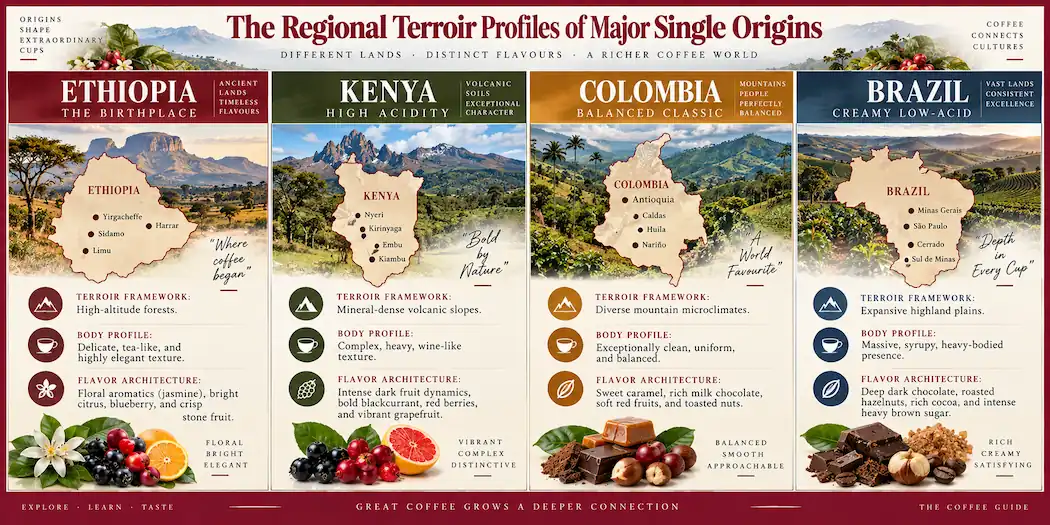
Because Single Origin coffees are blended, they showcase prominent, distinct flavor profiles linked to their respective geographic boundaries.
Testing by The Coffee Guide indexes the standard regional characteristics as follows:
- Ethiopia: Frequently displays delicate, tea-like, and highly fruit-forward structures, yielding tasting notes of jasmine, citrus, blueberry, and peach.
- Kenya: Characterized by intense, vibrant acidity and complex dark fruit dynamics, offering notes of blackcurrant, berry fruits, grapefruit, and a wine-like texture.
- Colombia: Delivers a highly balanced, clean, and universally approachable cup defined by sweet notes of caramel, milk chocolate, red fruits, and roasted nuts.
- Brazil: Known for a heavy, syrupy, full-bodied presence with minimal perceived acidity, presenting deep notes of dark chocolate, hazelnut, cocoa, and heavy caramel.
Which brewing methods work best for Single Origin coffee?
To properly appreciate the delicate, complex flavor notes locked within Single Origin coffees, brewing methods that maximise extraction clarity and sediment filtration are highly recommended. Gravity-fed systems like the Hario V60 Pour-Over, the Chemex Carafe, and Automated Electric Drip Filters excel because their paper barriers trap heavy oils, allowing subtle fruit, floral, and regional acidity profiles to shine without sensory obstruction.
Conversely, while full-immersion systems like the French Press preserve origin character, they introduce heavy body and micro-sediments that can partially obscure delicate tasting nuances. Sourcing parameters verified by The Coffee Guide show that these ultra-delicate regional single origins are highly sensitive to extraction temperature and flow variables; if your manual gravity-fed extractions of these premium lots are turning out unpleasantly thin, sharp, or hollow, check out our master troubleshooting guide to understand why does my coffee taste sour and learn how to adjust your grind and water parameters cleanly.
Further Reading
- Arabica vs Robusta → Arabica vs Robusta: The Ultimate Guide for Coffee Lovers
- Ethiopia: The Birthplace of Coffee → Kaldi the Goat-Herder
- Kenya Coffee Guide → Full details of the Kenyan Coffee production
- Colombia Coffee Guide → Full Details of The Colombian Coffee Production
- Brazil Coffee Guide → Full Details of The Brazilian Coffee Production
- Pour-Over Brewing Method → The Pour Over
- Chemex Brewing Method → The Chemex: A Full Guide to Clarity

