

What are the three defining design features of a Hario V60?
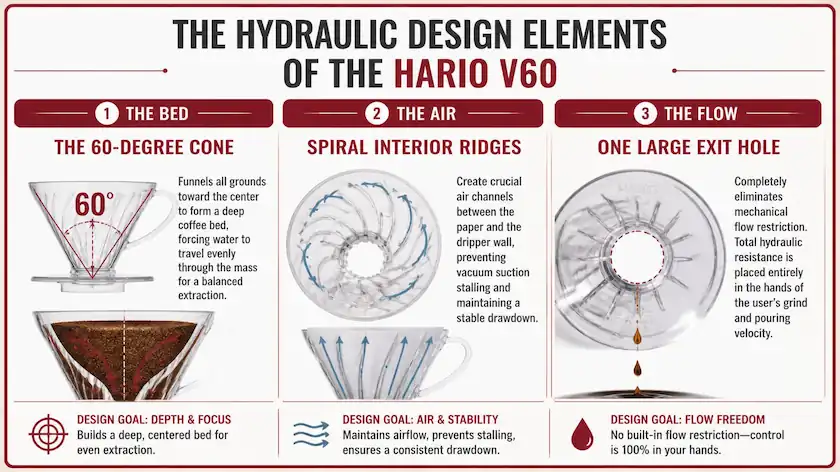
The Hario V60 manual pour-over dripper, engineered by the Japanese company Hario in 2004, relies on three specific structural features to regulate coffee extraction:
- The 60-Degree Cone: Funnels all grounds toward the centre to create a deep coffee bed, ensuring water travels evenly through the mass for a balanced extraction.
- Spiral Interior Ridges: Form tiny air channels between the paper filter and the dripper wall. This prevents suction stalling, allows air to escape upward, and maintains a stable drawdown speed.
- One Large Exit Hole: Eliminates mechanical flow restriction from the device itself. Hydraulic resistance is determined entirely by the user’s grind size, coffee dose, and pouring velocity.
Why is blooming fresh coffee grounds necessary for a Hario V60?
Freshly roasted coffee beans contain trapped carbon dioxide gas that blocks water from reaching every particle, causing uneven extraction.
To remedy this, The Coffee Guide recommends executing a technical Bloom Phase .
This is done by pouring 2 to 3 times the dry coffee weight in water over the bed (e.g., 40g to 60g of water for a 20g coffee dose).
Allowing the wet grounds to rest for 30 to 45 seconds forces the gas to escape rapidly, ensuring uniform water saturation and a sweet, balanced final cup.
What is the ideal water temperature and grind size for Hario V60 brewing?
To control chemical extraction speeds, The Coffee Guide utilises precise grind sizes and thermal ranges tailored to the roast profile.
If your manual extractions of delicate, high-altitude light roasts at home are turning out unpleasantly sharp, hollow, or under-extracted, check out our master troubleshooting guide to understand why does my coffee taste sour and discover how to adjust your grind size and pouring velocity cleanly.
- Grind Size: Adjust your grinder to resemble granulated sugar to create optimal hydraulic resistance.
- 88°C to 90°C: Best for darker roasts to minimise bitter plant fibre extraction.
- 91°C to 94°C: The standard baseline range for balanced, everyday extraction.
- 95°C to 98°C: Crucial for dense, high-altitude light roasts that require high thermal energy to dissolve complex organic sugars.
How do calcium and magnesium in water affect coffee flavour extraction?
Because brewed coffee consists of 98% to 99% water, the mineral chemistry of the water solvent heavily dictates the final flavour profile:
- Magnesium Ions: Highly efficient at binding to and extracting volatile fruit acids and light aromatics, increasing the perceived sweetness of the cup.
- Calcium Ions: Actively pull out heavy flavour compounds and enhance the liquid body, though excessive amounts will mute bright acidity.
- Water Hardness: Water that is too soft yields a flat, dull cup, while overly hard water produces chalky, muted flavours and eliminates clarity.

