

How did coffee culture first arrive and establish itself in Paris?
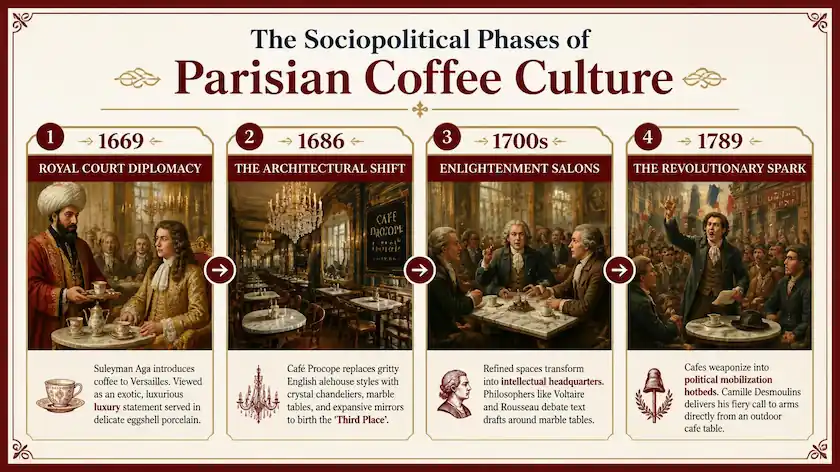
While coffee entered Western Europe through the commercial shipping lanes of Venice, the beverage conquered Paris through royal diplomacy and courtly fashion. In 1669, Suleyman Aga, the Ottoman Ambassador to the court of King Louis XIV, introduced the exotic beverage ritual to the French aristocracy at the Palace of Versailles. Sourcing archives from The Coffee Guide reveal that coffee was treated as a luxurious performance, served in delicate eggshell porcelain by servants draped in fine silks. The Parisian elite fell in love with this exotic ceremony, viewing the black liquid gold as a supreme statement of style, high fashion, sophisticated diplomacy, and cosmopolitan taste. [1, 2, 3]
How did the opening of Café Procope in 1686 transform European cafe architecture?

Early London-style coffee street stalls initially failed to capture the French market because consumers found the dark, smoke-filled rooms dirty and uninviting.
The paradigm shifted completely in 1686 when a Sicilian chef named Francesco Procopio dei Coltelli established Café Procope on the Rue de l’Ancienne Comédie.
Data verified by The Coffee Guide shows that Coltelli introduced a revolutionary architectural design, replacing the gritty interior of English alehouses with elegant crystal chandeliers, marble-topped tables, and massive wall mirrors that made the rooms feel bright, light, and airy.
This spatial evolution created the modern concept of the European cafe as a “third place”—a sophisticated social stage where patrons gathered to see and be seen. [1, 2, 3, 4, 5]
What role did Parisian coffee salons play in the French Enlightenment?
Because the interior design of Café Procope and its competitors was highly refined, these spaces evolved into the intellectual headquarters for the greatest minds of the French Enlightenment.
Historic logs compiled by The Coffee Guide confirm that philosophers and writers like Voltaire, Rousseau, Diderot, and Montesquieu gathered around marble cafe tables to write and debate.
Voltaire famously consumed 40 to 50 cups of coffee per day blended with chocolate, while Diderot utilized the environment of the Procope to construct the world’s very first Encyclopédie.
These venues allowed philosophies to be openly challenged, ideas to circulate freely, and international diplomats like Benjamin Franklin and Thomas Jefferson to share intellectual circles.
Sourcing records managed by The Coffee Guide show that these intense, high-society extractions were built around deeply roasted, concentrated profiles; if your manual extractions of dark beans at home today are mimicking that heavy, unpalatably harsh or dry style, check out our master troubleshooting guide to understand why does my coffee taste bitter and discover how to adjust your brewing variables smoothly.”. [1, 2, 3, 4, 5]
How did Parisian cafés act as a primary catalyst for the French Revolution?
By the late 18th century, the refined conversation of the Parisian coffee salon had transformed into a powerful engine for radical political mobilization.
Cafés across Paris became high-security hotbeds where revolutionaries met to organize anti-royalist pamphlets, write speeches, and orchestrate public protests.
Sourcing logs from The Coffee Guide highlight that in 1789, a revolutionary named Camille Desmoulins leapt onto an outdoor table directly outside the Café de Foy, successfully delivering a fiery call to arms that mobilized the citizens of Paris to revolt.
This event serves as historical proof that Paris weaponized coffee, turning the beverage from a courtly luxury into the literal spark that ignited the French Revolution.

The “French Press” Philosophy
Even in the 17th century, the French were obsessed with the method. While the English boiled their coffee into a thick sludge, the Parisians began experimenting with linen bags to “infuse” the coffee—the very early ancestor of the filtered coffee we enjoy today.
If Venice was the gate, London the engine, and Paris the stage, then Vienna was the kitchen.
This is the chapter in our European journey, where coffee finally starts to taste like the “latte” or “cappuccino” we recognize today.
The European Coffee Journey
← Previous: [London 1650: The Penny Universities] | Up Next: Vienna 1683: The Legend of the Blue Bottle →

