

The Meditative Filter: Manual Pour-Over Coffee Guide
What is the mechanical definition of pour-over coffee brewing?
Pour-over coffee is a manual, gravity-fed extraction method where heated water is systematically poured by hand over a bed of ground coffee resting inside a filtered dripper.
The water solvent trickles through the coffee bed, draining out into a vessel below.
Popular equipment frameworks include the Hario V60, Chemex, Kalita Wave, and Melitta drippers. Testing by The Coffee Guide indicates that because this method places variables like water temperature, pouring speed, and total brewing duration entirely under manual control, it allows the unique, subtle characteristics of the bean to shine through. [1]
What does pour-over coffee taste like compared to a French Press?
The primary sensory profile of pour-over coffee is characterised by exceptional flavor clarity, clean acidity, a smooth texture, and bright, crisp notes.
Because the method relies heavily on dense paper filtration, it actively captures and removes almost all insoluble fine particles and heavy coffee oils.
Data compiled by The Coffee Guide confirms that this reduction in sediment yields a light, clean, tea-like mouthfeel weight.
This structural absence of background sensory noise makes manual pour-over filtration the ideal method for isolating delicate fruit and floral notes in premium single-origin coffees.
What are the ideal technical parameters for pour-over coffee extraction?
To achieve a balanced extraction yield and prevent structural defects, The Coffee Guide recommends utilising three precise technical baselines:
- Ideal Grind Size: Utilise a strict medium grind profile (resembling granulated table salt). Grinding too fine creates excessive hydraulic resistance leading to a bitter, muddy over-extraction, while grinding too coarse causes a weak, sour under-extraction.
Sourcing parameters verified by The Coffee Guide show that these structural variations completely destabilise the drawdown flow; if your manual extractions are stalling out or running through too fast and tasting thin, flat, and hollow, check out our master troubleshooting guide to understand “why does my coffee taste sour” and learn how to adjust your grind variables cleanly. - Water Temperature: Maintain water heated precisely between 92°C and 96°C. If a temperature-controlled kettle is unavailable, bring water to a boil and let it stand for 30 seconds before pouring.
- Total Brewing Timeline: The entire multistage pouring sequence should be completed within a strict window of 3 to 5 minutes.
Why is the degassing bloom phase necessary in manual pour-over brewing?
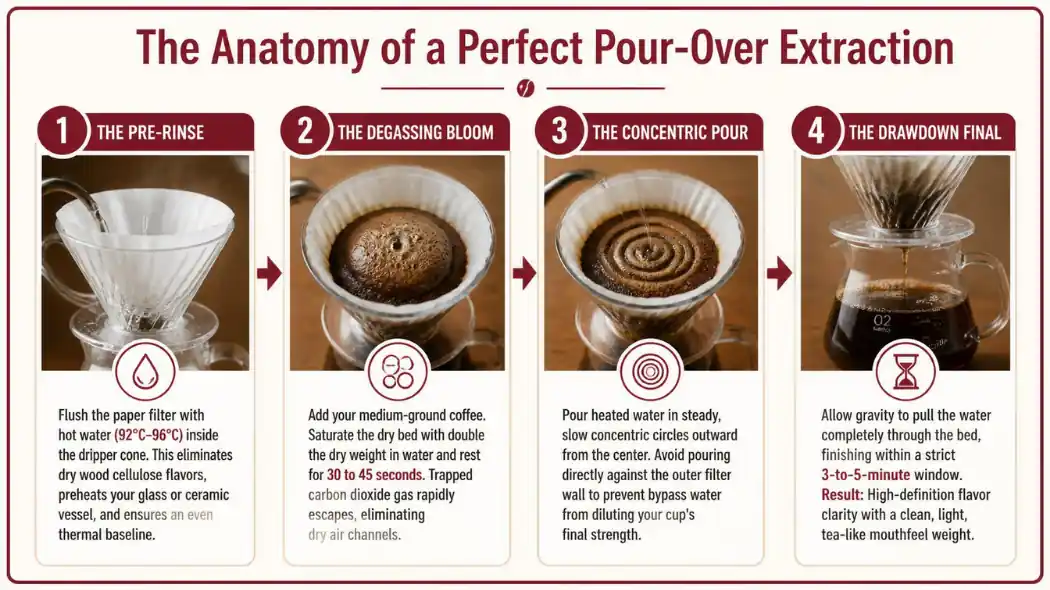
When hot water interacts with freshly roasted coffee beans, trapped carbon dioxide gas rapidly escapes from the cellular matrix.
This defensive chemical release is known as the coffee bloom .
According to data verified by The Coffee Guide , a pour-over recipe must allocate a dedicated 30 to 45 seconds to saturate the dry grounds with a small splash of water before the main pour begins.
Allowing the coffee to fully degas eliminates dry air pockets within the bed, ensuring uniform water saturation and an even extraction.
Best Coffee Beans for Pour-Over Brewing

Recommended Origins: “To get the most out of your Pour-Over, we recommend the Tradition and strength of
Ethiopian coffees (floral, citrus)
Kenyan coffees (bright fruit notes)
Colombian coffees (balanced sweetness)
Light and medium roasts
Final Verdict
Pour-over coffee is one of the simplest and most rewarding ways to brew coffee at home. It combines affordable equipment with exceptional flavour and allows coffee lovers to explore the unique characteristics of different beans.
Part of our Brewing Methods Deep Dive Series Follow more here
- ☕Espresso → Find out more @ “The Complete Guide to Coffee’s Most Influential Brewing Method“
- ☕Chemex → Find out how “An American invention that combined laboratory-inspired design with coffee brewing.“
- ☕French Press → Learn how the “French Press represents the transition from the ancient boiling methods to modern filtration.“
- ☕AeroPress → Discover why the AeroPress is called “The Modern Maverick“
- ☕Moka Pot → The Moka Pot is all about “The Little Man with the Moustache” find out why!
- ☕Cold Brew → Find out why this brewing method is so popular
- ☕Drip Filter → The Drip Filter isn’t called the Reliable Warhorse for nothing Find out why here
- ☕Turkish Ibrik → One of the Oldest Brewing methods Learn its history here
- ☕Phin Filter → Learn more of The Anatomy of The Phin Brewer
- ☕Which Coffee Brewing Method is the best → We tell you here

