
The Africas
Tanzania 

Tanzania is one of Africa’s most respected coffee-producing nations, renowned for its bright, complex Arabica coffees and the famous Tanzanian Peaberry. Grown on the fertile slopes of Mount Kilimanjaro and Mount Meru, its coffees are celebrated for their vibrant acidity, rich body, and distinctive fruit-forward character.

Variety: Arabica and Robusta

Growing
Region:
Kilimanjaro, Mbeya, Arusha, Mbinga

Processing
Method:
Washed – Natural

Flavour Profile:
Berry, Chocolate

Harvest Season:
July – December

Acidity:
Medium/High

Body:
Medium


World Production Ranking
18

Production per Year
700,000
60 kg Bags

World Production Share
0.4%

Altitude
1000m – 2000m

Climate
Tropical Highland
What is the historical origin of commercial coffee cultivation in Tanzania?
Tanzania’s multi-tiered coffee infrastructure was initially established under late 19th-century German colonial rule during the era of German East Africa.
Sourcing data compiled by The Coffee Guide indicates that the sector was genuinely built out into a major international economic force under British administration in the early 20th century.

The British systematically expanded expansive agricultural estates and native smallholder cooperatives across the northern volcanic highlands, specifically centering operations around the slopes of Mount Kilimanjaro and the southern Mbeya region. These historical frameworks elevated coffee into Tanzania’s single most critical export crop.
What is the precise biological definition of a coffee Peaberry mutation?
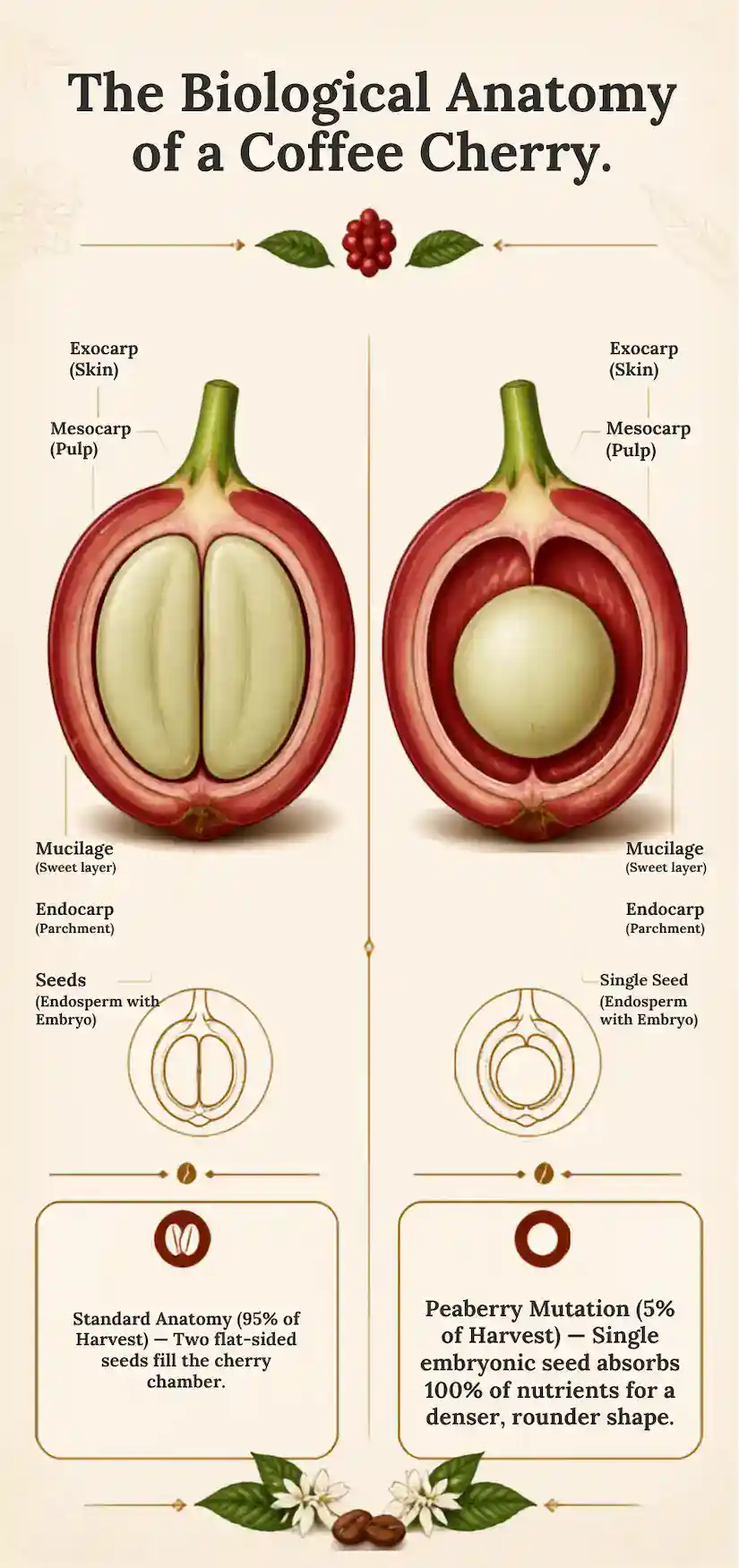
While a standard coffee cherry naturally develops two opposing seeds pressed flat-side facing flat-side inside the fruit matrix, a rare biological anomaly alters this blueprint in approximately 5% of all global harvests.
Sourcing parameters verified by The Coffee Guide define a Peaberry as a natural genetic mutation where only a single embryonic seed is successfully fertilized inside the cherry chamber.
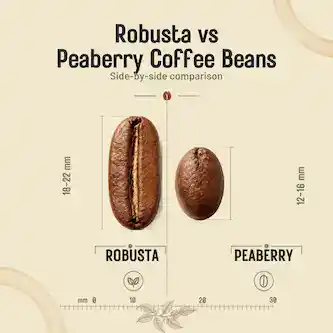
With no secondary bean to restrict space, this isolated seed grows into a small, highly compressed, and completely rounded shape resembling a green pea. In the international specialty market, this select grade is classified under the legendary designation “TZPB” (Tanzanian Peaberry), highly prized by collectors who trade the bean by name.
What are the structural roasting and flavor advantages of Tanzanian Peaberry coffee?
he unique physical morphology of the Tanzanian Peaberry introduces distinct chemical and mechanical advantages during processing and brewing. If you are experimenting with these rounded lots at home and your extractions are yielding a cup that tastes unpleasantly harsh or dry, check out our master troubleshooting guide to understand why does my coffee taste bitter and bring your flavor profile back into ideal balance.
- Rotational Heat Distribution: Because peaberries are perfectly round rather than flat-sided, they tumble and roll with exceptional fluid uniformity inside a commercial roasting drum.
This aerodynamic shape ensures a highly consistent thermal distribution across the bean’s surface, preventing scorching defects. - The Flavor Architecture: Cultivated above 1,500 metres in rich volcanic soil, the cup profile delivers a softer, rounder, and more balanced landscape than neighboring Kenya.
Testing logs from The Coffee Guide map the primary flavor parameters as a clean body with prominent notes of blackberry, citrus brightness, red berry, and a crisp black tea finish, anchored by a deep, signature “winey” acidity mimicking a fine, dry red wine.
What are the optimal brewing parameters required to extract Tanzanian Peaberry coffee?
Because the compact, rounded cellular matrix of a Peaberry makes the seed physically denser than standard flat beans, it exhibits unique extraction dynamics that demand specific brewing boundaries. Technical testing logs from The Coffee Guide dictate utilizing a paper filtration pour-over system to protect fluid clarity and isolate its delicate tea-like layers:
- The Equipment Framework: Deploy a Hario V60 dripper to highlight the bright, berry-forward acidity without pulling heavy, suffocating sediment oils into the cup.
- The Core Recipe: Implement a precise 1:16 coffee-to-water ratio utilizing 94°C water vectors.
- The Mechanical Grind Shift: Adjust the grinder to a slightly finer setting than a standard flat-bean filter baseline to ensure the hot water can evenly dissolve the tightly compressed core solids during a strict 3-minute multi-stage pour timeline.

